Swimming takes a bigger toll than it looks.
In the water, the shoulder piles up thousands of repetitions and the legs work through a constant kick that moves the hip, thigh and calf, so "resting a little" is not enough. Recent literature points to the shoulder as the area most affected in swimming, followed by the knee and the spine, and reminds us that what we call swimmer's shoulder is not a single diagnosis but a mix of overuse, instability, altered scapular control and rotator cuff fatigue.
Red & infrared light
Recover faster, at home
★★★★★ 4,8/5 · rated by verified customers
The KumoLux panel supports muscle recovery with full-body red and infrared light.
- 660 nm red + 850 nm infrared light
- Full-body muscle recovery
- Clinically validated biohacking protocols
€399,00€499,00
−10% on your 1st order when you subscribe to the newsletter

Why swimming calls for specific recovery
A swimmer's load is nothing like the load in other sports. A 2021 systematic review on the relationship between load and pain in swimming screened 1,959 papers and selected 15; it concluded that prevention depends on monitoring internal load properly, especially in young, masters and lower-level swimmers, and that winter phases, high-intensity sessions and speed work call for more care.
In other words, recovery is not only about "doing less", but about organizing deloading, mobility, strength and the gradual return to the water more carefully. Done well, the goal is to reduce irritation, keep technique clean and avoid the kind of pain that forces you to stop all at once.
Personalized protocol · included with your purchase
Want us to tell you how to use it in your case?
With your purchase, our experts set up your red and infrared light sessions for your sport and goal.
Message us on WhatsAppOur experts reply · no obligation
What gets overloaded in shoulders and legs
Practical summary by area
| Area | What usually gets loaded | What to prioritize | Signs you should ease off |
|---|---|---|---|
| Shoulders | External rotators, rotator cuff, scapular retractors and control of the shoulder blade. | Dryland strength, thoracic mobility, pec stretching and scapular stability. | Pain on hand entry, loss of strength, a compensated stroke or night pain. (nhs.uk) |
| Legs | Hip flexors, quadriceps, glutes, hamstrings, tibialis anterior and calves, especially in the freestyle kick and underwater work. (pmc.ncbi.nlm.nih.gov) | Calf and soleus deloading, hip strength, ankle mobility and trunk control. | Stiffness pushing off the wall, very loaded calves or a kick that loses effectiveness. |
| Trunk | Lumbopelvic stabilization and force transfer between arms and legs. | Core control, breathing, thoracic rotation and coordination. | Visible compensations, loss of alignment or early fatigue. |
The key is to understand that swimmer's shoulder is not a closed label but the sum of factors such as volume, technique, mobility, stability and muscle control. In a 2022 scoping review on therapeutic exercise in swimmers, 14 studies included after screening 452 papers showed that a 6 to 8 week program combining strengthening of the external rotators and scapular retractors with pec stretching can reduce the incidence of shoulder pain.
How to design specific recovery
Think in three phases: deload, reactivate and reload. After a demanding session, the priority is to lower the volume of work that irritates the area, keep pain-free mobility and reintroduce dryland strength before raising technical work in the water again. The evidence on load in swimming suggests this approach is more useful than improvising complete rest with no criteria.
- Shoulders: prioritize external rotation, scapular stability, thoracic mobility and pec stretching, in short, regular sessions.
- Legs: work calves, soleus, glutes, hip flexors and hamstrings, because the kick does not depend on the ankle alone.
- Trunk: add lumbopelvic control, breathing and stability to transfer force better between arms and legs.
- Progression: return to normal volume gradually, watching pain during and after every session.
If you want to see how a short deloading session is put together, the guide to percussion massage by muscle group explains how to aim it at shoulders, back, glutes and legs. Used well, it can help prepare tissue for mobility or strength, but it does not replace an assessment if the pain is acute. (pmc.ncbi.nlm.nih.gov)
on your first order when you join the newsletter
We send you the code instantly. No spam.
Wellness tools that can support recovery
Pressotherapy, red light therapy and percussion massage can be wellness allies, always as a complement and never as a substitute for a professional assessment if pain persists or function is lost. A review on photobiomodulation and return to sport found promising effects on pain and recovery, although the response depends heavily on the protocol; and a review on percussion massage recalls that it should not be applied over open wounds, bruises, recent fractures or deep vein thrombosis.
If you prefer a practical routine, you can combine that block with red light therapy for post-workout recovery and with a complete routine of pressotherapy, massage and red light therapy when the week stacks up a lot of sets. The idea is to add a sense of relief and better perceived rest, not to promise medical results.
If you use photobiomodulation or LED therapy, remember that the FDA advises against it when you are taking photosensitizing medication, and that the American Academy of Dermatology recommends caution in people with greater light sensitivity. This resource should be understood as support for rest and for the feeling of recovery, not as medical treatment. (fda.gov)
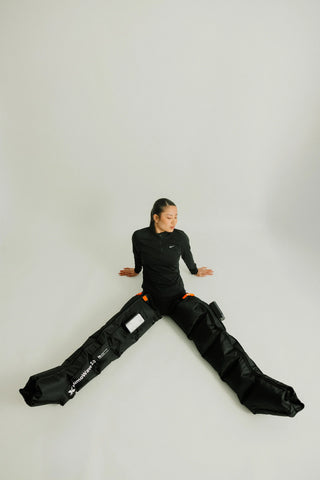
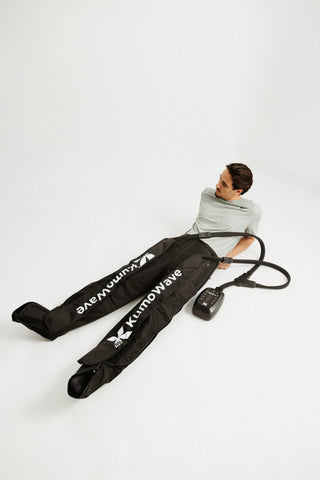
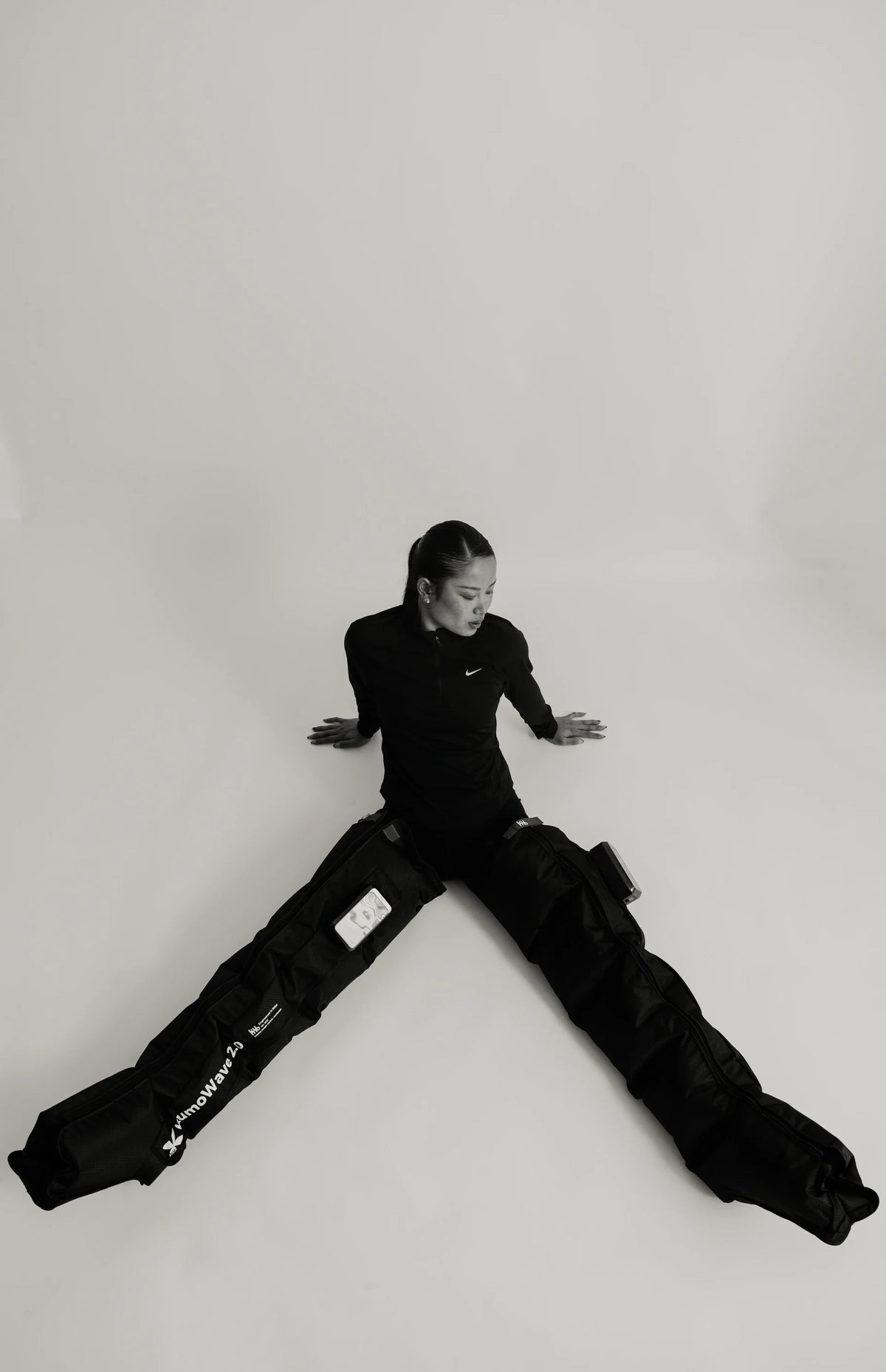
Pneumatic compression, or pressotherapy, can fit legs loaded by kicking, turns and long sessions, because it helps encourage a feeling of lightness and supports daily recovery. Even so, an international consensus on medical compression insists on assessing contraindications such as severe heart failure, severe peripheral artery disease, allergy to the compression material and severe diabetic neuropathy, and on being especially careful with active skin infection.
If you want to understand this resource better, the guide to pressotherapy for the legs with a well-planned session and the article on what pressotherapy is and how it works help you place it inside a recovery routine, always with judgment and without confusing wellness with medical care.
When to seek advice and which signs need medical assessment
If pain lasts more than 2 weeks, gets worse, clearly limits movement or appears after a blow, improvising is not the answer. The NHS recommends medical assessment if pain does not improve after 2 weeks or if moving the arm is very difficult, and urges urgent care if sudden severe pain, deformity or marked swelling, persistent tingling, loss of sensation, fever or general malaise appear.
- Night pain that wakes you or grows with every session. (hss.edu)
- Loss of strength, an asymmetric stroke or being unable to swim without compensating.
- Swelling, change in shape, local warmth or loss of sensation.
- Chest pain, shortness of breath or pain radiating to the arm or jaw. (mayoclinic.org)
While you wait for that assessment, avoid forcing the area, reduce load and do not use compression or percussion tools over an acute injury or a suspected thrombosis. (journals.sagepub.com)
FAQ on swimmer recovery
Why does swimmer's shoulder appear and which recovery exercises work best?
Swimmer's shoulder rarely comes down to a single structure; it is usually a combination of overuse, technique, fatigue, instability and altered scapular control. The most useful reviews agree that the best-fitting exercises are external rotation, scapular stabilization and pec stretching, preferably in a 6 to 8 week block and with dryland work. The goal is not only to remove pain, but to recover control, strength and tolerance to the stroke.
How do you design specific shoulder and leg recovery for high-performance swimmers?
Load has to be controlled first, because the 2021 review showed that volume, intensity and speed phases need particular attention. Then it makes sense to split the work into three blocks, shoulder, legs and trunk, with pain-free mobility, dryland strength and a gradual return to the water. At a high level, the aim is to hold technique without accumulating irritation, so deloading sessions should be regular, short and well measured, not improvised.
What are the signs that shoulder recovery is not working in swimming?
The clearest signs are pain that does not improve, worsens after training or comes back every session, loss of mobility, weakness on hand entry or when pulling through the water, and night pain. If you also notice tingling, swelling, changes in shape or real difficulty moving the arm, it is better to stop and get it checked. In swimming, keeping load on an irritated shoulder usually drags the problem out rather than solving it.
How long does it take to recover from subacromial impingement syndrome in swimmers?
There is no single timeline. In practice, recovery depends on the degree of irritation, technique, scapular strength and how long the problem has been there. Evidence in swimmers shows that a 6 to 8 week block can start to change the picture, and that programs longer than 12 weeks improve external rotation strength and endurance. Even so, the return to the water should be based on function and control, not on the calendar alone.
Which strengthening exercises belong in shoulder rehabilitation for swimmers?
The ones repeated most often in the literature are external rotation, scapular retraction, serratus anterior control, rotator cuff work and open-chain control exercises. Rhythmic stabilization and proprioceptive work are sometimes added. What matters is that the movement causes neither strong pain nor a loss of technical quality, and that it is folded gradually into the stroke, first on dryland and then in the water.
What now?
If you want to build a more complete routine, start with the complete athlete recovery routine and keep exploring at Kumo Balance for resources built around daily life, mobility and performance. The best recovery for swimmers does not look for shortcuts; it looks for continuity, judgment and consistency.

Red & infrared light
KumoLux Panel – Red and Infrared LED Panel
★★★★★ 4,8/5 · rated by verified customers
- 660 nm red + 850 nm infrared light
- Full-body muscle recovery
- Clinically validated biohacking protocols
€399,00€499,00· pay in installments with seQura or Klarna