

No, lactic acid is not to blame for DOMS. When the effort ramps up, the body produces lactate to keep generating energy, while the delayed soreness shows up through other mechanisms, above all after new or eccentric exercise.
The old explanation, which pinned almost every ache on "lactic acid," has fallen short. Today lactate is understood as a useful molecule that travels between tissues, gets reused, and also takes part in metabolic signaling.
Pressotherapy at home
End the day with light legs
★★★★★ 4,8/5 · rated by verified customers
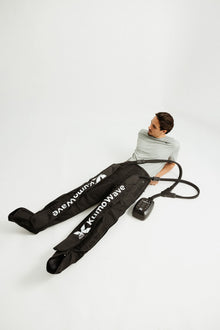
KumoWave pressotherapy boosts circulation and helps drain fluid with sequential compression, in 20-minute sessions at home.
- Boosts circulation and helps drain fluid
- Chamber-based compression, adjustable to you
- Sequential compression that mimics manual drainage
€799,00€999,00
−10% on your 1st order when you subscribe to the newsletter

What lactic acid really is
Strictly speaking, what circulates in your body is mostly lactate. At physiological pH, lactic acid is almost entirely dissociated, so the dominant form is not an "acidity" floating around the muscle but lactate and hydrogen in chemical equilibrium. For a detailed explanation, this review of lactate as a signaling molecule sums up its physiological role well.
During effort, lactate acts as a piece of metabolic exchange between muscles and other tissues.
Personalized protocol · included with your purchase
Want us to tell you how to use it in your case?
With your purchase, our experts prepare a personalized usage protocol for your case: sport, circulation, fluid retention, pregnancy or lipedema.
Message us on WhatsAppOur experts reply · no obligation
And there is another important correction: lactate production does not itself cause exercise acidosis; the biochemical literature reviewed in 2004 showed there is no support for that idea and that lactate actually delays acidosis. To go deeper, this biochemical analysis of exercise-induced acidosis explains it in detail.
What lactate does during exercise
During intense work, lactate helps sustain ATP production, can be used as fuel by the heart and other muscles, and also serves as a precursor for rebuilding glucose in the liver. The review on the role of lactate in energy and performance sums up this shift in thinking well.
- Fast fuel: lactate makes it possible to keep sustaining the effort when energy demand is high.
- Useful recycling: it can be oxidized in other tissues or turned back into glucose.
- Adaptation signal: it does not only produce energy, it also takes part in training responses and metabolic regulation.
Why it is not to blame for DOMS
DOMS, the physiological name for the soreness that shows up later, usually appears between 24 and 72 hours after exercise, especially after eccentric contractions or unfamiliar efforts. That timeline does not fit lactate, which peaks minutes after exercise and can stay elevated for more than 60 minutes.
on your first order when you join the newsletter
We send you the code instantly. No spam.
A specific clinical study on this topic, Is Lactic Acid Related to Delayed-Onset Muscle Soreness?, found that lactate is not related to delayed soreness.
What is considered more plausible today is a combination of micro-damage, changes in connective tissue, local inflammation, and sensitization of nerve endings. The classic hypothesis of lactate as the main cause has been largely discarded.
Visual summary: myth versus reality
| Myth | Reality | What the evidence shows |
|---|---|---|
| Lactate stays trapped in the muscle for hours. | Its concentration rises with effort and then falls; in some studies it stays elevated for more than 60 minutes, but that does not explain the delayed soreness. | Lactate kinetics are much shorter than the typical DOMS window. |
| DOMS appears because "lactic acid built up." | DOMS is mainly associated with eccentric exercise, connective tissue damage, and local inflammation. | The lactate theory fits neither the time pattern nor the experimental findings. |
| Only untrained people get DOMS. | Trained people can also get DOMS after a new or very demanding stimulus. | The novelty of the stimulus matters as much as or more than fitness level. |
How the body clears lactate after effort
The body does not simply "get rid of" lactate, it reuses it. Part of it is oxidized in the muscle itself or in very active tissues such as the heart, and another part is converted back into glucose in the liver through the Cori cycle. If you want a clear clinical reference on interpreting blood lactate, the 2009 clinical guide to lactate during exercise is very useful.
As for timing, there is no universal figure. In the 2009 clinical guide to blood lactate, the peak appears between 3 and 8 minutes after a maximal effort and can stay high for more than 60 minutes, although active recovery usually speeds up its decline compared with passive rest.
That is why it makes more sense to talk about "clearance" or "recycling" than about cleaning. Training level, intensity, and the type of recovery greatly change how fast the body returns to balance.
What really helps you recover better
If you are looking to recover better, the sensible approach is still the basics: bring the intensity down gradually, go back to gentle movement, hydrate well, eat enough, and sleep. For delayed muscle soreness, rest is usually the foundation, and stretching does not appear to meaningfully reduce the discomfort itself. (my.clevelandclinic.org)
Active recovery can help lactate come down sooner than with complete rest, and some people notice relief with massage or with offloading strategies, although the effect varies a lot from person to person and by context.
If you want to put this into practice, you can read how to relieve DOMS faster and recover sooner and how pressotherapy and DOMS relate to next-day stiffness. These are useful resources for understanding what is usually done in a recovery routine, without confusing relief with a medical solution.
If you are also interested in the broader approach to recovery and well-being, in our technology you can see how that proposal is organized around pressotherapy, LED light, and percussive massage.
Before using compression, it is worth reviewing the benefits and contraindications of pressotherapy at home, because compression therapy has to be individualized. A 2020 international consensus is a reminder to assess contraindications and pays particular attention to advanced peripheral artery disease and decompensated heart failure; if you have a diagnosed vascular or cardiac condition, check with a professional first.
Frequently asked questions
What exactly is lactic acid and what does it do in the body?
In everyday language we talk about lactic acid, but physiologically most of it is present as lactate. At body pH the molecule dissociates and circulates as lactate, which the body uses in energy metabolism and as a signal. This matters because the term "lactic acid" suggests an irritating waste product, when in reality we are dealing with a useful intermediate.
Does lactate buildup really cause delayed onset muscle soreness?
No. Lactate rises during effort and comes down relatively soon, while DOMS takes between 24 and 72 hours to appear. What fits DOMS best is damage from eccentric contraction, inflammation, and nerve sensitization. That is why a very intense session can leave you tired or with a burning feeling, but does not on its own explain next-day soreness.
How does the body clear lactate after effort and how long does it take?
The body reuses it. Part of it is oxidized in muscles and the heart, and another part is converted into glucose in the liver. The pace depends on intensity, training status, and the type of recovery: in studies, lactate can stay high for more than 60 minutes, but active recovery speeds up its decline compared with rest.
Does lactate work as an energy source during exercise?
Yes. That is one of its most interesting roles. When energy demand rises, lactate helps sustain ATP production and can travel between tissues to be oxidized wherever it is needed. Today it is considered a bridge molecule between glycolysis and oxidative metabolism, as well as a precursor for making glucose.
When does DOMS stop being normal and when should you see a doctor?
If the pain is very intense, gets worse, greatly limits movement, or comes with marked swelling, significant weakness, or dark urine, it is worth asking for a medical assessment because it might not be DOMS. Common muscle soreness usually improves with rest and gentle movement; if it does not improve, the cause needs to be checked. (cdc.gov)
What now?
If you want to keep going deeper, visit the Kumo Balance website and read the guide to getting started with pressotherapy at home to see how a more complete recovery routine is put together.
To keep reading: Compression boots and circulation everything they do, DOMS how to relieve it faster and recover sooner and Pressotherapy and DOMS how to reduce next day stiffness.
KumoWave pressotherapy
Choose your at-home pressotherapy
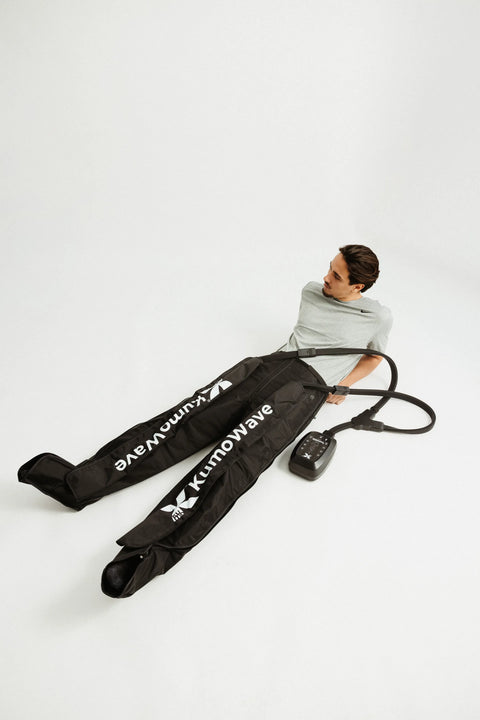
KumoWave Elite – Pressotherapy Pants
Full-coverage trousers. Ideal for lipedema, fluid retention and intensive use.
€799,00 €999,00
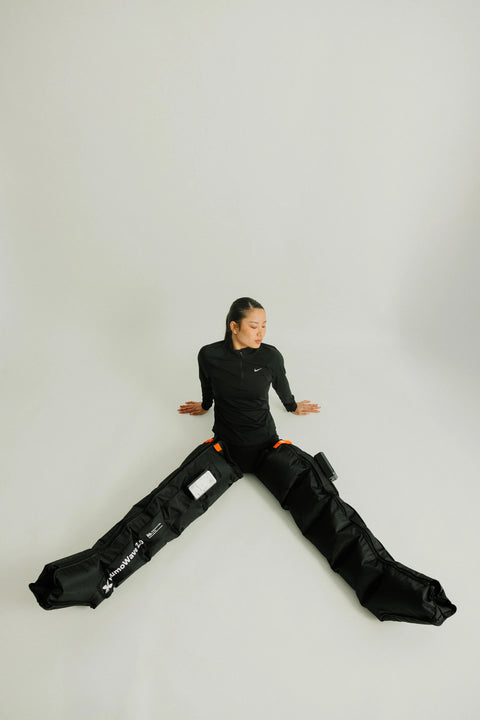
KumoWave 2.0 - Wireless Pressotherapy
Wireless, lightweight boots. Perfect for daily use and recovery.
€499,00 €599,00