
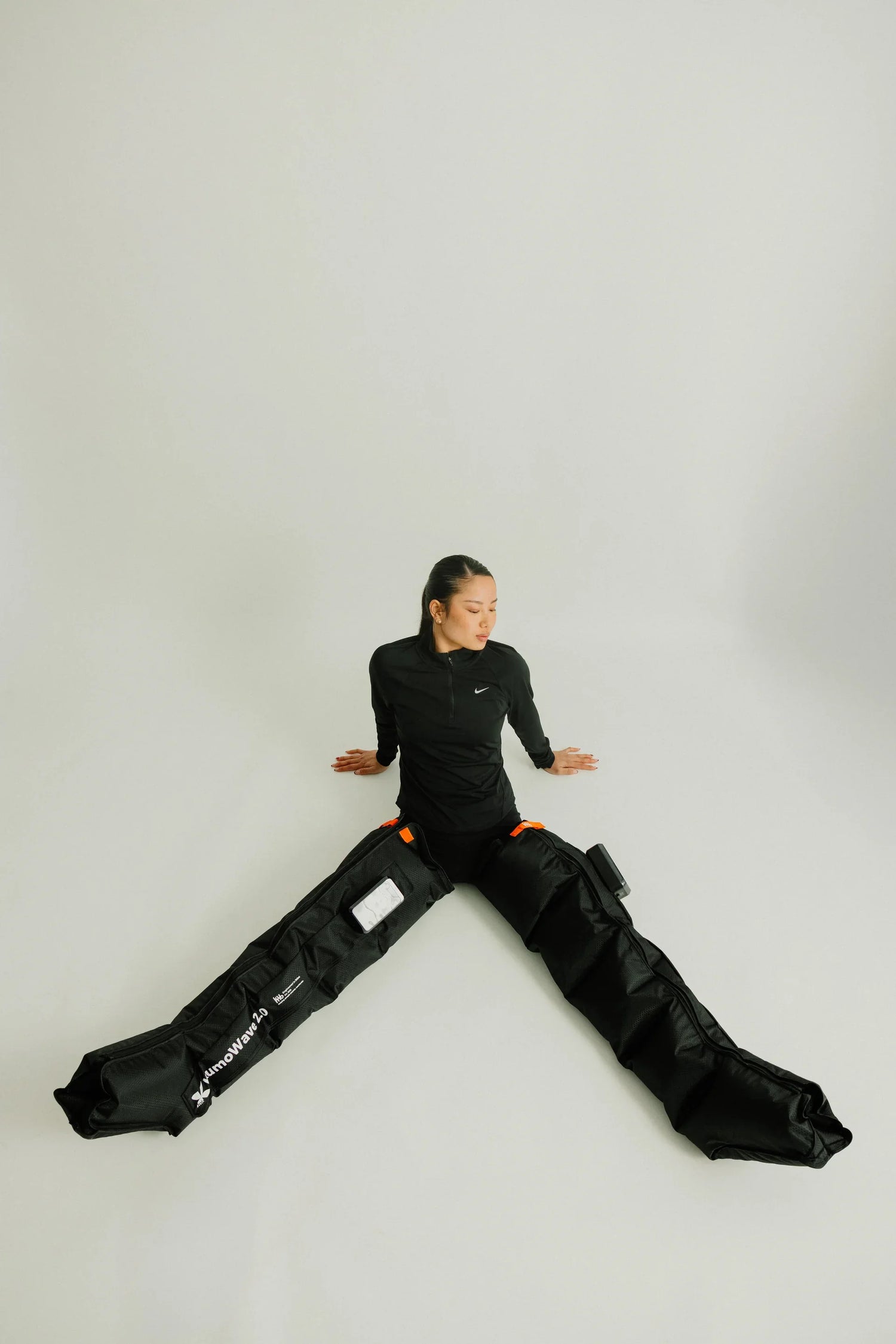
Leg compression therapy can relieve heaviness. It works through intermittent pneumatic compression: a boot or cuff inflates and deflates in chambers to aid venous return and fluid drainage. The Cleveland Clinic medical guide on compression therapy places it among useful tools for improving circulation in the legs, ankles, and feet when there is swelling or chronic venous insufficiency.
It can also fit into recovery routines or for people who spend many hours standing or sitting. MedlinePlus explains that compression helps move blood upwards in the legs and reduces swelling; furthermore, a 2024 systematic review on IPC and athletic recovery shows that it remains an active research field in athletic and healthy populations. (medlineplus.gov)
Pressotherapy at home
End the day with light legs
★★★★★ 4,8/5 · rated by verified customers
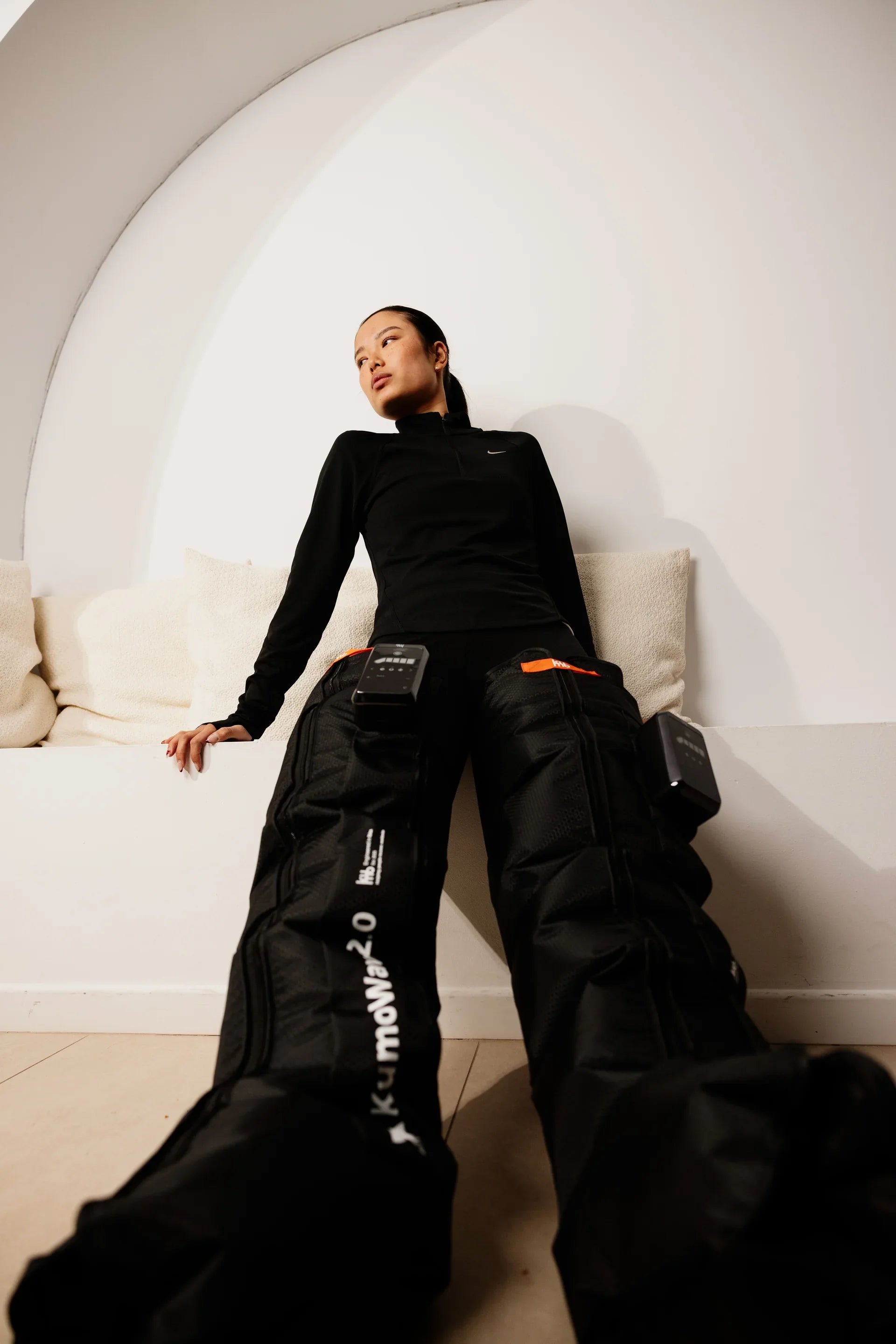
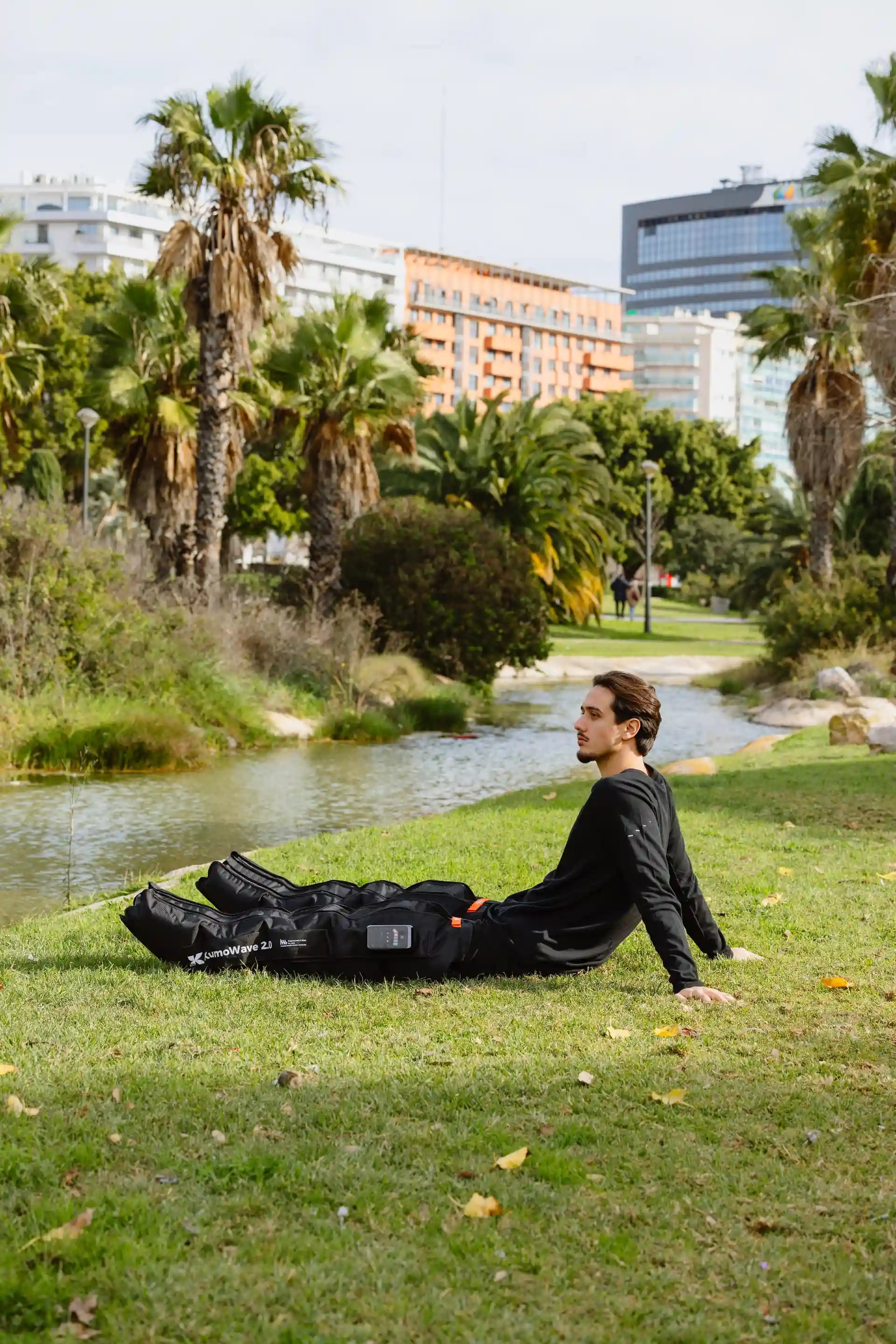
KumoWave pressotherapy boosts circulation and helps drain fluid with sequential compression, in 20-minute sessions at home.
- Boosts circulation and helps drain fluid
- Chamber-based compression, adjustable to you
- Sequential compression that mimics manual drainage
€799,00€999,00
−10% on your 1st order when you subscribe to the newsletter

What exactly is leg compression therapy?
In a medical context, the idea is similar to intermittent pneumatic compression, or IPC. Pressure is not applied suddenly or uniformly, but in phases, starting at the most distal part of the leg and moving upwards to promote blood and fluid flow. The MSD Manual Professional on chronic venous insufficiency describes it as part of conservative treatment along with elevation and exercise.
If you want a more physiological explanation of venous return, the relationship between compression and circulation is developed in compression therapy and circulation: how to support venous return.
Personalized protocol · included with your purchase
Want us to tell you how to use it in your case?
With your purchase, our experts prepare a personalized usage protocol for your case: sport, circulation, fluid retention, pregnancy or lipedema.
Message us on WhatsAppOur experts reply · no obligation
Main benefits of leg compression therapy
When the goal is to improve the sensation of heavy legs, compression can be a useful support within a broader approach. MedlinePlus links it to less swelling and improved venous blood flow, while the MSD Manual includes it among conservative measures for chronic venous insufficiency.
- Helps reduce the sensation of heaviness. Mechanical compression promotes the return of fluid and blood upwards, which is especially useful at the end of the day.
- Can complement the management of mild to moderate swelling. It does not replace walking, elevating the legs, or treating the underlying cause, but it can contribute when there is functional edema or retention.
- Fits into post-exertion recovery. In sports, IPC continues to be studied as a recovery tool, especially for tired legs after training.
- It is an interesting option for home routines. When used regularly and properly adjusted, it can be integrated more easily than a one-time solution.
During long days of standing or sitting, the key is not just "applying pressure," but supporting a system that already depends on movement, rest, and postural habits. If you are interested in that part of the mechanism, reading the home compression therapy starter guide helps set expectations before beginning.
How a compression therapy session unfolds
A well-planned session should not be improvised. Hospital leaflets on IPC indicate that a pneumatic garment is used that inflates and deflates in phases and that the session can last between 45 minutes and 1 hour, so it is advisable to calmly reserve that time. (wsh.nhs.uk)
on your first order when you join the newsletter
We send you the code instantly. No spam.
Phases of a compression therapy session
| Phase | What happens | What is usually felt | Objective |
|---|---|---|---|
| Preparation | It is verified that there are no contraindications and that the garment is well placed, without folds or improper size. | Initial adjustment and gentle pressure. | Start safely and comfortably. |
| Sequential compression | The chambers inflate and deflate in an orderly fashion from the distal to the proximal part of the leg. (leaflets.ekhuft.nhs.uk) | Rhythmic and enveloping compression. | Promote venous return and fluid displacement. |
| Release | The pressure drops or is interrupted at the end of each cycle. | Progressive sensation of relief. | Allow for tolerable and well-accepted compression. |
| Closing | The garment is removed, and the leg's response is checked. | Lightness, less tension, or, if something goes wrong, discomfort. | Assess tolerance and adjust the next session. |
If you are doing it at home, the general logic is the same as in a clinic. The step-by-step guide to using compression therapy at home can help you translate this process into a simple and repeatable routine.
- Before starting, check that there is no obvious contraindication and that the leg is in good general condition. (leaflets.ekhuft.nhs.uk)
- Place the boot or cuff with the correct size, without wrinkles or irregular pressure.
- Let the cycle do its work without changing the settings mid-session.
- At the end, observe if you feel lighter or less heavy, and if not, review the adjustment before repeating.
How to prepare and adjust the experience
Pressure is not chosen by intuition. Cleveland Clinic explains that the compression level, size, and usage time should be individualized according to the clinical situation and tolerance. If you want a practical reference to avoid overdoing it, the explanation on how to adjust pressure in mmHg without overdoing it can serve as a framework.
- Start with a conservative approach and observe how your body responds.
- Use the session as part of a routine, not as a substitute for walking, moving, or elevating your legs.
- If you want to organize yourself well from the start, a starter guide for home compression therapy helps create a habit without improvisation.
When compression is integrated at home regularly, consistency matters as much as technology. For those seeking a home solution, the category of home compression therapy systems with a drainage focus can be a comfortable starting point.
When to avoid it or consult beforehand
Compression therapy is not suitable in all cases. An NHS leaflet advises against pneumatic garments when there is acute or suspected deep vein thrombosis or pulmonary embolism, severe peripheral arterial disease, severe skin problems, massive edema due to congestive heart failure, or peripheral neuropathy. Additionally, the international consensus on medical compression reminds us that the most frequent non-serious effects are skin irritation, discomfort, and pain. (leaflets.ekhuft.nhs.uk)
- If there is suspicion of deep vein thrombosis or pulmonary embolism, do not use it until medical evaluation. (leaflets.ekhuft.nhs.uk)
- If you have severe peripheral arterial disease or an uninvestigated vascular problem, seek guidance before starting. (leaflets.ekhuft.nhs.uk)
- If the skin is severely injured, infected, or extremely sensitive, it is advisable to postpone the session. (leaflets.ekhuft.nhs.uk)
- If you have massive edema associated with congestive heart failure or peripheral neuropathy, you need prior clinical advice. (leaflets.ekhuft.nhs.uk)
When in doubt, the rule is simple: if something doesn't fit with a comfortable and progressive compression sensation, don't force the session. Safety depends on both the device and knowing when to stop. (pmc.ncbi.nlm.nih.gov)
FAQ
Is compression therapy suitable for people with chronic venous insufficiency in the legs?
Yes, it can be suitable as part of a conservative approach, provided there are no contraindications. Cleveland Clinic and the MSD Manual describe compression as a useful tool for reducing pain, swelling, and heaviness in chronic venous insufficiency. However, it is not an automatic decision: if there is peripheral arterial disease, suspected thrombosis, significant skin lesions, or congestive heart failure, professional evaluation is needed before using it.
How long does a leg compression therapy session last?
The duration depends on the objective and tolerance, but an IPC hospital leaflet mentions sessions of 45 minutes to 1 hour. This means it is advisable to reserve real time for the session, rather than seeing it as a quick accessory. At home, the important thing is to follow the device's instructions and professional guidance, because the compression, size, and usage time must be adapted to each case.
What does it feel like during the session?
Normally, you should feel rhythmic, enveloping, and progressive pressure. It should not become painful, and if significant discomfort appears, it is a signal to readjust the session. The international consensus on medical compression indicates that the most frequent non-serious effects are irritation, discomfort, and pain, so the experience should be comfortable and well-dosed. If the sensation is abrupt or too intense, it is advisable to check the size, pressure, and time.
When should compression therapy be avoided?
It should be avoided or consulted beforehand if there is acute or suspected deep vein thrombosis or pulmonary embolism, severe peripheral arterial disease, severe skin problems, massive edema due to congestive heart failure, or peripheral neuropathy. Medical attention is also warranted if sudden swelling or an uncontrolled vascular condition appears. The goal is not to "try and see what happens," but to use compression with clear safety criteria. (leaflets.ekhuft.nhs.uk)
Does it help with post-workout recovery?
It can be part of a recovery routine, especially when there is a sensation of heaviness in the legs, but it should not be seen as a magic solution. A 2024 systematic review on intermittent pneumatic compression in sports recovery shows that the topic is still being researched in athletes and healthy individuals. In practice, compression therapy can add benefit, provided you also prioritize rest, mobility, and a reasonable training load.
What's next?
If you want to incorporate all of this into a simple and realistic routine, start with the home compression therapy systems with a drainage focus and return to Kumo Balance to continue building a more comfortable, consistent, and easy-to-integrate recovery into your daily life.
KumoWave pressotherapy
Choose your at-home pressotherapy
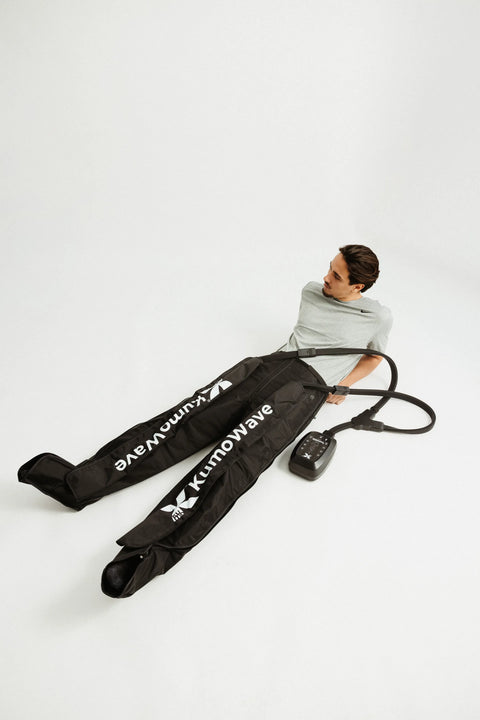
KumoWave Elite – Pressotherapy Pants
Full-coverage trousers. Ideal for lipedema, fluid retention and intensive use.
€799,00 €999,00
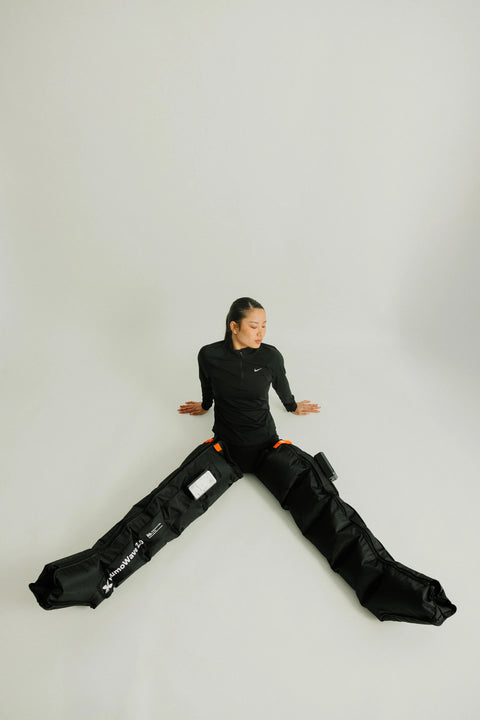
KumoWave 2.0 - Wireless Pressotherapy
Wireless, lightweight boots. Perfect for daily use and recovery.
€499,00 €599,00