

Playing should not hurt.
When your neck tightens, your shoulders creep up on their own and your forearm hardens, your body is asking for a break. A 2026 review found that musculoskeletal disorders are common among musicians, with the neck, shoulders, and hands among the most affected areas, and pointed to repetitive movements, poor ergonomics, psychological stress, and a lack of prevention as risk factors. Systematic review from 2026 on musculoskeletal disorders in musicians
Red & infrared light
Recover faster, at home
★★★★★ 4,8/5 · rated by verified customers
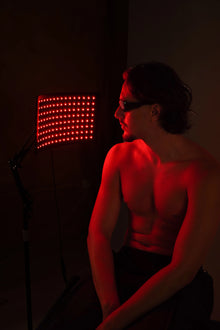
The KumoLux panel supports muscle recovery with full-body red and infrared light.
- 660 nm red + 850 nm infrared light
- Full-body muscle recovery
- Clinically validated biohacking protocols
€399,00€499,00
−10% on your 1st order when you subscribe to the newsletter

The good news is that a short routine, repeated consistently, can help lower the feeling of overload day to day. NIH ergonomics guidance recommends brief breaks with frequent stretching, because holding a fixed posture for too long tends to increase stiffness. NIH ergonomics pamphlet on breaks and stretching
Why the neck, shoulders, and forearms take on so much load
In musicians, tension rarely comes from a single movement. It usually builds from the sum of repetitions, held postures, fine grips, and small but continuous efforts. Reviews of upper limb disorders describe overuse patterns associated with repetitive movements, awkward postures, and sustained forces, exactly the kind of load that repeats during long practice sessions. CDC guide to preventing injuries related to musical practice (pmc.ncbi.nlm.nih.gov)
Personalized protocol · included with your purchase
Want us to tell you how to use it in your case?
With your purchase, our experts set up your red and infrared light sessions for your sport and goal.
Message us on WhatsAppOur experts reply · no obligation
Neck and trapezius
When you hold your head forward or turned for minutes at a time, the cervical muscles and the trapezius work too hard. The NHS points out that staying in the same position for long is not advisable and that it is better to keep the neck gently moving. If that is your main weak point, you can explore further with the self-care protocol for trapezius tension. (nhs.uk)
Forearms
In the forearm, the load usually comes from a sustained grip, fast passages, and fine repetition. If the discomfort concentrates near the elbow or on the outer side of the forearm, it may fit an overload pattern similar to the one discussed in the guide on everyday forearm tension. Prevention in musicians stresses spotting fatigue early and adjusting technique and habits before tension builds up.
Shoulders
Shoulders tend to take the load when the arm works far from the torso, when the strap pulls, or when support is poor. MedlinePlus notes that the shoulder needs good posture and movement to stay comfortable, and that pain which persists, swells, or comes with redness deserves medical review. (medlineplus.gov)
on your first order when you join the newsletter
We send you the code instantly. No spam.
What to do before, during, and after playing
Useful prevention is not complicated, but it does need to be consistent. The CDC, in its guide for musicians, stresses catching discomfort early, reviewing technique, and not letting fatigue build up. NIH ergonomics adds a very simple idea: short breaks and frequent stretching.
Before you start
- Do a brief activation of the neck, shoulders, elbows, and wrists for 1 to 2 minutes. Short breaks with gentle movement help prepare the body for repetition.
- Adjust the chair, music stand, or strap so the instrument does not force you to raise your shoulders. Reducing time under tension is usually more useful than holding the posture.
- Split the session into small blocks. If a passage already makes you grip too hard, lower the dose before the discomfort turns into a continuous load.
During the session
- Watch that your shoulders do not ride up as the difficulty increases. Keeping the neck and shoulder girdle in a less tense position often eases the feeling of being locked up.
- Take micro breaks even while you keep practicing. The NIH recommends brief breaks with stretching every 20 to 30 minutes, and that pattern fits musical work well.
- Alternate tasks of different demand. Moving from a very fine block to a lighter one helps spread the load across the forearm, shoulder, and neck.
After playing
- Walk for a couple of minutes and move your arms, hands, and neck gently. That closing step helps you leave the rehearsal without the same tension you walked in with.
- If the stiffness eases, you are on track; if it lasts for hours or always returns to the same spot, it is worth reviewing the total load of the week.
- If you want a ready-made sequence, you can draw on the quick mobility routine for feeling looser and adapt it to your instrument.
Studies on musicians suggest that exercise, postural education, and massage may offer relief, but the evidence does not yet allow anyone to promise uniform results. That is why the most sensible approach is to lean on simple, repeatable, realistic habits.
Practical self-care table by area
If you want to use a massage gun as occasional support, the guide to use by muscle group can keep you from working blind. The idea is to locate the broad area holding the tension and always respect what your body tolerates.
Practical summary by area
| Area | What usually loads it | What you can do | When to seek advice |
|---|---|---|---|
| Neck and trapezius | Head held forward, fixed gaze, and shoulders raised for long stretches. | Bring the sheet music closer, drop your shoulders, change position often, and take short breaks with gentle mobility. | If tingling, weakness, or pain running down the arm appears, get it checked. |
| Shoulders | Continuously holding the instrument, raised arms, or poor strap support. | Bring the instrument closer to your body, spread the load across blocks, and avoid holding the arm under needless tension. | If there is swelling, redness, fever, or significant pain when moving the arm, seek advice. |
| Forearms | Strong grip, repeated fingering, and fine effort without rest. | Release the hand between passages, shorten practice blocks, and check whether your posture forces you to grip too hard. | If pain lasts more than 2 to 4 weeks or gets worse, medical review is advisable. |
How to use a massage gun sensibly
A massage gun can support relief from the feeling of load, but it should not be used as a single solution or aggressively. A 2023 systematic review summarizes several contraindications and advises against applying it over open wounds, bruises, recent fractures, clotting disorders, thrombosis, areas with reduced sensation, and sensitive areas such as the face, eyes, head, neck, chest, and spine. Review of the safety and contraindications of massage guns
- Start with light pressure for a short time, over broad muscle mass and never over bone.
- Avoid the front of the neck, the spine, the head, the chest, and the joints.
- Stop using it if you notice dizziness, sharp pain, increased discomfort, or unusual sensations.
- If you take anticoagulants, or have osteoporosis, a recent fracture, thrombosis, a skin infection, or reduced sensation, seek advice before using it.
When to seek advice and signs that call for medical review
Most muscle tension improves with load adjustment and self-care, but some signs should not be ignored. MedlinePlus recommends seeking advice if shoulder pain lasts more than 2 to 4 weeks, if there is swelling, redness, or significant pain when moving the area, or if there was a severe injury. The NHS adds that neck pain which does not improve, or which comes with tingling, numbness, or weakness in the arms, should also be reviewed.
- Pain that does not improve after 2 to 4 weeks or that clearly increases.
- Tingling, numbness, weakness, or loss of strength in the arm or hand.
- Swelling, redness, local warmth, or fever.
- A recent injury, a fall, or difficulty moving the shoulder or neck properly.
- Shoulder pain along with chest pressure, shortness of breath, dizziness, or sweating.
Frequently asked questions
How often should I take a break if I practice for a long time?
A useful reference is a brief break every 20 to 30 minutes, even if it lasts only 1 or 2 minutes. The goal is not to stop the music, but to break the fixed posture before the neck and shoulders seize up. The NIH recommends exactly that: short breaks with frequent stretching, and the NHS reminds us that the neck should not be kept in the same position all the time. If you notice pain arriving sooner, bring the break forward.
Does gentle stretching help once the neck already feels tight?
Yes, as long as it stays gentle and unforced. The idea is not to stretch until it hurts, but to give some mobility back to the neck, shoulders, and shoulder girdle. NIH ergonomics guidance supports posture changes and breaks with movement, and the NHS stresses keeping the neck active rather than still. If the movement makes the pain worse, reduce the range or stop and review the total load of the day.
Can I use a massage gun on my shoulders and forearms?
Yes, as occasional support and over broad muscle areas, but carefully. The systematic review on massage guns indicates that it is better to avoid sensitive areas, wounds, bruises, recent fractures, thrombosis, and areas such as the front of the neck, head, spine, chest, or face. The most useful approach is usually to start with little time and light pressure, watch how your body responds, and stop if dizziness or sharp pain appears. If you have medical doubts, seek advice first.
When does tension stop being normal and deserve a review?
When it does not improve with relative rest, keeps returning to the same spot, or comes with signs such as tingling, weakness, swelling, or very intense pain on movement. MedlinePlus recommends seeking advice if shoulder pain lasts more than 2 to 4 weeks, and the NHS notes that neck pain with symptoms in the arms also deserves review. In musicians, the sooner the load is adjusted, the easier it usually is to slow the build-up of discomfort.
What now?
If you want to turn these ideas into a simple routine, start at the Kumo Balance home page and set aside a few minutes to organize your recovery and your mobility. The key is not to play less, but to spread the load better and listen to your body's signals sooner.

Red & infrared light
KumoLux Panel – Red and Infrared LED Panel
★★★★★ 4,8/5 · rated by verified customers
- 660 nm red + 850 nm infrared light
- Full-body muscle recovery
- Clinically validated biohacking protocols
€399,00€499,00· pay in installments with seQura or Klarna