
Tennis elbow is more bothersome than it looks, especially when gripping, turning the wrist or carrying weight hurts. Mayo Clinic links it to overuse and to repeated forearm and wrist movements, and the pain can radiate into the forearm and the wrist. Mayo Clinic
The useful day-to-day answer is not to push through or to immobilize completely, but to lower the load, spread the effort out and get moving again gradually. The NHS and the AAOS agree that relative rest, adapting activities and well-guided exercises are usually the basis of the conservative approach.
Red & infrared light
Recover faster, at home
★★★★★ 4,8/5 · rated by verified customers
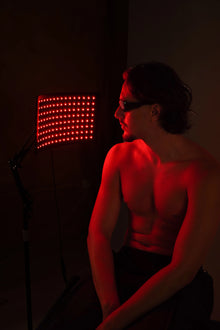
The KumoLux panel supports muscle recovery with full-body red and infrared light.
- 660 nm red + 850 nm infrared light
- Full-body muscle recovery
- Clinically validated biohacking protocols
€399,00€499,00
−10% on your 1st order when you subscribe to the newsletter

What is really happening in the elbow
The pain usually shows up on the outer part of the elbow, where the tendons of the forearm muscles attach to the bone. Mayo Clinic explains that overuse can create small tears and sustained irritation of the tendon, which ends up causing pain and tenderness in the area.
You do not have to play tennis to feel this problem. According to Mayo Clinic, activities as common as heavy mouse use, painting, screwing, cutting food or working with repetitive tools can trigger the discomfort, and it is most frequent between the ages of 30 and 60.
Personalized protocol · included with your purchase
Want us to tell you how to use it in your case?
With your purchase, our experts set up your red and infrared light sessions for your sport and goal.
Message us on WhatsAppOur experts reply · no obligation
Habits that usually help day to day
Lower the load without keeping the arm still
The first step is to take the fuel away from the movement that triggers the pain. The NHS recommends reducing or modifying the activities that make symptoms worse for two to four weeks, but without falling into total immobility, because the elbow also needs to move gently. NHS
A simple idea is to break the task into short blocks and take regular breaks. If your forearm gets loaded by accumulated tension, it may help you to better understand the approach behind deep tissue massage and relief of muscle tension, always as wellness support and never as a substitute for an assessment if the pain persists.
Look after temperature and support
The NHS notes that ice or heat can ease the discomfort if applied for about 20 minutes every 2 or 3 hours, always protected with a towel or a cloth. MedlinePlus adds that ice is usually especially useful for recent and more reactive injuries.
on your first order when you join the newsletter
We send you the code instantly. No spam.
A forearm band, a brace or a similar support can also help if it takes pressure off the movement. It does not fix the problem on its own, but it lets some people carry on with everyday tasks with less discomfort.
Quick table of useful habits
| Situation | What to try | Reference source |
|---|---|---|
| When the elbow gets loaded by repeated movements | Reduce hard gripping, alternate tasks and work in short blocks with breaks. | NHS |
| When you notice stiffness or tenderness | Apply cold or heat for about 20 minutes, every 2 or 3 hours, with a cloth in between. | MedlinePlus |
| When you want to rebuild strength little by little | Do forearm stretching and strengthening exercises gradually and with supervision. | AAOS (orthoinfo.org) |
Gentle exercise, yes, but well chosen
The AAOS explains that specific exercises to stretch and strengthen the muscles pulling on the injured tendon help improve resistance to repetitive stress. The idea is not to do a lot at once, but to build tolerance with a well-structured program.
In practice, that usually means elbow mobility, gentle palm-up and palm-down rotations, and progressive wrist and forearm work. If you are picking it back up after a painful stretch, it is better to start within comfortable limits than to try to recover everything in a single session. (hiowhealthcare.nhs.uk)
How to use a massage gun carefully
As a wellness tool, the massage gun can accompany the feeling of relief from stiffness, but it should not be used on the elbow bone or on a recently injured area with significant pain and swelling. Hospital for Special Surgery points out precisely that, if you have just been injured and feel a lot of pain or inflammation, it is not a good time to use it.
UCLA Health recommends working only on muscle, avoiding joints and bones, starting at low speed and not going over 2 minutes per muscle group in a session. If you are a beginner, the same source suggests starting with 10 to 30 seconds per area.
- Start on the muscle belly of the forearm, not on the bony ridge of the elbow or on the most sensitive tendon.
- Use a low speed at first and move it slowly, without always pressing on the same spot.
- Limit the first go to 10 to 30 seconds per area if you have never used it.
- Do not go over 2 minutes per muscle group in a single session.
- If more pain, more swelling or an odd tenderness shows up, stop and let the area rest.
If you want to fine-tune your technique, it may be worth also reading the massage gun mistakes that can increase muscle tension and which head and which speed to choose for each muscle. And if what you feel is very localized knots, reading about trigger points and safe percussion massage can help you understand when to be gentle and when to stop.
As a reasonable precaution, avoid using it on open wounds, stitches, unhealed fractures, deep vein thrombosis, clotting disorders, skin infections or areas with loss of sensation. Mayo Clinic lists these situations as precautions for therapeutic massage, and that can be taken as a sensible reference for a percussion tool at home too, even if it is not a universal medical rule for the device. Mayo Clinic
When to seek care and which signs call for medical assessment
If the pain is still there after resting the elbow and trying self-care measures for at least 2 weeks, the NHS recommends getting it assessed.
- If the pain started after a fall, a blow or any recent injury, seek medical assessment.
- If the elbow is red, swollen and you also have a fever or feel unwell, it is best to get seen quickly.
- If you feel very intense pain with a snapping sensation at the front of the elbow when lifting weight, do not let it slide.
- If you do not improve with activity changes and exercises over 6 to 8 weeks, ask for a professional evaluation.
Frequently asked questions
Should I stop moving my arm completely if I have tennis elbow?
That is usually not the best idea. What helps most is relative rest, meaning you reduce whatever triggers the pain but keep the elbow moving gently. The NHS insists that the elbow should not become stiff and that it is worth continuing to use the arm for shorter, more comfortable tasks. If you stop everything for many days, stiffness is more likely to set in and getting back to activity becomes harder.
Which is better, ice or heat?
It depends on how the area behaves. Ice usually works better if the elbow is very reactive or if the discomfort comes from a recent injury, while heat can feel more pleasant when stiffness is what dominates. The NHS suggests 20 minutes every 2 or 3 hours, always with a cloth between the skin and the cold or heat source. MedlinePlus also points out that ice is useful for recent severe injuries.
Can I use a massage gun on my forearm?
Yes, but with a lot of care. UCLA Health recommends working only on the muscle, starting at low speed, not spending more than 2 minutes per muscle group and avoiding joints and bones. HSS adds that it should not be used if the area has just been injured and there is significant pain or swelling. With tennis elbow, the sensible thing is to focus it on the muscle belly of the forearm, never on the bony ridge of the elbow.
When should I ask for a medical assessment?
It is worth getting checked if the pain does not improve after 2 weeks of relative rest and self-care, if it appeared after a fall or a blow, or if the elbow is red, swollen or accompanied by a fever. It is also advisable to ask for help if the problem gets worse instead of better, or if you are in the same place after 6 to 8 weeks of changes and exercises. In those cases, a professional can confirm the source of the pain and adjust the plan.
Does tennis elbow usually improve with exercise?
In many cases, yes, a progressive program of mobility, stretching and strengthening does help. The AAOS explains that these exercises aim to improve resistance to repetitive stress and make it easier to return to daily activities. The key is progression, not intensity: if an exercise increases the pain a lot or leaves the area irritated for hours, it is better to lower the load and review it with a physical therapist.
So what now?
If you want to keep looking after your forearm with a practical approach, you can head back to the Kumo Balance site and explore a quick percussion massage and mobility routine to fit active rest into your week without straining the area.

Red & infrared light
KumoLux Panel – Red and Infrared LED Panel
★★★★★ 4,8/5 · rated by verified customers
- 660 nm red + 850 nm infrared light
- Full-body muscle recovery
- Clinically validated biohacking protocols
€399,00€499,00· pay in installments with seQura or Klarna