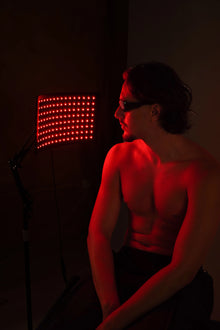


Eczema itches, burns, and can get out of hand fast. (mayoclinic.org)
The good news is that a flare-up usually improves when you protect the skin barrier, cut back on irritants, and choose the type of light carefully. That means telling medical phototherapy, which uses ultraviolet light and has to be prescribed by a dermatologist, apart from LED or red light devices, which are not used for the same purpose or in the same way. (aad.org)
Facial red light
Bring your skin back to life
★★★★★ 4,8/5 · rated by verified customers
The KumoSkin LED mask helps repair and calm your skin in short sessions at home.
- 250 LEDs in flexible medical silicone
- Red light to boost collagen and glow
- 4 lights: red, infrared, blue and yellow
€299,00€429,00
−10% on your 1st order when you subscribe to the newsletter

What happens in the skin during a flare-up
Atopic dermatitis is a chronic inflammatory condition that tends to alternate calm phases with flare-ups. The skin becomes more reactive, loses water easily, and falls into the itch-and-scratch cycle, which makes redness and irritation worse.
Triggers vary from one person to another, but several factors come up again and again in dermatology guidelines. (aad.org)
Personalized protocol · included with your purchase
Want us to tell you how to use it in your case?
With your purchase, our experts prepare the ideal LED protocol for your skin type and goal (acne, wrinkles, dark spots...).
Message us on WhatsAppOur experts reply · no obligation
- Fragrances, scented soaps, and cosmetics that irritate already sensitive skin.
- Heat, sweat, and overheating, which can set off the itch.
- Wool or synthetic clothing, especially if it rubs and traps heat. (aad.org)
- Sunburn or sun exposure if you notice that natural light brings on flare-ups. (aad.org)
If you want to understand the more technical side of light on the skin, the guide on what photobiomodulation is and what it is used for helps put things in order before you try any device.
How to calm a flare-up at home
Basic routine for the first 24 hours
- Take short baths, 5 to 10 minutes, with lukewarm water and a fragrance-free cleanser. Then pat the skin dry instead of rubbing.
- Apply a fragrance-free emollient cream or ointment while the skin is still damp, ideally within 3 minutes of the bath.
- If your dermatologist prescribed an anti-inflammatory cream, use it exactly as directed. Many treatment plans combine skin care with topical medication to control symptoms better.
- Avoid scratching and choose loose cotton clothing, because friction and heat can make the itch worse.
If the flare-up is very dry, very irritated, or weeping, your dermatologist may consider wet wraps and other adjustments to the treatment. Do not improvise new therapies if you suspect an infection or the skin is very broken.
If you already use light therapies at home for other goals, the explanation of how red light therapy works will help you avoid confusing visible light with medical phototherapy.
on your first order when you join the newsletter
We send you the code instantly. No spam.
What precautions to take with light
Sunlight: when it helps and when it makes things worse
Sun exposure is not the same for everyone. In some people the skin improves a little, but in others heat, sweat, or sunburn trigger flare-ups. If you notice that natural light irritates you, look for shade, wear protective clothing, and cover exposed areas with a broad-spectrum sunscreen of SPF 30 or higher. For very reactive skin, the AAD recommends fragrance-free options and, in children from 6 months of age, mineral filters such as titanium dioxide and zinc oxide.
If the sun makes your eczema worse, tell your dermatologist, because that detail helps decide whether it is worth continuing with phototherapy or looking for another strategy. (aad.org)
Medical phototherapy: the light a specialist has to supervise
Phototherapy for atopic dermatitis uses ultraviolet light, usually narrowband UVB, and is generally reserved for moderate or severe cases, widespread ones, or those that respond poorly to topical treatment. It has to be prescribed by a dermatologist and carried out with clinical follow-up. A randomized trial published in 2026 found that narrowband and broadband UVB were equally effective in adults with moderate to severe atopic dermatitis, although narrowband was better tolerated. (nationaleczema.org)
You should not start phototherapy on your own if there is photosensitivity, a history of skin cancer, or a combination of immunosuppressants. A 2025 clinical guideline recommends avoiding it in those situations. (doi.org)
Red light and photobiomodulation: what we know today
Red and near-infrared light are not the same as ultraviolet light. In general they appear safe in the short term when used properly, but long-term safety is not fully established and the specific evidence for eczema is still limited. The National Eczema Association notes that there may be promising signals, but that there are still not enough clinical trials to present it as a main treatment for atopic dermatitis. (aad.org)
That does not mean it cannot be part of a well-planned routine, only that it should not replace the usual treatment or be used as the single solution for a flare-up on the face. If you have darker skin, check with a dermatologist first, because visible light can encourage more persistent hyperpigmentation.
If you want to tell wavelengths apart more clearly, the guide on the practical differences between 660 nm and 850 nm is useful for understanding why not all red lights work the same way. And if you already use a panel or a mask at home, the read on steps and frequency of use at home will help you avoid overdoing it.
Quick summary so you do not make the skin worse
| Situation | What helps | What to avoid |
|---|---|---|
| Very dry skin | Fragrance-free cream or ointment, applied right after the bath while the skin is still damp. | Waiting too long to moisturize or using scented products. |
| Intense itching | Short baths, cotton clothing, and less heat to break the scratching cycle. (aad.org) | Scratching, wearing wool or fabrics that rub. |
| The sun irritates you | Shade, protective clothing, and broad-spectrum sunscreen of SPF 30 or higher. | Getting burned or staying out longer once you already feel heat or itching. |
| You are going to use light at home | Check that the device is suitable, protect your eyes, and ask for medical guidance before starting. | Using it instead of treatment or piling on sessions without any control. |
The idea is not to live in the dark, but to choose a routine that calms the skin instead of overstimulating it. When the skin barrier is fragile, less irritation usually means fewer flare-ups.
FAQ
Can eczema get worse with the sun?
Yes, in some people. Others feel partial relief, but heat, sweat, and sunburn can trigger a flare-up or make it more intense. That is why it is not worth generalizing. The safest approach is to watch your own response, protect the skin with shade, light clothing, and suitable sunscreen, and mention it to your dermatologist if you notice that the sun is a clear trigger.
Is UV phototherapy the same as a red LED mask?
No. UV phototherapy uses ultraviolet light and is prescribed for moderate or severe atopic dermatitis, usually under dermatological supervision. A red LED mask uses visible light, not UV, and the evidence for eczema is still limited. They are also not used for the same purpose or with the same supervision. If you have active flare-ups, do not assume an LED mask can replace medical treatment.
Can I use red light at home if I have flare-ups on my face?
Only with caution and, better still, after medical advice. Red light may look safe in the short term, but the AAD points out that its long-term effects are not well known and that it can cause irritation or hyperpigmentation, especially on darker skin. The National Eczema Association also stresses that it should not be the main strategy for facial eczema. If the skin is broken, very inflamed, or very sensitive, it is better to postpone it.
What are the warning signs of an infected flare-up?
Seek medical care if yellow crusts, pus, reddish streaks, pain, swelling, or fever appear. It is also worth checking in if the flare-up does not improve with basic care or if the itching keeps you from sleeping and going about your day. In children and people who are immunosuppressed, some infections may need urgent attention. When you are unsure whether it is a flare-up or an infection, it is better to have a health professional assess it.
What now?
If the flare-ups are intense, recurrent, or seem to get worse with light, the safest step is to ask for a dermatology assessment before trying more devices. If you want to keep learning at your own pace, you can read how to use photobiomodulation at home with safety criteria and then go back to the Kumo Balance home page to go through more guides on light and recovery.

Facial red light
KumoSkin Mask – LED Facial Mask
★★★★★ 4,8/5 · rated by verified customers
- 250 LEDs in flexible medical silicone
- Red light to boost collagen and glow
- 4 lights: red, infrared, blue and yellow
€299,00€429,00· pay in installments with seQura or Klarna