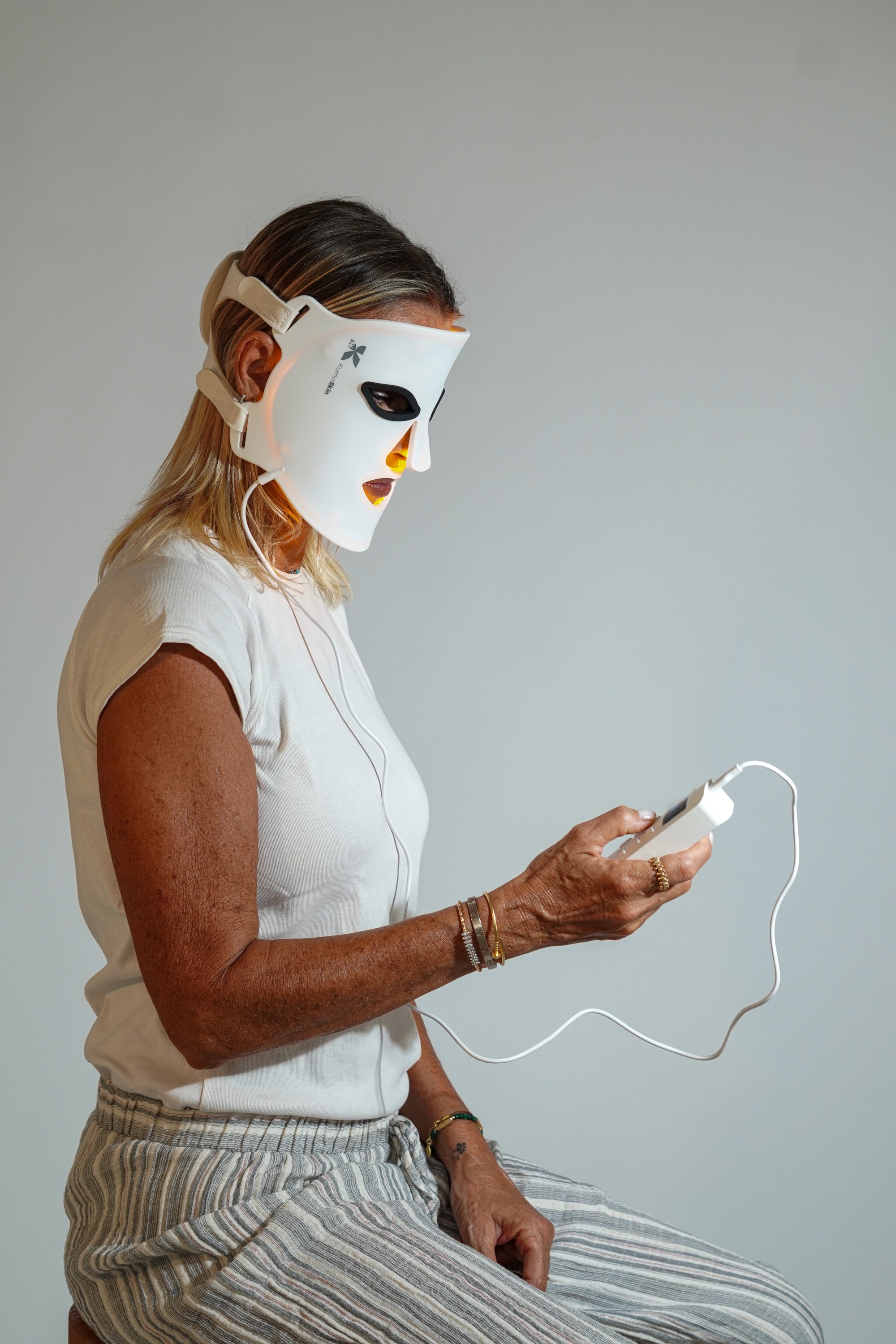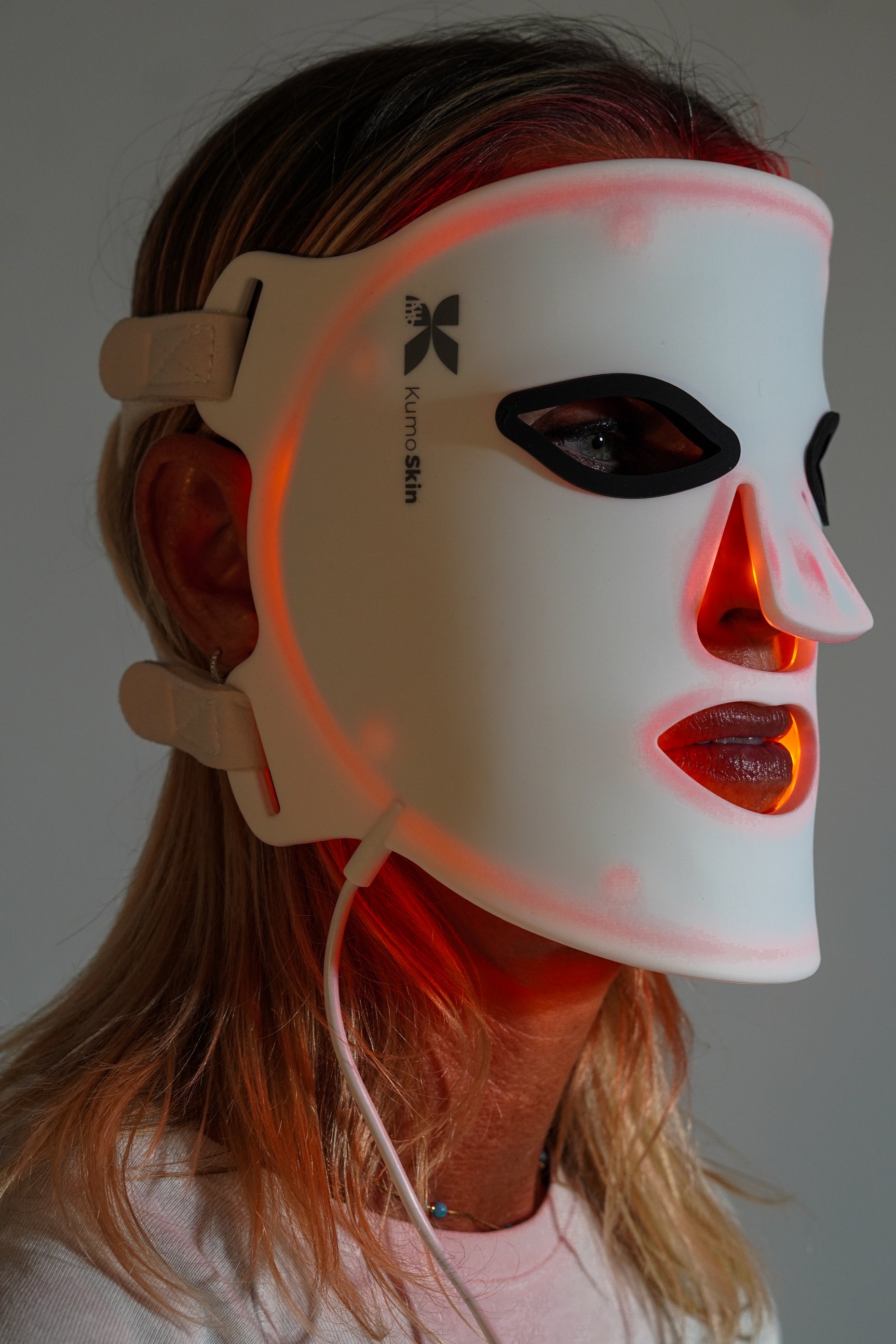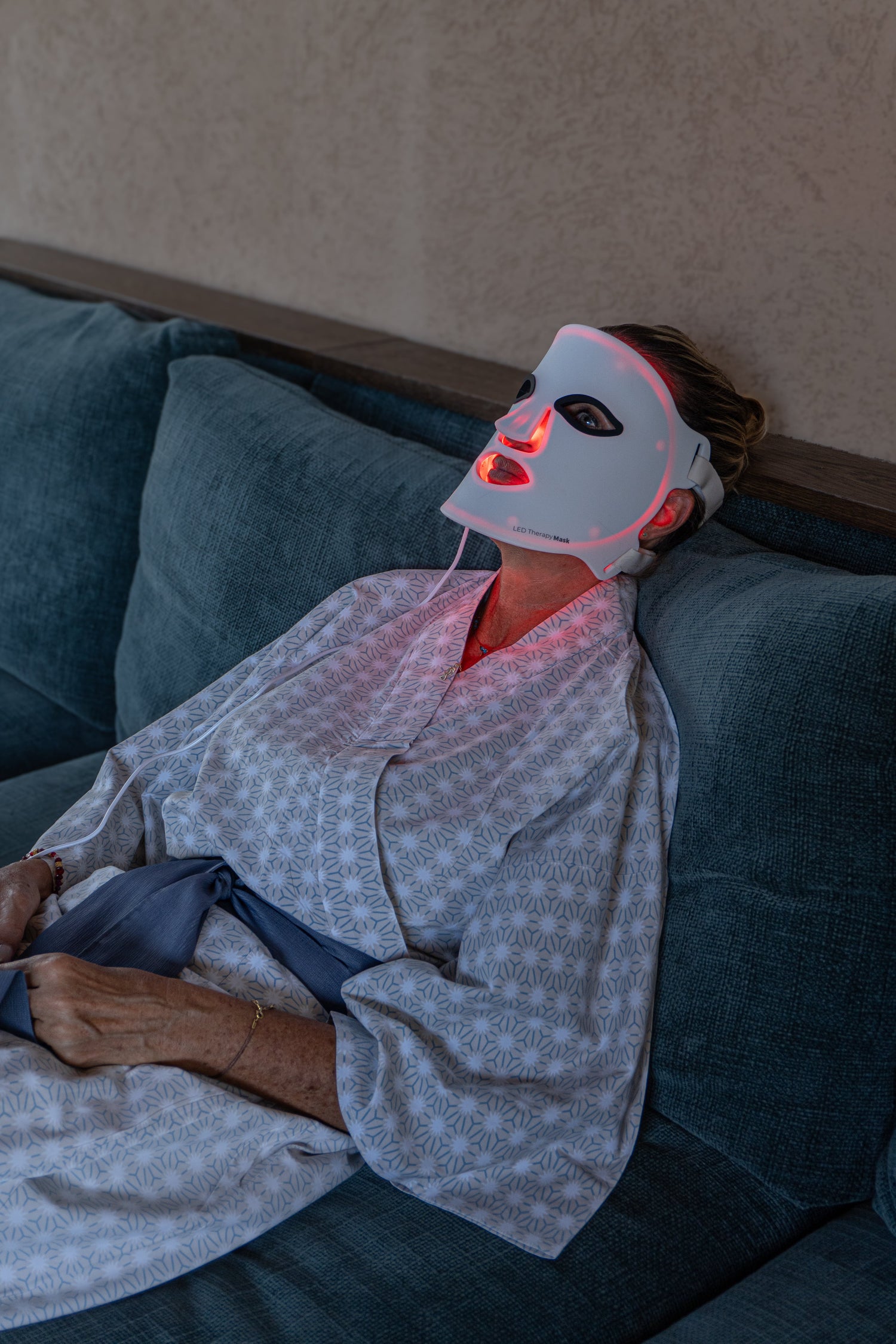
LED face masks can work. Their effect is gradual and depends on the light, dosage, and consistency: they can help with mild acne, redness, and signs of aging, but they don't produce miraculous or identical changes in everyone.
The key is photobiomodulation: low doses of visible or near-infrared light that don't heat the skin and can modify cellular activity. That's why results are usually measured in weeks, not in a single session, and the protocol matters more than the number of LEDs alone. (fda.gov)
Red & infrared light
Recover faster, at home
★★★★★ 4,8/5 · rated by verified customers
The KumoLux panel supports muscle recovery with full-body red and infrared light.
- 660 nm red + 850 nm infrared light
- Full-body muscle recovery
- Clinically validated biohacking protocols
€399,00€499,00
−10% on your 1st order when you subscribe to the newsletter

How an LED Face Mask Works
These masks emit light at specific wavelengths to generate a biological response in the skin. The FDA describes photobiomodulation as a low-intensity therapy that does not heat the skin and can change cell behavior without raising temperature; the AAD presents it as a non-invasive resource that dermatologists use as an adjunct for acne, wrinkles, and other signs of aging.
The AAD summarizes this approach well in its clinical guide on red light therapy, where it explains that home devices are usually less powerful than in-office ones and that their effects, when they appear, tend to be subtle or moderate.
Personalized protocol · included with your purchase
Want us to tell you how to use it in your case?
With your purchase, our experts set up your red and infrared light sessions for your sport and goal.
Message us on WhatsAppOur experts reply · no obligation
What each type of light does
| Light | Common Use | What is usually sought | Most important thing to remember |
|---|---|---|---|
| Red (630–660 nm) | Photoaging, texture, redness, and fine lines. | In 2023, a randomized trial with 137 women had 10 sessions over 4 weeks and observed a significant 31.6% reduction in periorbital wrinkle volume with 660 nm. (pubmed.ncbi.nlm.nih.gov) | Works best with consistency and realistic expectations. |
| Blue (~415 nm) | Mild inflammatory acne and active pimples. | The AAD indicates that visible light can help with pustules and papules, but not with comedones, cysts, or nodules. (aad.org) | Not a solution for all types of acne. |
| Near-infrared (830–850 nm) | Rejuvenation, skin comfort, and combined protocols. | In 2025, a multicenter, randomized, double-blind, sham-controlled trial evaluated a home mask with 630 and 850 nm; the study reported improvement in wrinkles with good tolerance. (pmc.ncbi.nlm.nih.gov) | Combination and dosage matter as much as wavelength. |
In other words, counting LEDs is not enough. What truly changes the result is the wavelength, power per area, uniformity of light, session time, and design safety. The FDA reminds us that dosage modifies the effect and that an "FDA-cleared" device is considered low-risk, not automatically more effective.
What results you can really expect
The most common changes are subtle but visible over time: slightly smoother skin, less redness, improved overall appearance and, in some people, fewer active pimples. In a study cited by the AAD, 90 patients received 8 facial treatments over 4 weeks and more than 90% reported some improvement, such as softer skin, less redness, and fewer spots.
“No one laser or light treatment can treat pimples, blackheads, whiteheads, acne cysts, and acne nodules.”
−10%on your first order when you join the newsletter
We send you the code instantly. No spam.
This sums up the limitation of this technology very well: it is useful for certain goals, but it does not replace dermatological treatment when the problem is deeper or more complex. In the case of aging, a 2023 trial showed a reduction in periorbital wrinkles, but not all hydration and elasticity parameters improved at the same time.
- For fine lines and texture: improvement is usually gradual and depends on several weeks of consistent use.
- For mild acne: blue light and the blue + red combination can help with active pimples, but not with all forms of acne.
- For redness and irritation: some people notice calmer and more even skin, although the effect is usually more subtle than spectacular.
When changes begin to be noticed
Think in terms of weeks, not days. For acne, the AAD mentions home protocols of repeated use for 4 to 5 weeks for some devices; for wrinkles and texture, clinical studies usually work with blocks of 4 weeks or more, and some trials reach 16 weeks.
If you want a clearer and more organized routine, this step-by-step usage guide helps you integrate the LED mask into your daily life without improvisation.
How to use it well at home
The best protocol is one that you can repeat regularly without irritating your skin. The AAD emphasizes always following the manufacturer's instructions, using the device at the indicated frequency, and understanding that results depend on consistency and the goal you want to treat.
- Clean and dry your face thoroughly before putting on the mask, to avoid mixing the light with makeup or product residue.
- Start with the session time indicated by the manufacturer and do not extend it "to go faster," because the dose does influence the result.
- Use the device consistently for several weeks, because the skin responds cumulatively.
- Protect your eyes if the manual requires it and use the protection recommended by the brand.
- Stop use if you notice persistent irritation, more redness than usual, or new spots.
If you prefer to review the cautionary points first, you can find more information in this analysis of benefits and risks of the LED face mask.
Safety, contraindications, and common mistakes
When used correctly, facial LED light is a low-risk technology, but it is not harmless. The FDA notes that photobiomodulation is not recommended for people with photosensitivity disorders, pregnancy or planning pregnancy, active implants, skin cancer or a history in the treated area, photosensitizing medication, or active lesions; additionally, light can damage the eyes and, when applicable, protective eyewear should be used.
- Do not look directly at the LEDs or use the mask as if it were a desk lamp. (pubmed.ncbi.nlm.nih.gov)
- Do not use it on your eyelids if the manual does not allow it.
- Do not multiply the session duration thinking that this will accelerate the result.
- Do not combine it with photosensitizing medication without first checking compatibility.
- Do not expect an instant effect in a single session.
The AAD adds another important precaution: darker skin types may be more sensitive to visible light and develop hyperpigmentation, with more intense and long-lasting spots. Therefore, it is advisable to personalize use if your phototype is high or if you tend to get spots easily.
What to look for when choosing a good LED face mask
There is no magic number of LEDs. It is reasonable to look at four things: that it clearly indicates the wavelengths, that it thoroughly explains the usage time, that it includes eye safety measures, and that it specifies what objective it is designed for. The AAD reminds us that a device can be safe and, even so, not be the most effective for your particular case.
- Clear wavelengths: red, blue, or near-infrared must be precisely specified.
- Well-explained protocol: time, frequency, and duration of the plan must be defined.
- Eye protection: if the device requires it, it must be included or clearly indicated.
- Realistic home use: comfort and fit to the face matter for consistency to be possible.
Frequently Asked Questions
Do LED face masks really work?
Yes, but moderately and with specific goals. The evidence is strongest for mild inflammatory acne and for signs of photoaging, such as fine lines, redness, and uneven texture. A randomized trial in 2023 with 137 women showed a 31.6% reduction in periorbital wrinkle volume with 660 nm red light after 10 sessions over 4 weeks. Even so, the response varies greatly depending on the skin, protocol, and quality of the device.
When do you see the first results with an LED mask?
It's normal to think in terms of weeks, not days. For some acne devices, the AAD mentions 4 to 5 weeks of regular use; for rejuvenation, clinical studies usually work with 4 weeks or more, and in other cases, they reach 16 weeks. If the change is aesthetic, it is usually progressive: first less redness or calmer skin, and then more visible improvements in texture or fine lines. Consistency weighs more than a long, isolated session.
Are LED masks safe for the eyes?
They are when used correctly and with the indicated protection, but eye exposure should not be trivialized. The AAD recommends always following the glasses or protectors that come in the manual and not replacing them with sunglasses. In addition, a 2020 clinical case described photochemical retinopathy after prolonged exposure to a blue LED mask, so it is not advisable to look directly at the LEDs or improvise their use. If you have a pre-existing eye condition, it is best to consult a professional.
How many LEDs should a good LED face mask have?
There is no magic number. More diodes can help distribute the light better, but that doesn't guarantee effectiveness. What really matters is the wavelength, power per area, uniformity of coverage, session time, and design safety. The FDA and AAD insist that dosage and protocol weigh more than an isolated marketing data point. If a device does not explain these points well, it is a bad sign.
What is the difference between red light and blue light?
Red light and near-infrared are more associated with rejuvenation, inflammation, and texture; blue light is mainly used for active acne pimples. The AAD clarifies that visible light does not work well against comedones, cysts, or nodules, and that blue + red devices are better oriented towards mild inflammatory lesions. That's why the same light is not chosen to treat wrinkles as for an acne breakout.
What now?
If you want to move from theory to practice, start with the KumoSkin Mask and return to Kumo Balance to continue browsing from the source. This way you can assess whether photobiomodulation fits into your skincare routine with a realistic and consistent approach.

Red & infrared light
KumoLux Panel – Red and Infrared LED Panel
★★★★★ 4,8/5 · rated by verified customers
- 660 nm red + 850 nm infrared light
- Full-body muscle recovery
- Clinically validated biohacking protocols
€399,00€499,00· pay in installments with seQura or Klarna