
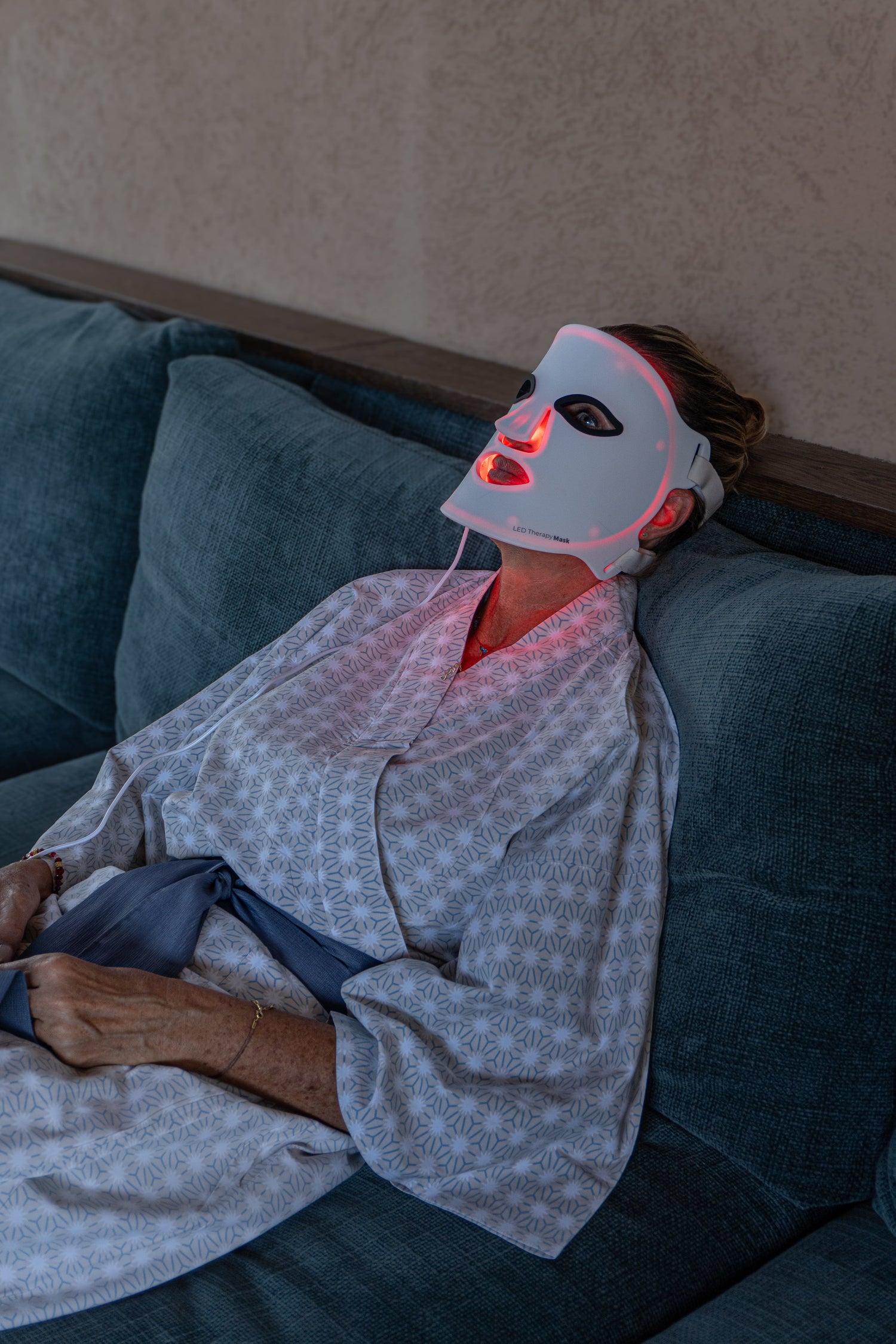

They do not work the same way.
The LED facial mask works with photobiomodulation and is usually gentle, progressive, and requires no downtime; in-office lasers use more intense energy, can correct with greater power, and typically require more recovery. This difference explains why they are not suitable for the same objective or the same skin type.
Facial red light
Bring your skin back to life
★★★★★ 4,8/5 · rated by verified customers
The KumoSkin LED mask helps repair and calm your skin in short sessions at home.
- 250 LEDs in flexible medical silicone
- Red light to boost collagen and glow
- 4 lights: red, infrared, blue and yellow
€299,00€429,00
−10% on your 1st order when you subscribe to the newsletter

“No downtime required.”
What each treatment is and how it works
LED facial mask
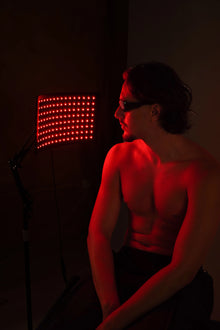
LED facial therapy uses red or near-infrared light to stimulate biological responses in the skin without using UV. The Cleveland Clinic's clinical guide on LED therapy describes it as a non-invasive, painless treatment with virtually no recovery; the AAD on red light adds that at-home devices are usually less powerful than those used in clinics, so changes are typically gradual and depend heavily on consistency.
Personalized protocol · included with your purchase
Want us to tell you how to use it in your case?
With your purchase, our experts prepare the ideal LED protocol for your skin type and goal (acne, wrinkles, dark spots...).
Message us on WhatsAppOur experts reply · no obligation
If you're looking to bring this routine home, an LED facial mask like this at-home option is best when you can repeat short sessions regularly.
In-office laser
Facial lasers work differently: they emit coherent, focused light, and can be ablative or non-ablative. Ablative lasers vaporize tissue to remodel the skin's surface, while fractional versions distribute the energy to reduce adverse effects and shorten recovery.
In practice, in-office lasers are usually reserved for more intense changes, such as those described by Mayo Clinic on laser resurfacing for fine wrinkles, uneven tone, photoaging, and spots.
on your first order when you join the newsletter
We send you the code instantly. No spam.
Quick comparison table
LED facial and in-office laser: practical comparison
| Aspect | LED facial mask | In-office laser | Practical reading |
|---|---|---|---|
| Energy | Non-invasive light, typically painless and UV-free. | Coherent and more concentrated light; in ablative lasers, it remodels the skin's surface. | LED is usually gentler; laser is more powerful and more technical. |
| Objective | Maintenance, fine lines, support for regeneration, and consistent routines. | Wrinkles, spots, uneven texture, scars, and photoaging. | LED is better for prevention; laser is better for more visible correction. (aad.org) |
| Results | Usually progressive and achieved with several sessions. | Tend to be more noticeable, especially with ablative or fractional resurfacing. | If you want quick changes, laser usually comes out ahead. |
| Recovery | Virtually none; generally, you can resume your day. | Can range from a few days to several weeks, depending on the type of laser. | LED wins in convenience; laser wins in intensity. |
| Usage profile | Very useful for home use and for skin types seeking high tolerance. | Requires clinical selection, especially for higher phototypes or reactive skin. | If your priority is simplicity, LED; if it's correction, laser. |
What the evidence says about wrinkles and spots
Evidence for facial LED exists and goes beyond marketing. A 2017 randomized trial of 52 women showed significant improvement in periorbital wrinkles after 12 weeks of red or white LED; in 2025, a double-blind trial with simulation and 95 women found significant improvement in glabellar and periorbital wrinkles with a red LED mask used two or three times a week for four weeks. You can read more about this in the evidence and real results of the LED facial mask. (pubmed.ncbi.nlm.nih.gov)
Still, the correct interpretation is cautious: improvement with LED is usually progressive and highly dependent on consistency, while lasers tend to produce more noticeable changes when used for resurfacing. If you want to understand how to integrate it into your daily life, the explanation of benefits and proper use of the LED facial mask helps to apply the technique to a realistic routine.
For spots and discoloration, the comparison is less symmetrical. The 2024 integrative review on photobiomodulation and melasma identified nine studies and concluded that photobiomodulation can reduce hyperpigmentation, but also emphasized that more well-designed trials are needed to define optimal parameters. In parallel, the AAD and Mayo Clinic still consider lasers useful for age spots, uneven tone, and melasma, although with a higher risk of color changes in certain phototypes.
Risks, tolerance, and recovery times
With LED, side effects are usually rare and mild. Cleveland Clinic mentions redness, rash, pain, or increased inflammation as possible effects, and recommends eye protection in addition to checking if the device is validated for home use. The AAD also insists on managing expectations and consulting if there is light sensitivity or diagnostic doubts.
With lasers, the risk profile is higher: Mayo Clinic details infection, herpes reactivation, and color changes as possible complications, especially in brown or black skin; the StatPearls technical review on ablative laser adds that ablative lasers are more aggressive, can cause more scarring or dyschromia if the energy is excessive, and require recovery ranging from a few days to several weeks depending on the type.
How to choose according to your goal
To summarize, the decision usually goes like this: LED for maintenance, laser for more intense correction. In between, the decisive variable is not only the result, but also how much time you are willing to invest, how much recovery you tolerate, and what level of clinical supervision you need.
- Choose LED if you want an at-home, comfortable, and low-friction routine.
- Choose laser if you are looking for a more visible change in wrinkles, texture, or spots.
- Choose LED if your skin is sensitive and you prefer a very well-tolerated option.
If you are looking for a consistent and gentle routine
Here, the LED facial mask wins. It's a maintenance option, usually better suited for sensitive skin, and doesn't require you to pause your routine afterward. To get the most out of it, it's advisable to follow a consistent protocol, such as the one explained in the nighttime facial routine with an LED mask. If you are still unsure between models, the guide to choosing the right LED facial mask in 2026 helps separate what's important from marketing noise.
If you want more visible correction of wrinkles, texture, or spots
Here, in-office lasers usually have an advantage, especially if you are looking for a faster change with more visual impact. Ablative and fractional lasers are used for photoaging, wrinkles, spots, and scars, although the price to pay is more medical planning, more precautions, and recovery that can be short or clearly visible depending on the intensity.
If your skin is sensitive or reactive
For sensitive skin, the balance usually tips towards LED because it is non-invasive and generally easier to tolerate. Still, it's not for everyone: if you have photosensitivity, medication that increases it, or an eye condition, it's advisable to review the indication with a specialist.
Frequently asked questions
LED facial mask vs. in-office laser: which offers faster visible results for wrinkle reduction?
In general, in-office lasers usually show faster and more noticeable results, especially when ablative or fractional, because they remodel the skin's surface more intensely. The LED facial mask can also improve wrinkles, but it usually does so progressively and requires several sessions. Recent clinical trials with LED show improvements in weeks, not in a single session, so consistency weighs much more than brute force.
Do the LED facial mask and in-office laser treatment work in the same way to treat spots and skin discoloration?
No. Lasers act more directly on chromophores such as melanin and water, which is why they are used for age spots, uneven tone, and melasma. LED photobiomodulation can help with hyperpigmentation and melasma, but the evidence is more emerging and still needs more robust trials to establish ideal parameters. In other words: they share a goal, but not the same mechanism or clinical strength.
What are the risks of an in-office laser treatment compared to using an LED facial mask at home?
Lasers have a higher risk of inflammation, infection, herpes reactivation, color changes, and, in some cases, scars. Additionally, in darker skin, the probability of post-inflammatory hyperpigmentation increases. The LED facial mask, on the other hand, usually has rare and mild side effects, such as redness or rash, as long as you follow eye protection and manufacturer instructions. If there is light sensitivity or eye problems, prudence is key.
Is it possible to achieve similar benefits with an LED facial mask versus an in-office laser treatment for people with sensitive skin?
Yes, but not in the same way. For sensitive skin, LED is usually easier to tolerate because it is non-invasive and requires no recovery time, so it fits well when you are looking for gradual improvement and maintenance. Lasers can work, but they require more skin type selection, more clinical experience, and a very clear conversation about risks and downtime. For reactive skin, the question is not just "what works," but "what can you sustain without irritating the skin barrier."
How do the cost, recovery time, and frequency of sessions differ between an LED facial mask and an in-office laser?
Without going into specific prices, lasers usually involve more cost per session and more clinical logistics, while LED distributes use across many short sessions at home. Downtime also differs: LED has virtually no recovery, but lasers can require anywhere from a few days to several weeks depending on the type. The real comparison is not just economic; it's also about time, convenience, and tolerance for recovery.
What now?
If you've recently had an aesthetic procedure or want to know when to wait, review when to and when not to use LED after aesthetic treatments and return to Kumo Balance's main website to see which approach best suits you. The idea is simple: choose the tool you can maintain, not the one that sounds most spectacular.

Facial red light
KumoSkin Mask – LED Facial Mask
★★★★★ 4,8/5 · rated by verified customers
- 250 LEDs in flexible medical silicone
- Red light to boost collagen and glow
- 4 lights: red, infrared, blue and yellow
€299,00€429,00· pay in installments with seQura or Klarna