
The red light dosage does matter.
If you change the irradiance, distance, or exposure time, you change the energy the tissue receives, and with it, the possible effect. In photobiomodulation, intuition does not replace dosimetry. (fda.gov)
Red & infrared light
Recover faster, at home
★★★★★ 4,8/5 · rated by verified customers
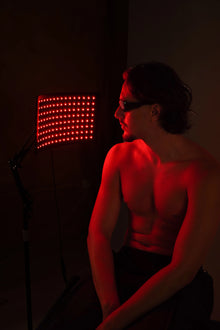
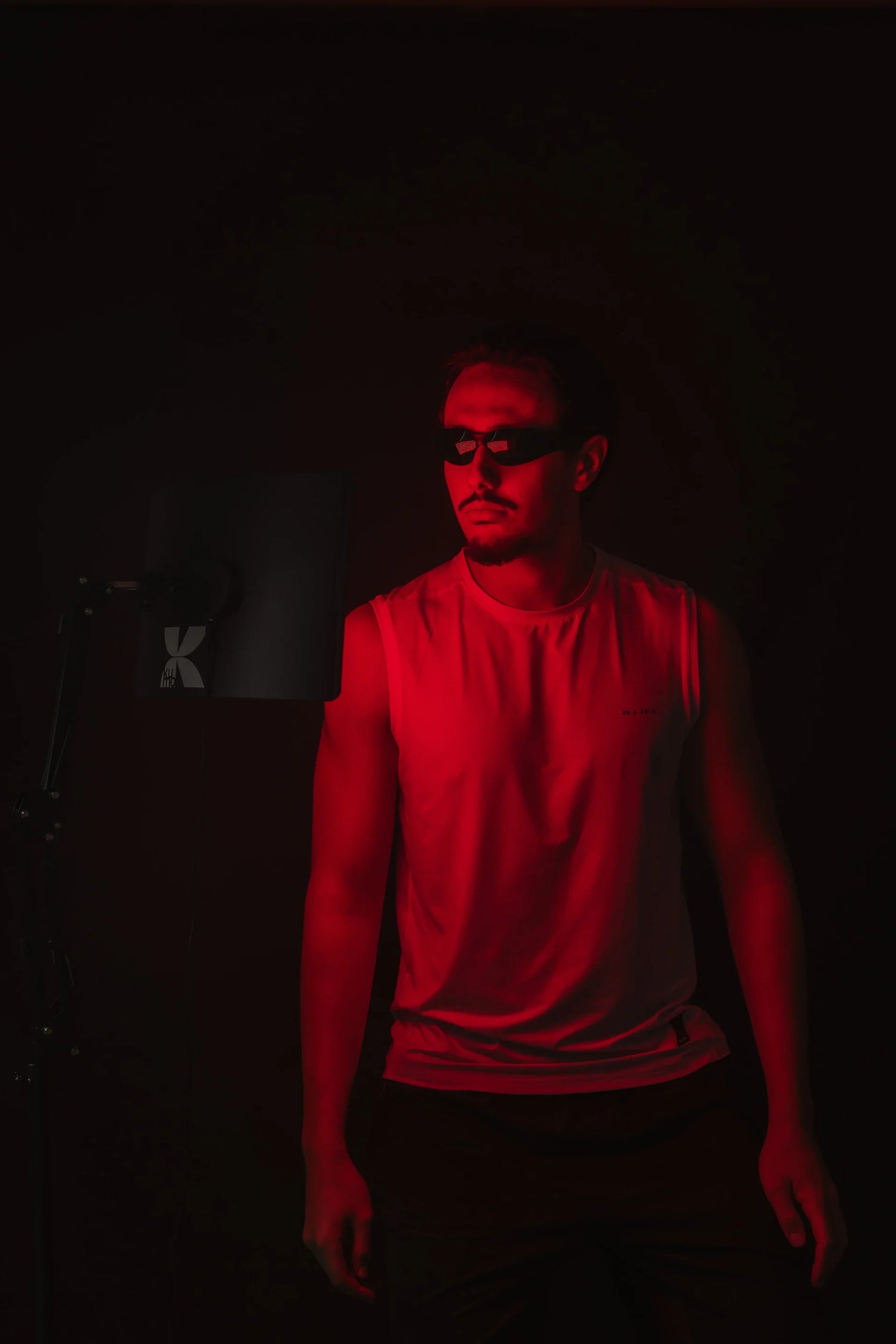
The KumoLux panel supports muscle recovery with full-body red and infrared light.
- 660 nm red + 850 nm infrared light
- Full-body muscle recovery
- Clinically validated biohacking protocols
€399,00€499,00
−10% on your 1st order when you subscribe to the newsletter

What irradiance, fluence, and exposure time mean
The FDA's technical guidance on PBM devices defines irradiance as the power received by a surface per unit area and fluence as the energy received per unit area. It also asks for documentation of wavelength, spot size, output mode, and distance to the tissue, because all those data change the actual dose. The guidance is a draft of recommendations, but it summarizes well what parameters should be read before using equipment.
In other words: irradiance describes the instantaneous “intensity” of the beam, while fluence summarizes the total accumulated energy at the end of the session. An article on radiometry in low-intensity therapy insists that correct measurement and precise terminology are key to interpreting clinical results. (pmc.ncbi.nlm.nih.gov)
Personalized protocol · included with your purchase
Want us to tell you how to use it in your case?
With your purchase, our experts set up your red and infrared light sessions for your sport and goal.
Message us on WhatsAppOur experts reply · no obligation
Key idea: the useful dose does not depend only on adding minutes; power per area, distance to the tissue, and the way the beam is distributed over the surface also matter.
Why there is no universal dose
Photobiomodulation shows a biphasic response: a dose can stimulate, but a larger dose does not always improve the result and, sometimes, it worsens or neutralizes it. Reviews and meta-analyses agree that the combination of wavelength, fluence, power density, pulse mode, and time explains why two similar protocols can produce different effects. (pubmed.ncbi.nlm.nih.gov)
If you want a broader base before adjusting numbers, what red light therapy is and how it works helps you place the concept within photobiomodulation.
on your first order when you join the newsletter
We send you the code instantly. No spam.
The lack of consensus is not just a feeling: a 2026 systematic review on LED photobiomodulation for lower limb wound healing concluded that clinical evidence remains inconsistent and that standardized dosimetry protocols are needed. (pubmed.ncbi.nlm.nih.gov)
How to translate irradiance into actual minutes
Useful formula: fluence (J/cm²) = irradiance (W/cm²) × time (s). If your equipment marks 50 mW/cm², that is equivalent to 0.05 W/cm²; to reach 15 J/cm², 300 seconds are needed, that is, 5 minutes. In pulsed equipment, the duty cycle and average power also influence, so the calculation should not be done only with the number of minutes.
This conversion is practical, but it is not enough to just look at the clock. The beam distribution is not always uniform and irradiance changes with distance and with the device's profile, especially in LED panels. That is why the FDA asks for a description of the treatment distance and how to maintain it during the session.
If you want to translate that theory into a clearer home routine, adjusting distance and time in red light therapy to improve your at-home sessions may be useful.
Quick table for reading your equipment
Before touching the timer, it is advisable to review four parameters together: irradiance, fluence, distance, and illuminated area size. Changing just one can alter the session more than it seems.
Quick dosimetry summary
| Variable | What it is | Why it changes the session | What to look at before using it |
|---|---|---|---|
| Irradiance | Power per unit area, expressed in W/cm² or mW/cm². | Marks the speed of energy delivery to the tissue. | Check the value at the actual distance of use. |
| Fluence | Total energy per unit area, usually in J/cm². | It is the final sum received by the tissue at the end of the session. | Remember that it is calculated by multiplying irradiance by time. |
| Distance | Separation between the source and the treated area. | Affects effective irradiance and beam distribution. | Follow the distance indicated by the manufacturer. |
| Area size | Surface illuminated by the session or “spot”. | Distributes energy and modifies the local dose. | A larger area does not always equal more local intensity. |
| Frequency | Number of sessions per week and total accumulated. | Determines the overall load of the protocol. | Consistency matters as much as a single long session. |
In practice, two pieces of equipment that advertise the same “time” can deliver different doses if the spot, distance, panel uniformity, or pulsed mode change. That is one reason why good measurement is worth more than improvisation.
What guiding ranges appear most in the literature
The correct dose depends on the objective, the tissue, and the type of device. Even so, there are recurring patterns that help avoid basic errors. (pubmed.ncbi.nlm.nih.gov)
In a 2026 systematic review on lower limb wound healing, trials included red emissions of 620-633 nm, infrared of 850-950 nm, and combinations of 625, 660, and 850 nm. This type of heterogeneity explains why wavelength cannot be separated from the clinical objective. (pmc.ncbi.nlm.nih.gov)
- Skin and face: in reviews of cutaneous photobiomodulation, red ranges of 630-660 nm and near-infrared of 830-850 nm frequently appear; in general, longer wavelengths penetrate more than visible red light. If your interest is aesthetic, you should read the complete guide to red light therapy for the skin. (pmc.ncbi.nlm.nih.gov)
- Muscle recovery: the literature also often relies on near-infrared because it facilitates reaching deeper tissues, although the dose still depends on the equipment and protocol. For that approach, the page on red light for muscle recovery fits better. (pubmed.ncbi.nlm.nih.gov)
- Specific clinical example: in a 2024 meta-analysis on depression, the best transcranial improvement was associated with 10-100 J/cm², 50-100 mW/cm², 30 minutes, less than 3 sessions per week, and more than 15 treatments. This data serves as a research reference, not a universal recipe. (pubmed.ncbi.nlm.nih.gov)
The lesson is simple: the therapeutic objective and tissue depth should guide the choice of dose, not just the color of the light or the total ON time.
Common mistakes when adjusting the dose
- Thinking that more minutes are always better. The biphasic response explains why a low or moderate dose can work better than excessive exposure.
- Using a distance different from the intended one without recalculating the session. The FDA asks to document the use distance, and the radiometric literature reminds us that the beam distribution changes with it.
- Confusing irradiance with fluence. The first is power per area; the second is total energy per area. If you do not distinguish between the two, it is easy to make a mistake when adjusting the time.
- Ignoring pulsed mode, duty cycle, and average power. In non-continuous devices, these parameters are also part of the actual dose.
- Overlooking manufacturer warnings. In the FDA's draft guidance, precautions include the use of safety glasses during treatment, as well as warnings about prolonged use, pregnancy, and cancerous lesions.
Frequently asked questions about red light dosage
Is red light dosage safe: how much daily exposure is recommended for optimal results?
There is no universal daily figure. Safety and utility depend on irradiance, distance, the treated area, and what the manufacturer indicates. In research, many protocols use several sessions per week rather than long daily exposure; for example, the 2024 meta-analysis on depression found better results with less than 3 weekly sessions and more than 15 total treatments. Start with the manual and do not automatically compensate high power with more minutes.
Does more irradiance mean better results?
Not necessarily. Photobiomodulation is biphasic: an insufficient dose may not do much, but an excessive dose may cease to provide benefit or even reduce it. Reviews on PBM indicate that the combination of wavelength, power, fluence, and time changes the outcome, so two pieces of equipment with the same color can behave differently. Think of irradiance as an adjustment tool, not an automatic reward for turning it up to maximum.
Does the distance to the panel change the actual dose?
Yes. The FDA explicitly asks to document it, and radiometric literature reminds us that irradiance distribution is not uniform, especially in LED panels. Moving the device closer or further away changes the energy that reaches the tissue, so it is advisable to always use the distance recommended by the manufacturer and maintain it stably during the session. If you do not control the distance, the “same” minute can end up being a different dose.
How do I calculate exposure time from irradiance?
Use the formula fluence = irradiance × time. For example, 50 mW/cm² is 0.05 W/cm²; to accumulate 15 J/cm², you would need 300 seconds, about 5 minutes. It is just a mathematical conversion: the actual value depends on the area, the distance, and whether the equipment emits continuously or pulsed. As a starting point, it works well, but it does not replace the device's specific instructions.
What wavelengths are most used for skin and recovery?
In the literature, red light from 630-660 nm and near-infrared from 830-850 nm appear repeatedly. In general, longer wavelengths tend to penetrate more, which is why near-infrared is widely used when the target is deeper, while visible red light is more associated with superficial targets. The final choice should follow the tissue, the actual power, and the device design.
What now?
If you want to move from theory to a clear routine, start on the Kumo Balance home page. There you can further refine your practice with a more organized approach and, if you want to go deeper, then move towards sessions that are more consistent with your goal and the equipment you use.

Red & infrared light
KumoLux Panel – Red and Infrared LED Panel
★★★★★ 4,8/5 · rated by verified customers
- 660 nm red + 850 nm infrared light
- Full-body muscle recovery
- Clinically validated biohacking protocols
€399,00€499,00· pay in installments with seQura or Klarna