

The correct distance is not singular. It is calculated based on the actual irradiance reaching your skin and the dose you want to receive; therefore, a small panel, one with lenses, and a full-body panel are not used in the same way. In photobiomodulation, irradiance is power per unit area, and the dose is expressed as energy per unit area. (nist.gov)
If the model changes, the point of use also changes. Reviews on PBM emphasize that clinical parameters remain complex and that beam size, working distance, and treated surface influence the outcome, so copying another user's distance is often a mistake. (pubmed.ncbi.nlm.nih.gov)
Red & infrared light
Recover faster, at home
★★★★★ 4,8/5 · rated by verified customers
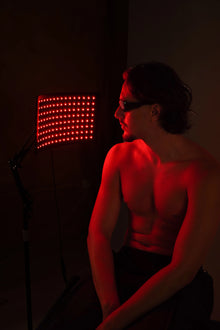
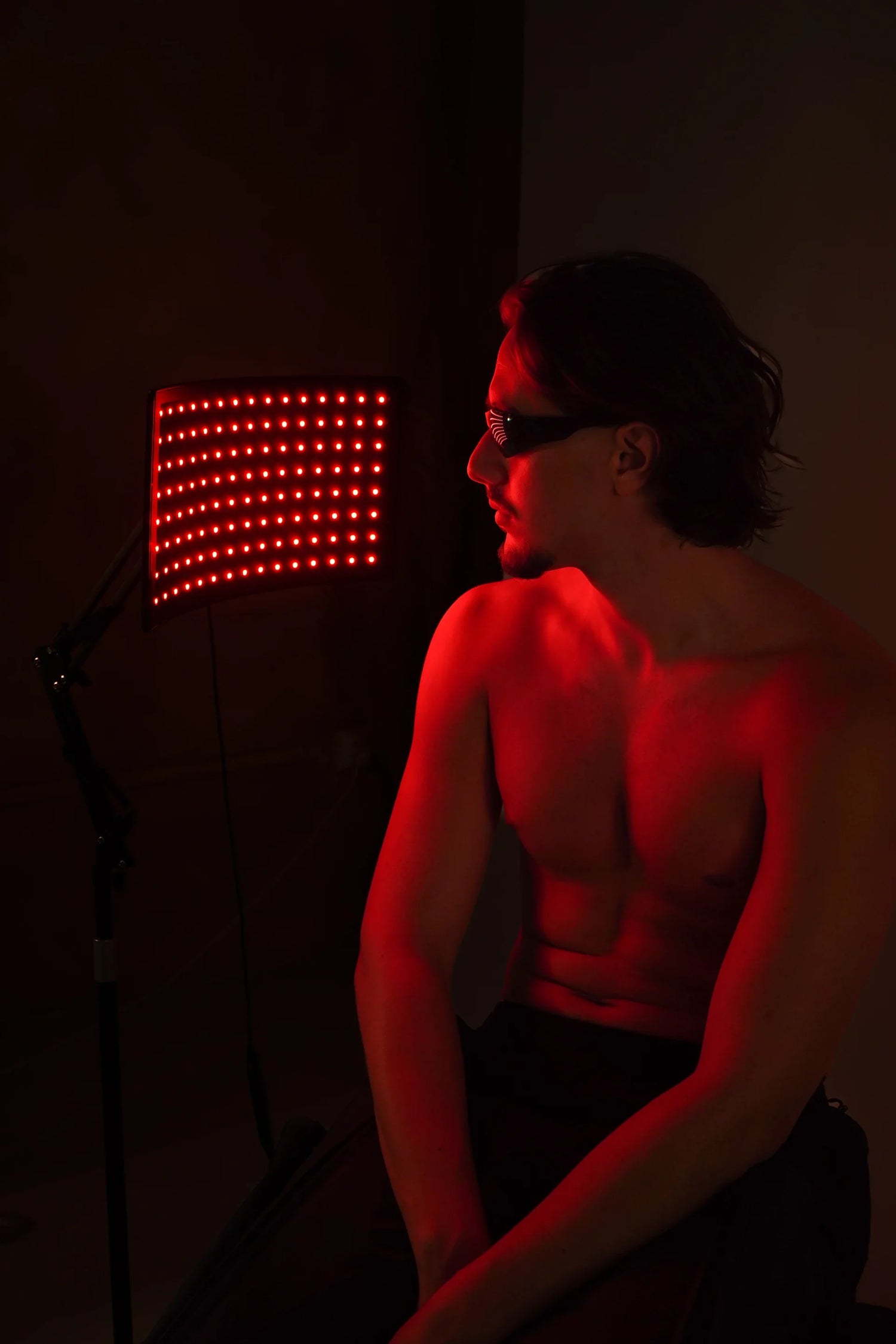
The KumoLux panel supports muscle recovery with full-body red and infrared light.
- 660 nm red + 850 nm infrared light
- Full-body muscle recovery
- Clinically validated biohacking protocols
€399,00€499,00
−10% on your 1st order when you subscribe to the newsletter

What the ideal distance really means
The ideal distance is that which allows you to achieve the target irradiance on the treatment surface. According to the NIST definition of irradiance, we are talking about power per unit area; therefore, simply looking at the total wattage of the equipment is not enough. In PBM, what matters is the energy that actually reaches the skin, not the most striking commercial figure.
To calculate correctly, focus on four pieces of data: actual irradiance, reference distance, beam size, and target dose. A dosimetry analysis in PBM emphasizes that what is important is the irradiance at the treatment surface; furthermore, a review of parameters associates the clinical outcome with spot size, irradiance, radiant exposure, and operator technique. (pmc.ncbi.nlm.nih.gov)
Personalized protocol · included with your purchase
Want us to tell you how to use it in your case?
With your purchase, our experts set up your red and infrared light sessions for your sport and goal.
Message us on WhatsAppOur experts reply · no obligation
- Actual irradiance: this is the power per area that reaches the skin at a specific distance.
- Reference distance: this is the point from which the manufacturer or a serious test measured the panel.
- Beam size: changes how the light is distributed over the treated area.
- Target dose: this is the energy per cm² you want to accumulate in the session.
The practical key is simple: if you don't know what irradiance is reaching the skin, you cannot correctly calculate the distance or the time. Therefore, in PBM, the treatment surface is worth more than the number of LEDs or the nominal power of the equipment.
How to calculate distance and time step by step
The safest way to calculate it is to start from the irradiance at the actual use distance. A dermatological review on LEDs describes uses at a static distance or with small movements, and another dosimetry review insisted on reporting irradiance at the treatment interface, not just at the emitter. (pmc.ncbi.nlm.nih.gov)
- Locate the actual irradiance of the model. Look for the data at the use distance, not just the total power or the number of diodes.
- Define the target dose. The value depends on the use, the area, and the protocol you follow.
- Apply the basic formula. Time = target dose ÷ actual irradiance.
- Check the result in a short session. If the panel forces you to very long times, you are probably too far away or the equipment delivers low useful irradiance.
If you want a practical guide for home, how to adjust distance and time in red light therapy to improve your home sessions arranges these steps without losing sight of the dose.
on your first order when you join the newsletter
We send you the code instantly. No spam.
Key idea: in PBM, distance only makes sense if you know what irradiance actually reaches the skin and what dose you want to accumulate.
As a general reference, PBM literature often works with fluences of 1 to 20 J/cm², and an update on biphasic response mentions irradiances of 5 to 50 mW/cm² as frequent values for stimulation and healing. This does not mean that every case should fall within this range, but it does mean that the dose should be considered before the distance. classic review on biphasic response in low intensity
Quick calculation examples
These numbers use the basic formula and serve to show how time changes when irradiance changes. If irradiance increases, the time needed to reach the same dose decreases.
| Objective | Actual irradiance | Approximate time | Practical reading |
|---|---|---|---|
| 1 J/cm² | 50 mW/cm² | 20 s | Useful as a very short session or as a starting point. |
| 5 J/cm² | 50 mW/cm² | 100 s | Intermediate example to understand the dose-time relationship. |
| 10 J/cm² | 50 mW/cm² | 200 s | Requires more time if you maintain the same distance. |
| 5 J/cm² | 100 mW/cm² | 50 s | By doubling the irradiance, the time is halved. |
How distance changes depending on the model
Not all panels behave the same way. A dermatological review on LEDs describes uses with a static distance of 1 to 20 cm or with slight movements, and a PBM laboratory article shows how the distance is set so that the beam covers the entire target surface. This does not make these numbers a universal rule, but it does demonstrate that the panel's optics dictate the outcome.
Therefore, when reviewing a specific model, it is worthwhile to look for its reference distance and not just its nominal power. In a panel like KumoLux Panel, the interest lies in real-world use on the skin, not in an isolated wattage figure. If you are comparing options, the red light panel buying guide for 2026 helps you critically read irradiance, coverage, and distance. (pubmed.ncbi.nlm.nih.gov)
Common errors that change the dose
The most common mistakes occur when nominal power is confused with actual dose. PBM literature shows that beam divergence, spot size, and technique influence the result, so two panels with the same appearance can behave differently.
- Measuring from the casing instead of the skin: the useful reference is the treated surface.
- Copying the distance from another model: each panel distributes light differently.
- Only looking at wattage: what matters is the irradiance that reaches the area.
- Forgetting the area size: a small area and a large one do not require the same strategy.
If you want to choose better before buying, don't just look at the panel's appearance. Review how irradiance, distance, and useful area are explained; this reading will save you many poorly adjusted sessions.
Safety and tolerance
More is not always better. Photobiomodulation exhibits a biphasic response described in the literature: there is a useful range, and if you exceed it, you can lose effect or fall outside the desired window. Therefore, it is advisable to adjust distance and time as a single system, not as two separate decisions.
For facial sessions or near the eyes, follow the manufacturer's instructions and prioritize eye protection when appropriate; a review on eye safety in light therapy noted that safety in people with alterations or photosensitivity deserves more study. If you want to review best practices, eye safety in red light therapy is a good resource.
If a session forces you to very long times to reach the dose, you are probably too far away or the panel delivers low useful irradiance; if heat or discomfort appears, review distance, time, or angle. The idea is not to feel more, but to dose better.
FAQ about red light panel distance
What is the ideal distance for a red light panel?
There is no universal distance. The correct distance is that which delivers the irradiance you need on the treatment surface for the dose you have chosen. A dermatological review on LEDs describes uses at a static distance, and a PBM review insists that the treatment surface and technique greatly change the outcome. Therefore, the ideal distance is taken from the specific model or validated with actual measurement.
Should I measure from the panel or from the skin?
From the skin, or at least from the surface where the light actually reaches. In PBM dosimetry, reporting the irradiance at the emitter can distort the real value of the session, because light does not behave the same at all distances. If you measure from the casing, it is easy to believe that you are receiving more energy than actually reaches. The useful reference is always the treatment interface.
How do I calculate session time if I know the irradiance?
Use this relationship: time = target dose ÷ actual irradiance. If your panel delivers 50 mW/cm², that is equivalent to 0.05 W/cm²; for 5 J/cm² you need about 100 seconds and for 10 J/cm², about 200 seconds. The formula comes directly from the definitions of irradiance and energy dose, so it is the cleanest way to go from theory to practice.
Is the same distance used for face and body?
Not always. The face, torso, and legs do not have the same surface or target coverage, so the distance may change to achieve useful irradiance without excessively lengthening the session. In LED, the literature describes uses with a fixed distance or with gentle movements, precisely because the treated area greatly influences light delivery. Think first about the area and then about the exact number of centimeters.
What happens if I get too close to the panel?
As you get closer, irradiance usually increases and the time needed to reach the dose decreases. This can be useful, but it also brings you closer to an area where it is easier to overdose or accumulate too much energy in a short time. Since the PBM response is biphasic, proximity does not guarantee better results. If you notice heat, discomfort, or a too intense session, review distance and duration before continuing.
What now?
If you now want to apply all this to a real routine, go back to the Kumo Balance home page to see the complete recovery approach, or check out KumoLux Panel if you are looking for a specific model to start with a clear reference. The logic is always the same: irradiance first, time second, and distance at the service of both.

Red & infrared light
KumoLux Panel – Red and Infrared LED Panel
★★★★★ 4,8/5 · rated by verified customers
- 660 nm red + 850 nm infrared light
- Full-body muscle recovery
- Clinically validated biohacking protocols
€399,00€499,00· pay in installments with seQura or Klarna