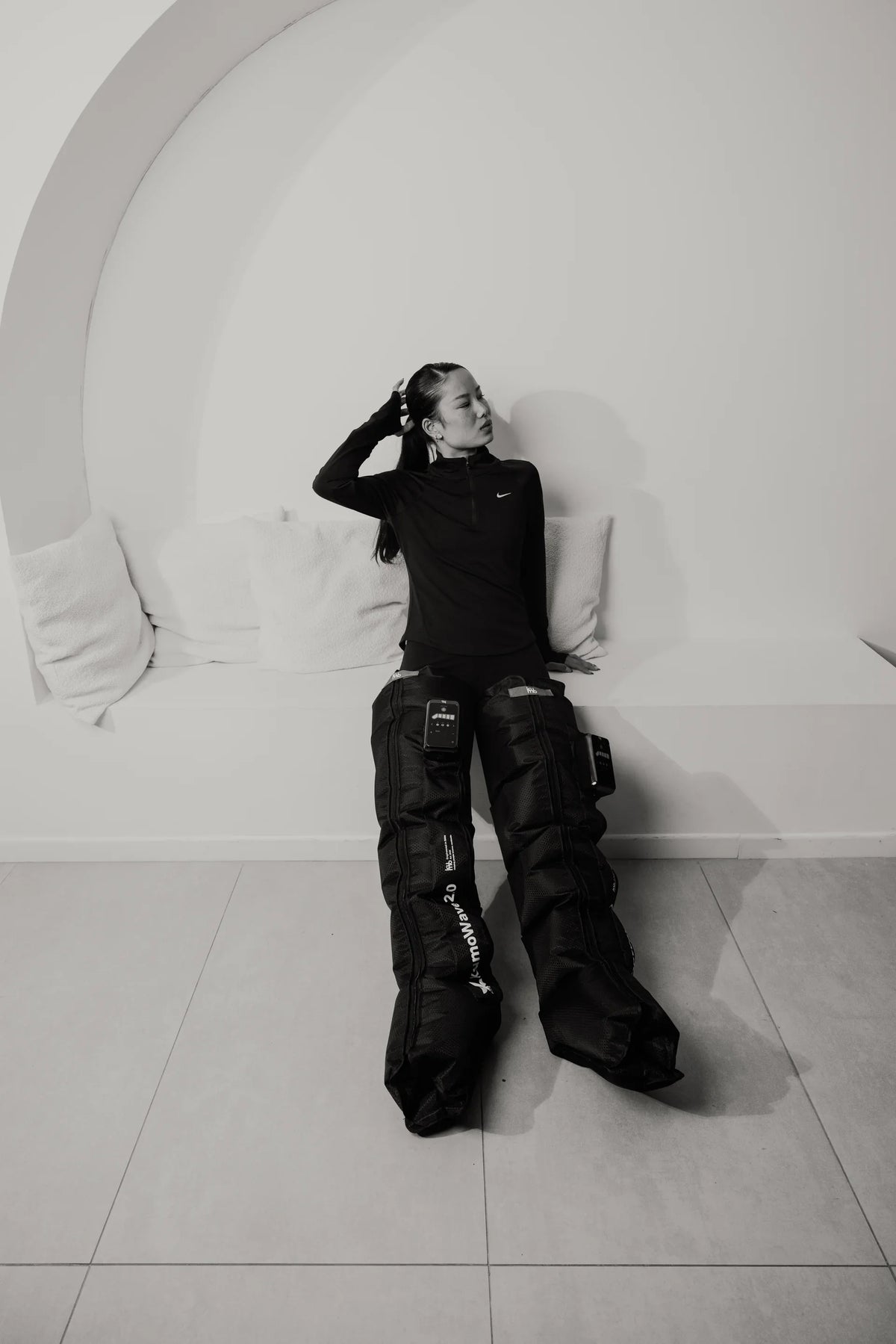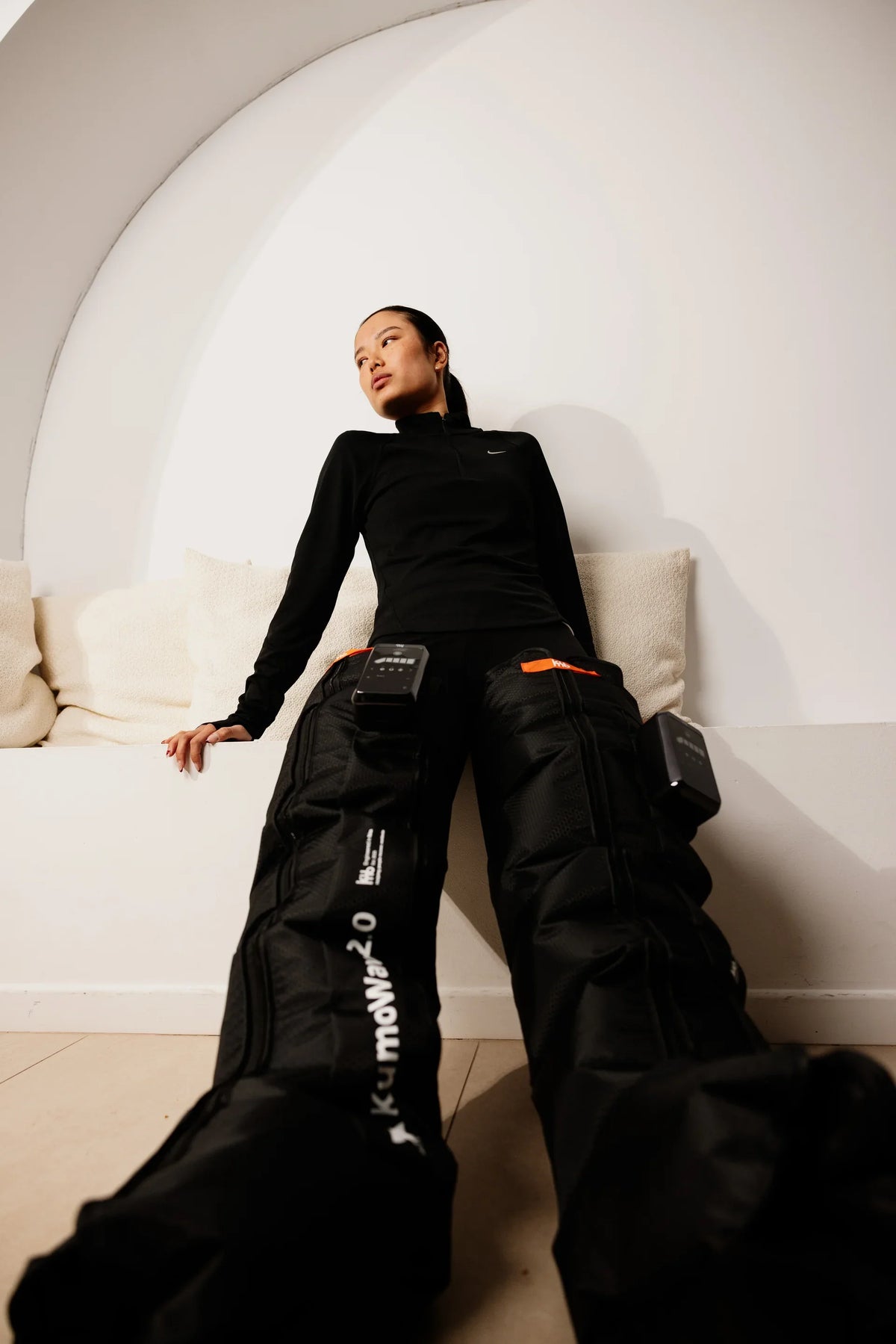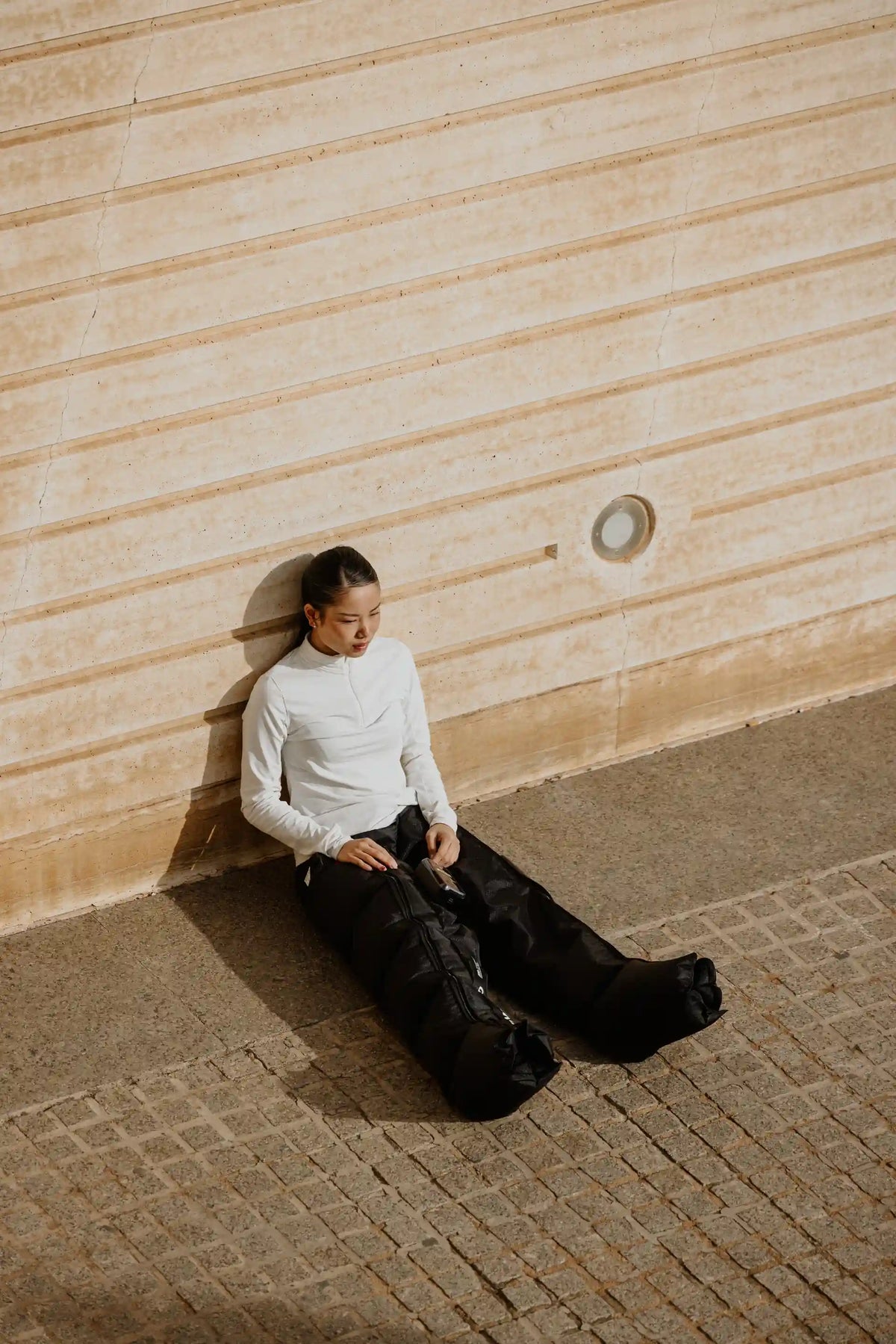
Dance puts a heavy load on the feet, calves and ankles. Jumps, turns, relevés and pointe work repeat the same demand over and over, which is why overload tends to concentrate right there. (sportsmed.org)
A good recovery routine doesn't have to be long to be useful. If it combines mobility, gentle strengthening, balance and a cool-down, it can help you finish a class, a rehearsal or a technique session in better shape. The AAOS and AOSSM guidelines emphasize warming up, unloading and not training through pain. (orthoinfo.aaos.org)
Pressotherapy at home
End the day with light legs
★★★★★ 4,8/5 · rated by verified customers
KumoWave pressotherapy boosts circulation and helps drain fluid with sequential compression, in 20-minute sessions at home.
- Boosts circulation and helps drain fluid
- Chamber-based compression, adjustable to you
- Sequential compression that mimics manual drainage
€799,00€999,00
−10% on your 1st order when you subscribe to the newsletter

Why feet, calves and ankles get so tired in dance
Dance isn't just about aesthetics; it's also a very demanding physical activity. The AOSSM notes that most dance injuries are caused by overuse and tend to appear in the foot, ankle and lower leg. Johns Hopkins adds that dancers concentrate much of their overload in the ankle, foot and lower leg, especially when jumps or sloppy landings are repeated.
The AAP's Spanish-language guide on ballet and dance explains that many styles involve jumping, turning, going up on pointe and rising, and that these actions can be linked to tendinitis, sprains and stress fractures. It also notes that turnout improves with the right exercises, but without forcing the alignment of the knees and feet.
Personalized protocol · included with your purchase
Want us to tell you how to use it in your case?
With your purchase, our experts prepare a personalized usage protocol for your case: sport, circulation, fluid retention, pregnancy or lipedema.
Message us on WhatsAppOur experts reply · no obligation
Step-by-step recovery routine
As a practical reference, the AAOS foot and ankle conditioning program suggests working for 4 to 6 weeks, repeating the exercises 3 to 5 days a week and then keeping up the routine to maintain strength and mobility. Before starting, it recommends warming up for 5 to 10 minutes and avoiding any exercise that causes pain.
1. Start with a cool-down
After dancing, spend a few minutes bringing your heart rate down with easy walking, calm breathing and wide, low-impact movements. The idea is to move from effort to rest without stopping abruptly. The AOSSM stresses that warm-ups and cool-downs are part of prevention, because they help you respect your body's limits and not keep pushing when fatigue has already set in.
2. Restore calf and ankle mobility
Next, work the triceps surae and the ankle with simple stretches. The AAOS suggests the calf stretch with the knee straight, the soleus stretch with the knee bent and the towel stretch, always holding the position for 30 seconds and repeating with control. It also notes that stretching after strengthening helps reduce muscle soreness and maintain range of motion.
on your first order when you join the newsletter
We send you the code instantly. No spam.
3. Add gentle strengthening to support the arch
The foundation of a stable ankle isn't just mobility; it's also strength. The AAOS points out that strengthening the muscles that support the lower leg, foot and ankle helps keep the joint stable, ease discomfort and prevent new overload. Its program includes heel raises, tracing the alphabet with your foot, towel curls and ankle flexion and extension with a resistance band.
4. Work on single-leg balance
Proprioception, meaning the sense of where your body is in space, is key to avoiding collapsing inward or outward when you land or bear weight. HSS recommends exercises such as single-leg balance, toe taps and the airplane for dancers, and the AAOS also includes single-leg stance in its foot and ankle program. If control breaks down, lower the intensity and go back to a simpler version. (hss.edu)
5. Finish with a comfort aid if it feels good
If it works for you, sequential compression can fit in as part of the end of your routine, always as wellness support and never as a substitute for rest, strength or technique. If you'd like a practical reference for use at home, you can take inspiration from this short session for tired feet or from how to use pressotherapy at home step by step. The NHS guide on intermittent pneumatic compression points out that there are clear contraindications, so it's important to always respect them. (wsh.nhs.uk)
Practical outline for a short session
The table below summarizes a simple way to organize your recovery. It's based on the AAOS recommendations on mobility, strength and balance, along with the proprioception exercises HSS describes for dancers.
| Block | Example | Suggested reps | Goal |
|---|---|---|---|
| Mobility | Calf, soleus and towel stretch | 30 seconds, 2 reps per side | Regain range and release tension |
| Strength | Heel raises and ankle flexion with a band | 2 sets of 10 | Better support the arch and ankle |
| Foot | Foot alphabet or towel curls | Daily or as tolerated | Activate the small muscles of the foot |
| Balance | Single-leg stance | Up to 30 seconds, 3 to 5 reps | Improve control and proprioception |
What to avoid so you don't add load
In dance, improving doesn't mean pushing harder. It means moving better, with more control and less compensation. The AOSSM stresses not progressing too fast, listening to your body and keeping proper technique, while the AAP reminds dancers that turnout should come from the hip, not from forcing the knees or shins.
- Don't force turnout if your knee drops inward or your weight-bearing gets disorganized, because alignment should come mainly from the hip.
- Don't move up to pointe before you have enough strength, control, bone maturity and supervision, since doing it too early increases the risk of sprains and other injuries.
- Don't keep dancing through pain, because the AOSSM and AAOS agree that training in pain alters technique and can make overload worse.
- Don't suddenly increase your volume of classes, rehearsals or repetitions, especially if you're coming off several intense days or a long break.
- Don't underestimate footwear or the type of floor, because both affect the load your feet and ankles take.
When to see a professional
Mild muscle soreness after dancing can be normal and, according to Johns Hopkins, usually eases within 24 to 48 hours. What you shouldn't treat as normal is pain that wakes you up at night, shows up when you start an activity, gets worse as you move or makes you compensate. The AAOS also notes that you shouldn't feel pain during an exercise. (hopkinsmedicine.org)
Signs that call for a medical evaluation
- Pain that lasts several days or gets worse with activity instead of better.
- Significant swelling, a feeling of instability or trouble putting weight on your foot normally after a turn or landing.
- Numbness, tingling or clear changes in the way you step.
- Pain at night or pain that forces you to change your technique or the way you walk.
Contraindications for sequential compression
If you're going to use compression boots or devices, always respect the contraindications. The NHS guide on intermittent pneumatic compression advises against using it with untreated deep vein thrombosis, recent thromboembolism, acute skin infection, severe heart, kidney or liver failure, ischemic vascular disease, severe neuropathy and open wounds. It also recommends stopping if you experience sudden chest pain, shortness of breath, sudden numbness or dizziness.
- Don't use sequential compression if you have untreated thrombosis or a known ischemic vascular problem.
- Don't use it if you have an acute skin infection, open wounds or very fragile skin.
- Don't use it without professional review if you have severe heart, kidney or liver failure.
- Stop the session if you notice sudden chest pain, shortness of breath, dizziness or noticeable numbness.
FAQ on dance and ankle stability
When can I start working on pointe?
The Spanish-language AAP guide on ballet and dance explains that age alone isn't enough. The decision depends on several criteria at once, such as bone maturity, strength in the arch, ankle, legs and core, balance, control and proper supervision. It also warns that starting too early increases the risk of sprains, fractures and growth plate injuries. In practice, proper preparation matters more than rushing.
Can I improve my turnout?
Yes, in many cases it can be improved, but with realistic expectations. The same AAP guide notes that hip anatomy sets part of the limit, so not everything can be fixed with stretching. What usually helps most is working on hip mobility and the strength of the surrounding muscles, without compensating with the knees or shins. If turnout isn't well aligned, the body ends up paying the price in the legs and lower back.
How many times a week should I do the routine to improve ankle stability?
As a practical baseline, 3 to 5 days a week is usually a reasonable frequency to work on stability and maintain progress. The AAOS sets its foot and ankle program at 4 to 6 weeks and notes that, after recovery, these exercises can be continued to maintain strength and range of motion. If you're coming back from an injury or a lot of accumulated fatigue, the key isn't doing more, but doing enough and with good technique.
Is it normal to get DOMS when starting an ankle stability routine?
Yes, mild muscle soreness can be normal at first, especially if you rarely worked your calves and feet before. Johns Hopkins explains that after dancing, muscle soreness usually eases within 24 to 48 hours. The important difference lies in how it evolves: DOMS gets better, but pain that wakes you up, increases with activity or forces you to change how you place your foot deserves an evaluation. Good technique should feel worked, not punished.
How long should I keep up a routine to improve ankle stability?
Think in weeks, not a single session. The AAOS proposes a 4- to 6-week program for the foot and ankle, followed by ongoing maintenance. That fits dance very well, because a stable ankle isn't built overnight. The most useful approach is to turn the routine into a short, repeatable and sustainable habit, and come back to it whenever your load of rehearsals or performances goes up.
What's next?
If you want to bring this routine into your everyday life, start with Kumo Balance, browse the at-home pressotherapy collection and use this guide to building an at-home recovery routine as a reference. The idea is simple: take care of your foundation so you can dance with more control and less accumulated load.
KumoWave pressotherapy
Choose your at-home pressotherapy
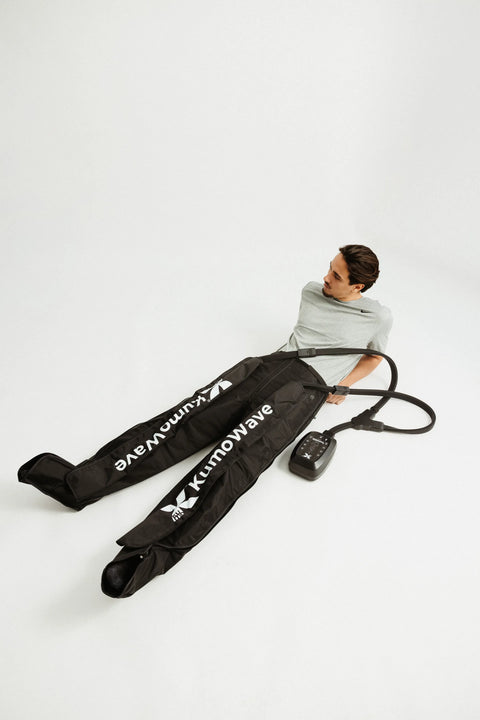
KumoWave Elite – Pressotherapy Pants
Full-coverage trousers. Ideal for lipedema, fluid retention and intensive use.
€799,00 €999,00
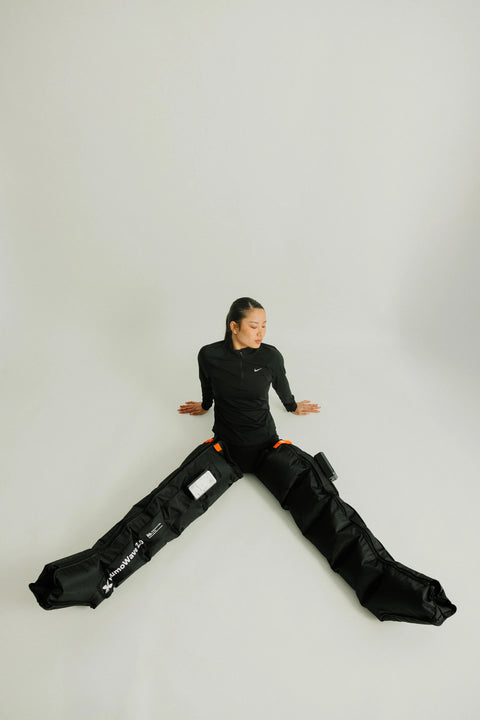
KumoWave 2.0 - Wireless Pressotherapy
Wireless, lightweight boots. Perfect for daily use and recovery.
€499,00 €599,00