


Creatine is not the same in all its forms.
If you want to understand why monohydrate remains the benchmark and how to assess the purity of a product, the key lies in separating the molecule, the manufacturing process, and batch control. In the EU, moreover, only certain claims are authorized and always under specific conditions of use.
Pressotherapy at home
End the day with light legs
★★★★★ 4,8/5 · rated by verified customers
KumoWave pressotherapy boosts circulation and helps drain fluid with sequential compression, in 20-minute sessions at home.
- Boosts circulation and helps drain fluid
- Chamber-based compression, adjustable to you
- Sequential compression that mimics manual drainage
€799,00€999,00
−10% on your 1st order when you subscribe to the newsletter

What types of creatine really exist
When talking about creatine, different concepts are often mixed up. One thing is the chemical form, another is the particle size, and another, very different, is the batch quality. That is why monohydrate, micronized, and other salts do not automatically mean the same thing from the point of view of evidence. (pmc.ncbi.nlm.nih.gov)
- Monohydrate is the reference form, the most studied and the basis of the authorized claims in the European Union. (pmc.ncbi.nlm.nih.gov)
- Micronized creatine is still monohydrate; the particle size changes, not the molecule, and the critical review finds no evidence that it is more bioavailable than standard monohydrate.
- Other forms, such as citrate, malate, or esters, may modify technological properties, but available reviews have not shown a consistent advantage over monohydrate. (pubmed.ncbi.nlm.nih.gov)
If you are also organizing your nutrition around training, it may help you to also review the guide on protein after training and the article on magnesium and muscle recovery.
Personalized protocol · included with your purchase
Want us to tell you how to use it in your case?
With your purchase, our experts prepare a personalized usage protocol for your case: sport, circulation, fluid retention, pregnancy or lipedema.
Message us on WhatsAppOur experts reply · no obligation
Why monohydrate concentrates the evidence
Scientific literature continues to place monohydrate at the center. The International Society of Sports Nutrition describes it as the most extensively studied and clinically effective form of creatine for supplements, especially in the capacity for high-intensity exercise. A systematic review on alternative forms added that, due to the scarcity of studies and the higher cost of many of them, monohydrate remains the best-supported option for the consumer.
Quick table to guide you
| Form | What changes | What the evidence says |
|---|---|---|
| Monohydrate | It is the reference form in research and in the authorized claims of the EU. | It is the form with the most data in humans and the easiest to interpret when looking for purity and traceability. |
| Micronized | Reduces the particle size, but does not change the molecule. | There is no evidence that it increases bioavailability compared to standard monohydrate. |
| Other salts or esters | May vary in solubility or formulation. | Reviews have not shown a consistent superiority in efficacy or safety. (pubmed.ncbi.nlm.nih.gov) |
In summary, the brand name does not replace the quality of the raw material. If a label does not clearly explain what it contains, how it has been analyzed, and by what criteria the batch has been released, the rest matters little.
How to assess the purity of a creatine
Purity is not guessed by marketing. It is checked with documents: certificate of analysis, batch number, manufacturer traceability, and tested contaminants. In the literature and in regulatory evaluations, impurities such as creatinine, dicyandiamide, dihydrotriazine, and, in some cases, heavy metals, have been described, so that analytical quality is not a minor detail.
on your first order when you join the newsletter
We send you the code instantly. No spam.
Practical checklist before buying
- Look for a batch certificate of analysis and not just a generic commercial sheet.
- Check that the purity and the analytical method used to verify it are indicated. (fda.gov)
- Review which impurities have been measured and if the manufacturer reports creatinine, dicyandiamide, or dihydrotriazine. (sciencedirect.com)
- If you compete or are subject to controls, prioritize independent verification of prohibited substances.
If you practice sports with controls, it is advisable to look at third-party programs such as NSF Certified for Sport or Cologne List, because they add a layer of review on prohibited substances and batch by batch.
As a technical reference, some regulatory evaluations have described creatine monohydrate raw materials with purities of 99.9% or higher, and an evaluation cited by the FDA placed a specific raw material at 99.95%. Even so, the percentage only really serves if it is accompanied by traceability and a clear analysis of impurities.
What the EU and AESAN say about creatine
The European Union authorizes two very specific messages. The first is that creatine increases physical performance in successive bouts of short-duration, high-intensity exercise, provided that the daily intake is 3 g. The second is that, in adults over 55 years old, a daily intake of 3 g along with resistance training can reinforce the effect on muscle strength. The regulation itself specifies that this training should be done regularly, several times a week, and for several weeks. You can check it in the EU Register of authorized claims.
In Spain, the Scientific Committee of AESAN considers acceptable maximum daily amounts that provide 3 g of creatine in food supplements for the healthy adult population. That fits with the European framework and helps to understand why, in this context, talking about creatine requires precision with the dose and the recipient of the product. The reference is in the scientific report of AESAN on creatine. (aesan.gob.es)
The legal framework also matters: a food cannot be attributed the prevention, treatment, or cure of diseases, and health claims can only be used under the authorized conditions. (aesan.gob.es)
Safety and profiles where it is advisable to consult
In healthy adults, recent reviews describe creatine monohydrate as generally well tolerated when used within the usual ranges. Even so, caution is advisable if there is pre-existing kidney disease, because the evidence in that group is limited, and also in pregnancy or breastfeeding, where there are no well-designed trials that allow generalizing safety. In children and adolescents, the database is more limited than in adults. (pubmed.ncbi.nlm.nih.gov)
If there is liver or heart disease, or if you take medication regularly, the decision must be individualized with a healthcare professional. And if you get blood tests, remember that creatine can raise serum creatinine without that necessarily implying kidney damage; therefore, the interpretation must be done with clinical context. (pmc.ncbi.nlm.nih.gov)
If you want to put creatine within a broader strategy of habits, it may help you review how to measure your recovery with practical metrics and the keys to recovery and energy to train better.
FAQ
Why is creatine monohydrate the most studied and recommended form in research?
Because it concentrates most of the studies in humans and the review by the International Society of Sports Nutrition describes it as the most extensively studied and clinically effective form. Furthermore, a systematic review on alternative forms concluded that they have not shown to outperform monohydrate and that, due to the scarcity of data, this remains the benchmark. In practice, that means that the decision does not depend on the flashiest name, but on the solidity of the evidence.
How to assess the purity of a creatine monohydrate and what certifications are advisable to look for?
Start with the batch certificate of analysis, the declared purity, the manufacturer traceability, and the analyzed contaminants. If you do sports with controls, prioritize third-party programs that verify prohibited substances, such as NSF Certified for Sport or Cologne List. The literature has also described impurities in poorly controlled raw materials, so the paper and the batch matter as much as the percentage of purity. If something is not documented, it is better to distrust the label than the figure.
What other forms of creatine exist and how do they differ from monohydrate?
Micronized is the same molecule with smaller particles, so it changes the texture or the mixture, not the chemical essence. Other forms, such as citrate, malate, or esters, may modify solubility or composition, but available reviews have not shown a consistent advantage over monohydrate in efficacy, safety, or creatine retention. That is why, before letting yourself be carried away by a new name, it is advisable to look at what real human evidence supports that specific form.
Is creatine suitable for everyone?
No. This information is general and does not replace a professional assessment. Creatine is aimed at healthy adults under specific conditions and, in pregnancy, breastfeeding, childhood, adolescence, pre-existing kidney disease, or ongoing treatments, the evidence is limited or requires caution. It is also advisable to review the case if there is liver or heart disease. In case of doubt, consult a doctor or a pharmacist, and if you get blood tests remember that creatine can alter serum creatinine without equaling kidney damage by itself. (pubmed.ncbi.nlm.nih.gov)
And now what?
If you want to continue refining your recovery strategy, start with the keys to recovery and energy to train better and return to the Kumo Balance home page to continue exploring the content from a single base.
KumoWave pressotherapy
Choose your at-home pressotherapy

KumoWave Elite X – Pressotherapy Pants
Full-coverage trousers. Ideal for lipedema, fluid retention and intensive use.
€799,00 €999,00

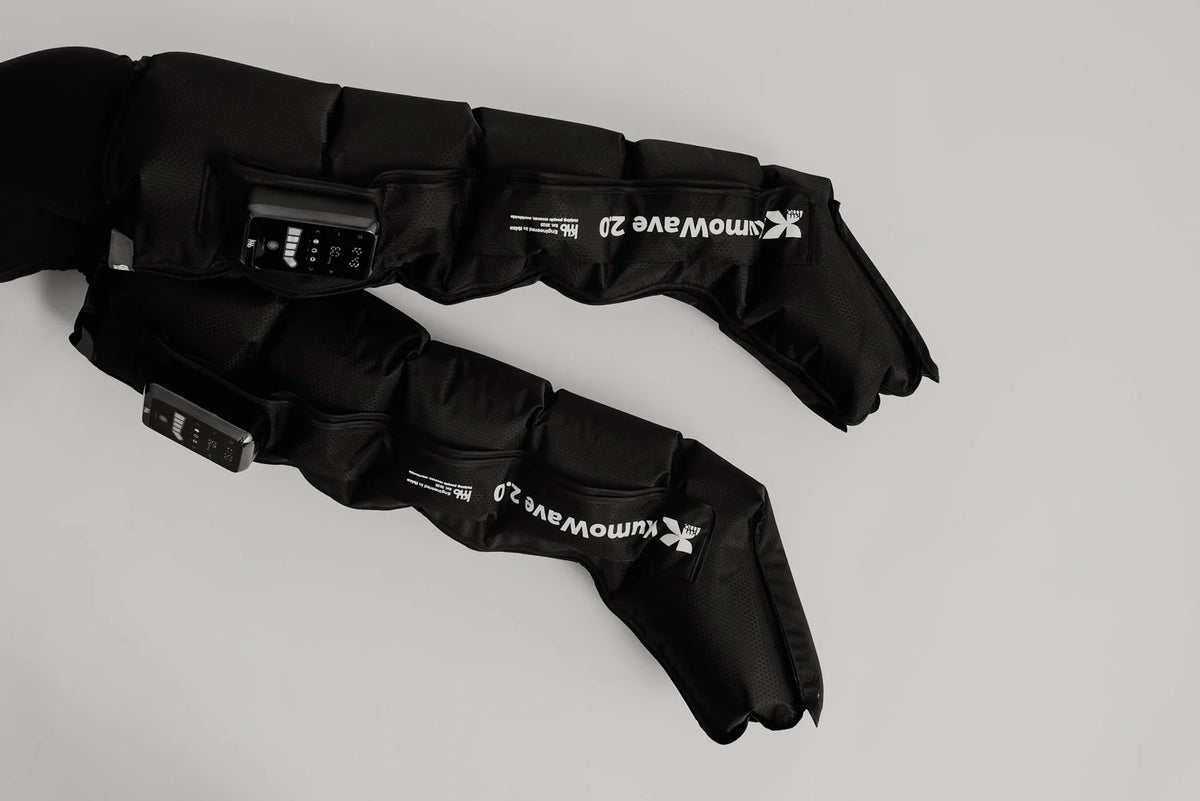
KumoWave 2.0 - Wireless Pressotherapy
Wireless, lightweight boots. Perfect for daily use and recovery.
€499,00 €599,00