

Proper recovery begins the moment you cross the finish line.
After a marathon or half marathon, your body needs a few days to reduce impact, rehydrate, and repair muscle tissue. This is not the time to improvise or run again out of pride. Mayo Clinic Orthopedics & Sports Medicine describes a marathon as a supramaximal effort and recommends a one to two-week break from running, with low-impact activities until you feel good again.
Pressotherapy at home
End the day with light legs
★★★★★ 4,8/5 · rated by verified customers
KumoWave pressotherapy boosts circulation and helps drain fluid with sequential compression, in 20-minute sessions at home.
- Boosts circulation and helps drain fluid
- Chamber-based compression, adjustable to you
- Sequential compression that mimics manual drainage
€799,00€999,00
−10% on your 1st order when you subscribe to the newsletter

If the race was a half marathon, the logic is the same: the goal is still to sleep, eat, hydrate, and listen for any signs of acute pain, swelling, or instability before increasing intensity.
What happens to your body after a long run
The feeling of "being broken" is no exaggeration: after a long event, there can be microscopic muscle damage, dehydration, and a temporary decrease in immune response. ASICS notes that inflammation markers can remain present for several days and that dehydration at the finish is often real; Mayo adds that susceptibility to infections can increase for up to four weeks. You can review this overview in the Mayo Clinic Orthopedics & Sports Medicine recovery guide.
Personalized protocol · included with your purchase
Want us to tell you how to use it in your case?
With your purchase, our experts prepare a personalized usage protocol for your case: sport, circulation, fluid retention, pregnancy or lipedema.
Message us on WhatsAppOur experts reply · no obligation
Therefore, the following days should not focus on "logging workouts," but on restoring energy, fluids, and sleep, and on getting back to moving without punishing impact.
Phased recovery plan
Practical summary of the first 7 days
| Phase | Goal | What to do |
|---|---|---|
| 0–6 hours | Rehydrate and replenish energy | Walk for a few minutes, change wet clothes, and eat carbohydrates with protein in a tolerable meal. (caf.com) |
| Day 1 | Relative rest | Avoid running, sleep as much as possible, and prioritize a complete meal with protein, carbohydrates, and easy-to-digest foods. |
| Days 2–3 | Active recovery | Try walking, very gentle cycling, elliptical, or water exercises if they don't increase pain. |
| Days 4–7 | Assess return to jogging | If there is no acute pain or swelling, return with fewer miles and an easy pace. If anything worsens, wait. |
This outline is useful for both marathon and half marathon: the magnitude of the effort changes, but not the logic of recovery. If a phase leaves you more tired, take a step back.
Eat and drink for better repair
Recovery improves when you respect two things: energy and fluids. The joint position of the Academy of Nutrition and Dietetics, Dietitians of Canada, and ACSM on nutrition and performance and the ACSM position on fluid replacement agree that exercise and its recovery benefit from a well-chosen eating and hydration strategy. (pubmed.ncbi.nlm.nih.gov)
on your first order when you join the newsletter
We send you the code instantly. No spam.
CAF summarizes the most delicate moment well: in the first 1–2 hours post-finish, it is advisable to combine carbohydrates and proteins, and in the following 24–72 hours, prioritize meals with quality carbohydrates, complete proteins, healthy fats, and micronutrient-rich foods. You can see this in their pre and post-marathon nutrition guide. (caf.com)
In practice, this translates into simple and tolerable options: yogurt with fruit and oats, rice with egg or chicken, a smoothie with fruit and protein, or a complete meal with bread, pasta, or potato if you can handle solid food better. The key is not perfection, but starting early and repeating well throughout the day. (caf.com)
To hydrate, sip water over several hours instead of trying to "recover everything" at once; ASICS reminds that a simple indicator is urine color, and that a dark tone suggests dehydration. Their practical approach appears in the ASICS marathon recovery guide.
Active rest and progressive return
If you're wondering whether to move or stay still, the helpful answer is "move little and better." Mayo Clinic recommends walking, cycling, elliptical, and water exercises during the week after a marathon because they reduce impact, maintain blood flow, and help reduce stiffness.
If a visual structure helps you, you can rely on a weekly home recovery protocol and, if you already use compression, review the guide on presotherapy for marathon the week before and after to better organize your sessions.
ASICS agrees that the return should be progressive, with fewer miles and an easier pace; the idea is to go out and test sensations, not prove anything.
Sleep and nighttime recovery
Sleep is a recovery tool as important as food. The CDC indicates that adults need at least 7 hours per night, and after a long run, it's worth protecting that window as part of the recovery plan. (cdc.gov)
If adrenaline keeps you restless, try dimming the lights, eating something light, and repeating a simple routine. If a quieter night works for you, you might also find the reading on red light and relaxation to recover better at night useful to turn that moment into an easy-to-maintain habit.
Warning signs: when not to push it
Normal muscle soreness usually improves gradually. However, Mayo Clinic insists on not confusing these signs with "race pain": acute pain in a joint or muscle, visible swelling, limping, feeling of instability, numbness, or loss of mobility.
- Consult if the pain does not improve and forces you to change your gait.
- Consult if you notice clear inflammation or unexpected bruising.
- Consult if tingling, numbness, or a feeling of joint "failure" appears.
- Consult if the pain persists for more than three days or increases when you try to run again.
When one of these signs appears, the priority shifts from the clock to proper evaluation.
FAQ
How long does it take to recover from a marathon?
It depends on the person, but a prudent reference is to assume that the body needs at least several days to return to normal. Mayo Clinic explains that a one to two-week break from running can be beneficial and that the return should be gradual, with fewer miles and an easy pace. That doesn't mean being immobile, but rather replacing running with low-impact activity, sleep, and sufficient food. If you continue to have localized pain, swelling, or instability, do not treat it as a simple passing discomfort.
What do I do right after finishing a long run?
The most useful thing is simple: keep walking for a few minutes, change your wet clothes, sip water, and eat something you tolerate well with carbohydrates and protein. ASICS and CAF agree that the first few hours are very important for rehydrating and replenishing energy; a perfect meal is not necessary, but a possible meal. If your stomach is upset, start with liquids, fruit, yogurt, or a light snack, and save larger meals for when the euphoria and fatigue subside. (caf.com)
Is it good to walk after a marathon?
Yes, as long as it's a gentle walk. Mayo Clinic recommends maintaining some low-impact movement because it helps maintain blood flow, reduces stiffness, and takes some of the impact stress off running. Walking is not "training"; it's recovery. If you notice that walking increases your pain or makes you limp, it's advisable to stop and lower your activity level even further. The idea is to finish the walk feeling a little better than when you started, not more fatigued.
What to eat after a marathon or half marathon?
In the first 1–2 hours, the most practical thing is to combine carbohydrates and protein; then, for one or two days, it is advisable to maintain complete meals with quality carbohydrates, sufficient protein, fruit, vegetables, and healthy fats. CAF provides a very clear guideline for that first window, and ACSM supports that a good nutritional strategy improves recovery. Simple examples: yogurt with fruit, rice with egg or chicken, pasta with a mild protein, or a smoothie with oats and protein if you tolerate liquids better. (caf.com)
When can I start running again after a marathon?
If all goes well and there is no acute pain, Mayo Clinic speaks of a one to two-week break as beneficial, while ASICS proposes returning with fewer miles and an easier pace. In practice, the return should be a short, comfortable, and unpretentious test run, not a full workout. If joint pain, limping, swelling, or a feeling of instability appears, wait longer and seek assessment. Returning too early is usually more costly than resting a little longer.
What now?
If you want to turn recovery into a simple and consistent routine, start on the Kumo Balance homepage, review the home pressotherapy collection and, if you are looking for a specific option for your recovery space, also check out KumoWave 2.0 Wireless Pressotherapy.
KumoWave pressotherapy
Choose your at-home pressotherapy
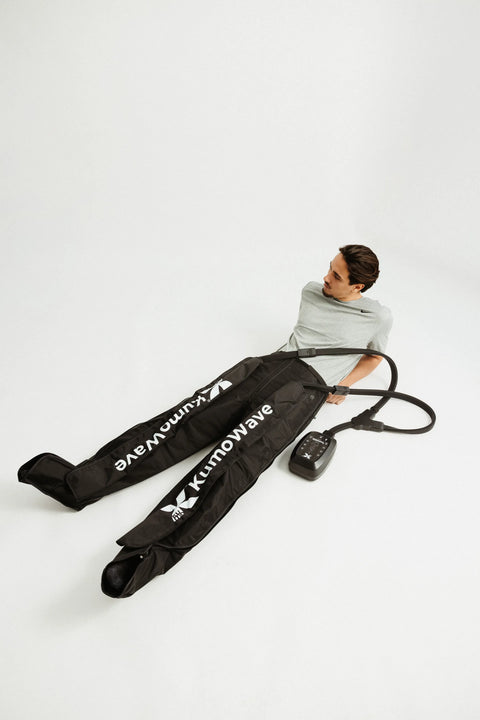
KumoWave Elite – Pressotherapy Pants
Full-coverage trousers. Ideal for lipedema, fluid retention and intensive use.
€799,00 €999,00
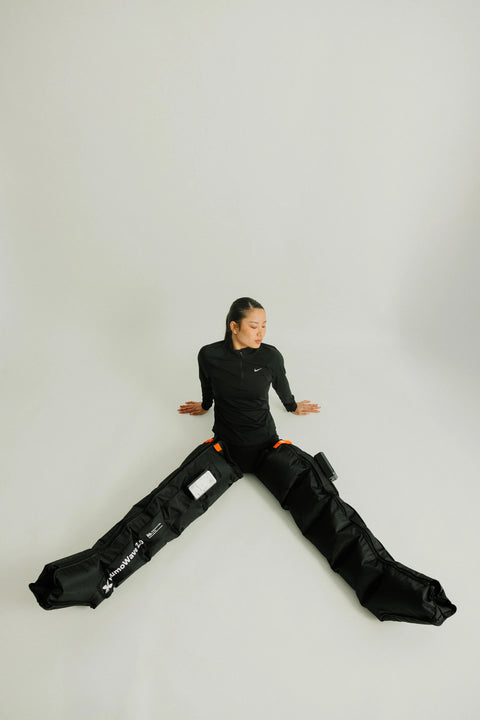
KumoWave 2.0 - Wireless Pressotherapy
Wireless, lightweight boots. Perfect for daily use and recovery.
€499,00 €599,00