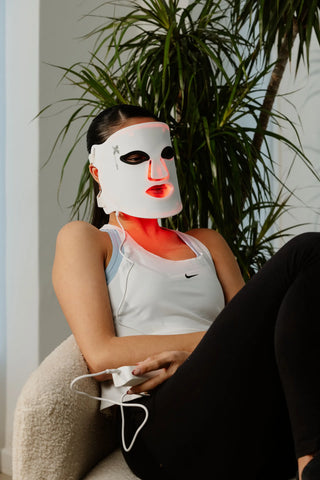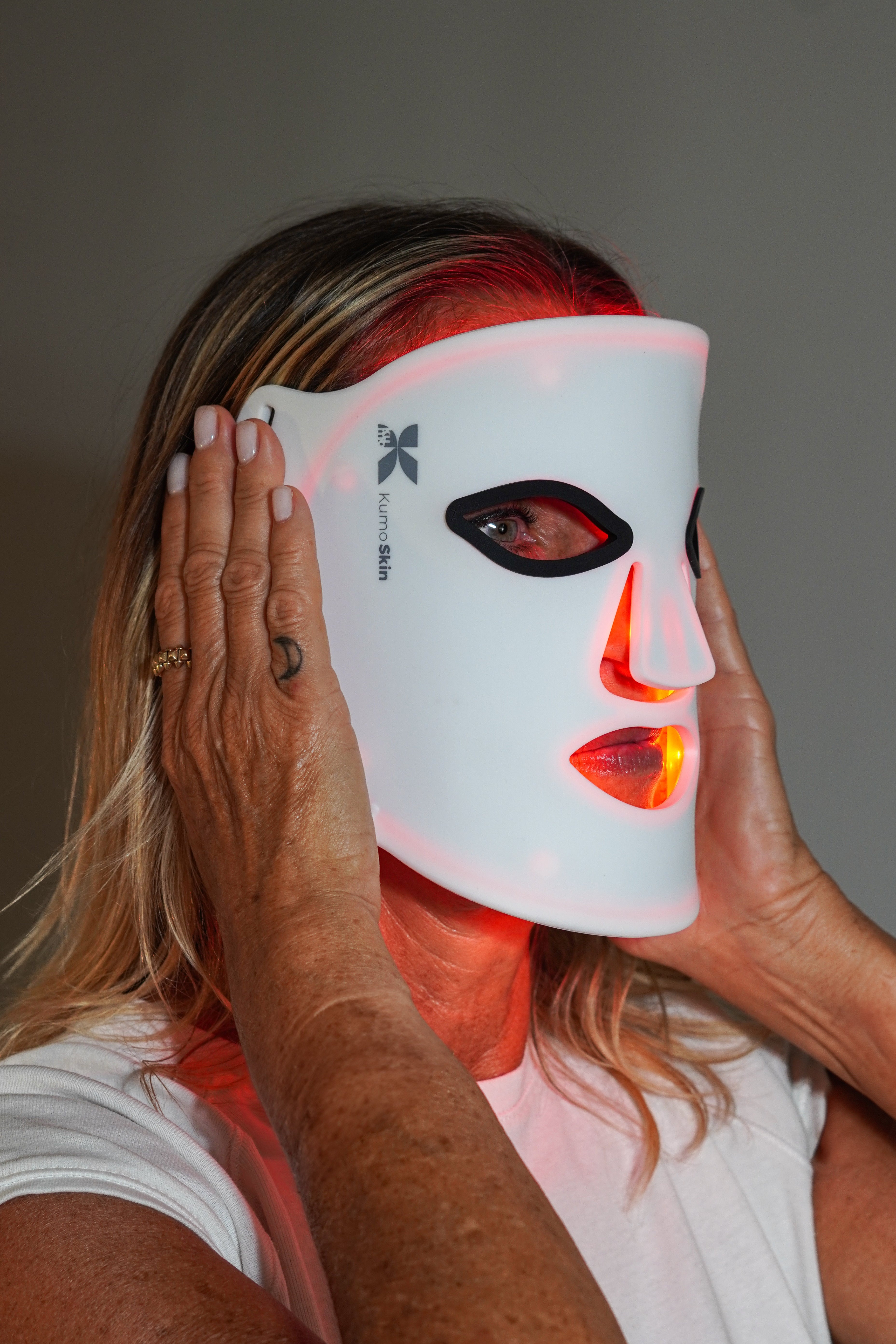

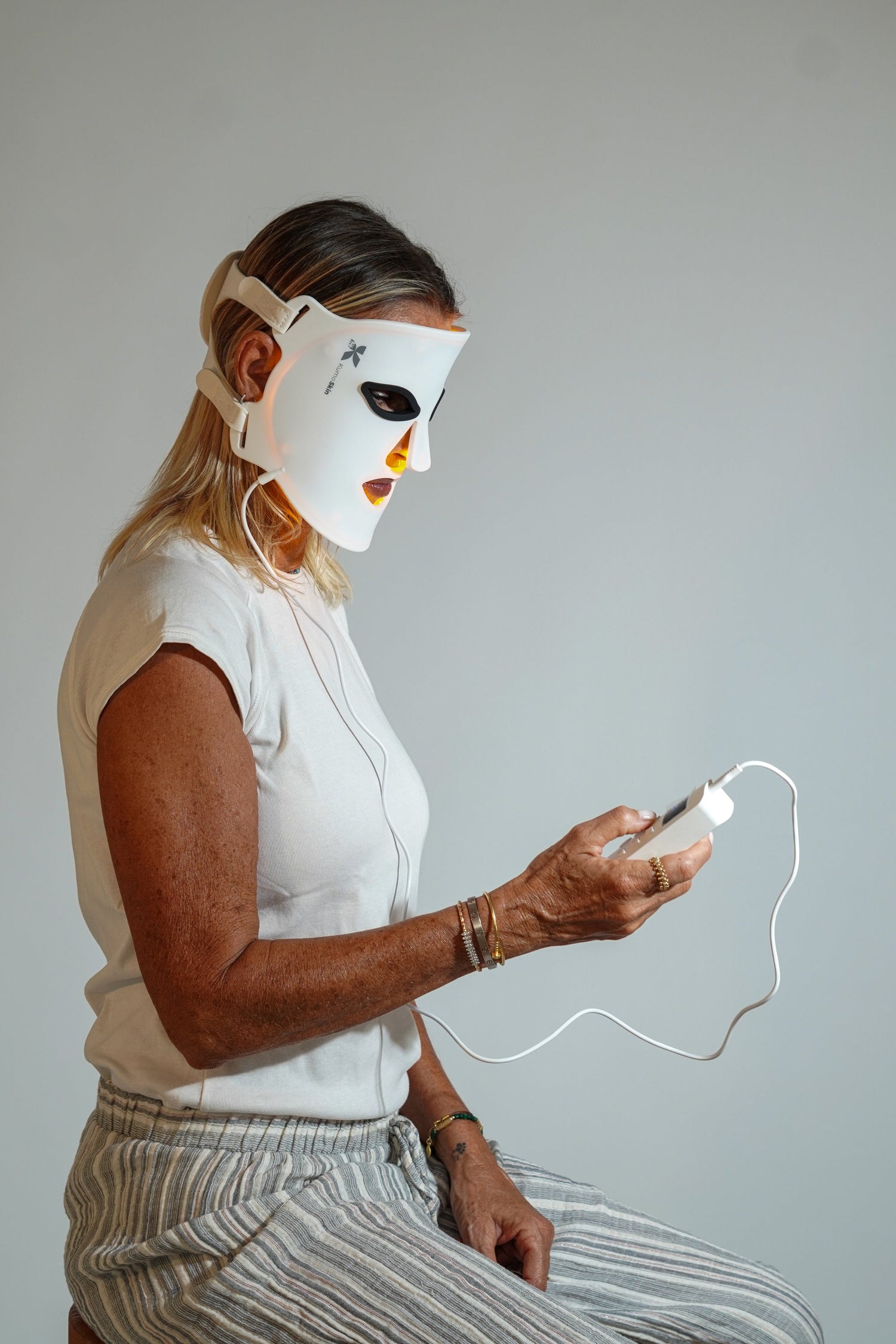
The LED facial mask can transform your skin.
But not all skin types improve equally or with the same lighting settings: understanding these differences is key to getting the most out of it.
In this article, you'll learn which skin type benefits most from an LED facial mask , which light colors work best in each case, how to adjust the frequency of use, and what precautions to take if your skin is sensitive, has rosacea, or blemishes. All of this is based on available evidence and without unrealistic promises.
Red & infrared light
Recover faster, at home
★★★★★ 4,8/5 · rated by verified customers
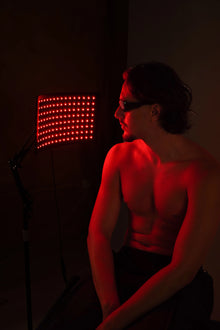
The KumoLux panel supports muscle recovery with full-body red and infrared light.
- 660 nm red + 850 nm infrared light
- Full-body muscle recovery
- Clinically validated biohacking protocols
€399,00€499,00
−10% on your 1st order when you subscribe to the newsletter

How does an LED facial mask work on the skin?
LED facial masks emit light of different wavelengths (usually blue, red, and sometimes near-infrared). This light does not "burn" or exfoliate: it's called photobiomodulation , meaning small light stimuli that modify the activity of skin cells. ( en.wikipedia.org )
In broad terms:
Personalized protocol · included with your purchase
Want us to tell you how to use it in your case?
With your purchase, our experts set up your red and infrared light sessions for your sport and goal.
Message us on WhatsAppOur experts reply · no obligation
- Blue light (~415 nm) :
- It helps reduce the amount of Cutibacterium acnes , the bacteria associated with acne.
- It penetrates superficially, so it focuses on inflamed pimples and excess sebum. ( aad.org )
- Red light (~630–660 nm) :
- It is associated with stimulation of fibroblasts and collagen synthesis , useful in aged skin or skin with irregular texture.
- It has a mild anti-inflammatory effect, which can soothe redness and promote repair. (acne.org)
- Near-infrared light (~800–850 nm) :
- It reaches deeper, supporting tissue repair and recovery processes.
- It generates a bit more heat, so it should be used with caution on very reactive skin.
The key isn't just "what light you use," but how often, for how long, and on what type of skin . The right combination makes all the difference in the results.
It is worth remembering that, according to systematic reviews, the evidence on light devices (including LEDs) is promising but still limited in quality, especially in the long term. ( pubmed.ncbi.nlm.nih.gov )
Skin types and response to the LED facial mask
Oily and acne-prone skin: one of the biggest beneficiaries
It is probably the skin type that most clearly improves with a well-used LED mask, especially when combining blue and red light.
on your first order when you join the newsletter
We send you the code instantly. No spam.
Why does it respond so well?
- Blue light helps reduce the population of bacteria involved in inflammatory acne. ( aad.org )
- Red light reduces inflammation and may speed up the repair of pimples. (acne.org)
Trials using blue and red light have shown notable reductions in mild to moderate inflammatory acne lesions after several weeks of consistent use (in the clinic and at home). ( pubmed.ncbi.nlm.nih.gov )
Typical benefits for oily skin/mild to moderate acne:
- Fewer active inflammatory outbreaks (pustules, papules).
- Pimples that heal faster.
- Visual reduction of post-inflammatory redness in the medium term.
- Less need to "aggress" the skin with highly irritating treatments.
General recommendations:
- Prioritize blue + red light .
- Indicative frequency:
- 3–5 times per week for 8–12 weeks, then maintenance (1–3 times per week), as tolerated.
- Always combine with a gentle routine (non-aggressive cleansing, light moisturizer, sun protection).
If acne is severe, cystic, or scars quickly , the LED mask should only be considered a complement to, and not a substitute for, medical treatment.
Dry or dehydrated skin: support for repair and barrier
Dry skin does not usually need as much antibacterial action, but rather to improve texture, repair and comfort .
How does an LED facial mask help this skin type?
- Red light promotes collagen regeneration and synthesis, which can improve the appearance of fine lines and the feeling of tightness over time. ( en.wikipedia.org )
- Near-infrared light , if present and well tolerated, can support deep tissue recovery.
Changes that people with dry skin often notice:
- Skin that looks visually "plumper" and juicier.
- Less visible flaking (when combined with good hydration).
- Skin feels more resistant to external aggressions.
Usage tips:
- Prioritize red light (and optional infrared) .
- Reduce frequency if skin becomes red or irritated.
- Always apply a nourishing moisturizer after use.
Mature skin: firmness, fine wrinkles and dull tone
Mature skin (with fine lines, loss of firmness, uneven texture) is another great candidate to benefit from the LED facial mask.
Studies on photobiomodulation with red light have shown improvements in fine wrinkles, skin elasticity and smoothness , associated with changes in collagen and microcirculation, especially after several weeks of repeated treatment. (acne.org)
Expected benefits:
- Progressive smoothing of fine lines.
- Better overall tone, brighter and more uniform.
- Feeling of firmer and more elastic skin.
Typical configuration:
- Red light as the main feature (sometimes combined with infrared).
- Sessions of 10–20 minutes, 3–5 times per week, for at least 8–12 weeks.
We are not talking about a surgical "lifting effect", but about a gradual and realistic improvement in skin quality .
Sensitive skin and rosacea: possible improvement, but with great caution.
The priority here is to reduce inflammation without causing outbreaks .
Some people with mild rosacea report improvement in baseline redness with low-intensity red light, while others experience increased flushing if the dose or heat is too high. The scientific literature recognizes the anti-inflammatory potential of photobiomodulation but emphasizes that the parameters (power, time, wavelength) are critical. ( pubmed.ncbi.nlm.nih.gov )
Potential benefits:
- Less baseline redness over time (in selected cases).
- Skin is less reactive if gentle and consistent parameters are used.
Potential risks:
- Temporary increase in redness or heat in the face.
- Outbreaks may worsen if too much intensity or very long sessions are used.
How to proceed if you have sensitive skin or rosacea:
- Consult your dermatologist first.
- Do a test in a small area and for short periods of time.
-
Start with:
- Only red light , avoiding infrared if you feel very hot.
- 2–3 minutes, 2–3 times per week, and gradually increase if well tolerated.
For highly reactive skin, the question isn't "what type of skin improves the most?", but rather "to what extent does my skin tolerate LED light?" . Safety always comes first.
Combination skin: balance between oily and dry areas
Combination skin combines the worst of both worlds: shine and enlarged pores in the T-zone , and drier or more sensitive cheeks.
In this case, the LED face mask can be used in the following ways:
- Global (especially with red light, well tolerated)
- Or localized , adapting the color and frequency:
- Oily T-zone with breakouts → more blue + red light .
- Dry or sensitized cheeks → red light only, less frequently.
The improvement is usually seen in:
- Fewer grains in the T zone.
- More homogeneous overall tone.
- Less contrast between oily and dull areas.
Skin with blemishes and hyperpigmentation: complementary, not primary treatment
LED light is not a powerful depigmenting treatment like a specific laser or a medical peel, but it could help improve skin tone when combined with other treatments.
Some clinical protocols use red light, and occasionally green or yellow light, to help even out skin tone, thanks to their effect on inflammation and skin regeneration. ( dermatologytimes.com )
What you can realistically expect:
- Skin with a more even and luminous appearance .
- Spots that appear somewhat less marked as the texture and underlying inflammation improve.
What you should NOT expect from the mask alone:
- Erase intense melasma or marked solar lentigines.
- Replace prescribed sunscreens or depigmenting treatments.
In cases of melasma or persistent spots, a dermatological consultation is essential.
So, what type of skin benefits most from an LED facial mask?
Summarizing the available evidence and clinical experience:
-
Oily skin with mild to moderate acne
- It usually shows the best visible improvements (fewer inflammatory pimples, less associated redness), provided it is used consistently and combined with a suitable routine. ( aad.org ) -
Mature skin with signs of aging
- It provides clear benefits in texture, radiance, and fine lines , especially under red light. (acne.org) -
Dry/dehydrated skin without active pathology
- Improved comfort, surface appearance and barrier, especially when accompanied by good hydration. -
Combination skin
- Combined improvement (fewer sprouts in zone T, better overall texture), provided that the strategy is adapted by zones. -
Sensitive skin or skin with rosacea
- It can improve, but not always ; it requires supervision and an ultra-gradual approach.
Rather than looking for an "absolute winner", the smart thing to do is to adapt color, frequency and duration to the behavior of your skin .
Comparative table: benefits according to skin type
Table: Typical response of each skin type to the LED facial mask
| Skin type | Most commonly used light colors | Most frequent benefits | Key precautions |
|---|---|---|---|
| Oily skin / mild-to-moderate acne | Blue + red | Fewer inflamed pimples, less redness, faster recovery | It does not replace medical treatment for severe acne. |
| Dry / dehydrated | Red (+/- infrared) | Suppler skin, less visible flaking, smoother texture | Avoid very long sessions if you feel heat or tightness |
| Mature (wrinkles, sagging) | Red (+/- infrared) | Improvement of fine lines, luminosity, overall firmness | Gradual results; demand consistency |
| Mixed | Blue + red (T zone), red rest | Fewer T-zone sprouts, more even tone, more balanced texture | Adjust intensity on cheeks if they are sensitive. |
| Sensitive / rosacea | Soft red (sometimes just red) | Possible reduction of baseline redness in some cases | Start with minimal time, avoid excessive heat, medical supervision is required. |
| With spots / hyperpigmentation | Red (+ other colors depending on the team) | A slightly more even tone, brighter skin, and an overall improved surface appearance. | It does not replace depigmenting treatments or sun protection |
How to use your LED face mask according to your skin type
Basic steps valid for everyone
-
Gentle cleaning
- Clean and dry face, without makeup or sunscreens. -
No aggressive assets right before
- Avoid using acids, retinoids, or chemical exfoliants immediately before the session to reduce the risk of irritation. -
LED Session
- Follow the time recommended by the manufacturer (usually between 10 and 20 minutes). -
Hydration and protection
- Next, apply a moisturizer suitable for your skin type.
- During the day, always use broad-spectrum sunscreen .
In KUMO's LED light therapy collection you will find devices designed to be integrated into overall care and recovery routines, prioritizing comfort and consistency.
Adjustments by skin type (illustrative examples)
- Oily skin with mild-to-moderate acne
- 3–5 sessions/week, alternating blue+red.
- Subsequent maintenance: 1–3 sessions/week.
- Mature skin
- 4–5 red light sessions/week.
- Combine with antioxidant care and daily photoprotection.
- Dry skin
- 2–4 sessions/week of red light, monitoring to ensure that dryness does not increase.
- Focus on rich hydration afterwards.
- Sensitive skin/rosacea
- Start with 1–2 sessions/week of a few minutes, using only soft red light.
- Increase gradually if there is no worsening in 2–3 weeks.
These examples do not replace a personalized medical guideline, but they serve as a framework to understand what type of skin usually tolerates more (or less) light stimulation .
Common mistakes and contraindications
Common mistakes
- Expect "miracle" results in a few days
- Most studies and protocols report significant improvements after several weeks of consistent use . ( aad.org )
- Using the mask as the only tool
- Without proper cleansing, hydration, and sun protection, the results are diluted.
- Increase uncontrolled time
- More time or more intensity does not always mean better results; sometimes it means more irritation.
When to take special care or avoid
Always consult a professional before using an LED face mask if:
- You are undergoing photosensitizing treatments (some oral or topical drugs).
- You have significant active skin diseases (cutaneous lupus, severe dermatitis, skin cancer, etc.).
- You are pregnant or breastfeeding and do not have clear information about the specific device. The safety of all devices in these circumstances is not fully established in the literature. ( pubmed.ncbi.nlm.nih.gov )
If in doubt, prioritize a dermatological evaluation.
Frequently asked questions about the LED face mask
How often should I use an LED facial mask depending on my skin type?
It depends on your goal and tolerance, but most protocols involve 3–5 sessions per week for 8–12 weeks , followed by a maintenance phase (1–3 sessions per week). For oily skin with mild acne and mature skin, these frequencies usually work well, provided no irritation occurs. For dry or sensitive skin, it's preferable to start with fewer sessions (2–3 per week) and assess the response. The key is moderate consistency ; avoid excessive light therapy.
Is the LED facial mask safe for sensitive skin or skin with rosacea?
It may be beneficial, but this is the group where caution is most needed. Low-intensity red light has a potential calming effect, although in some people with rosacea it can trigger flushing if the session is long or the device generates heat. Ideally, consult a dermatologist beforehand, start with very short sessions (2–3 minutes, 1–2 times per week), and observe the response for several weeks. If you notice a clear increase in redness or persistent discomfort, stop treatment and seek professional evaluation.
Which LED light color is best for acne?
For mild to moderate acne, combinations of blue (~415 nm) and red (~630–660 nm) light are the most commonly used and studied. Blue light helps reduce acne-associated bacteria, while red light modulates inflammation and promotes skin repair. Several controlled trials have shown a reduction in inflammatory lesions after weeks of repeated use of these wavelengths, both in clinics and with home devices. ( aad.org )
Can I use the LED facial mask along with acids, retinoids, or other potent active ingredients?
Yes, but with planning. It's best to avoid applying exfoliating acids (AHAs/BHAs), retinoids, or high-concentration vitamin C right before the session to prevent increased irritation. A common strategy is to use the LED mask on a clean, dry face, apply a soothing moisturizer afterward, and reserve stronger active ingredients for alternate nights or other times of the day. If you're currently undergoing medical treatment with retinoids (topical or oral), always consult your dermatologist beforehand.
When will I see results with an LED facial mask?
Most people begin to notice small changes (brighter skin, slight reduction in active blemishes or redness) after 3–4 weeks of regular use, and more noticeable improvements around 8–12 weeks . ( aad.org ) However, the response is highly individual and depends on the actual power of the device, consistency of use, skin type, and the rest of your routine. If after 3 months of correct use you don't see any appreciable changes, it's advisable to reassess your skin with a professional.
So what now?
If you're considering adding an LED facial mask to your routine, the next step is to honestly identify your skin type and your main concern (acne, aging, redness, dullness). At KUMO, you'll find advanced recovery technologies, including LED light therapy for the skin, complemented by solutions like leg compression therapy or the KUMO Pulse Air massage gun for muscle recovery.
If you need more personalized guidance on which device fits your specific needs, you can contact the team through the contact form and design a recovery and care routine that makes sense for your skin… and your lifestyle.

Red & infrared light
KumoLux Panel – Red and Infrared LED Panel
★★★★★ 4,8/5 · rated by verified customers
- 660 nm red + 850 nm infrared light
- Full-body muscle recovery
- Clinically validated biohacking protocols
€399,00€499,00· pay in installments with seQura or Klarna