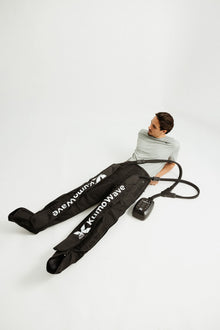

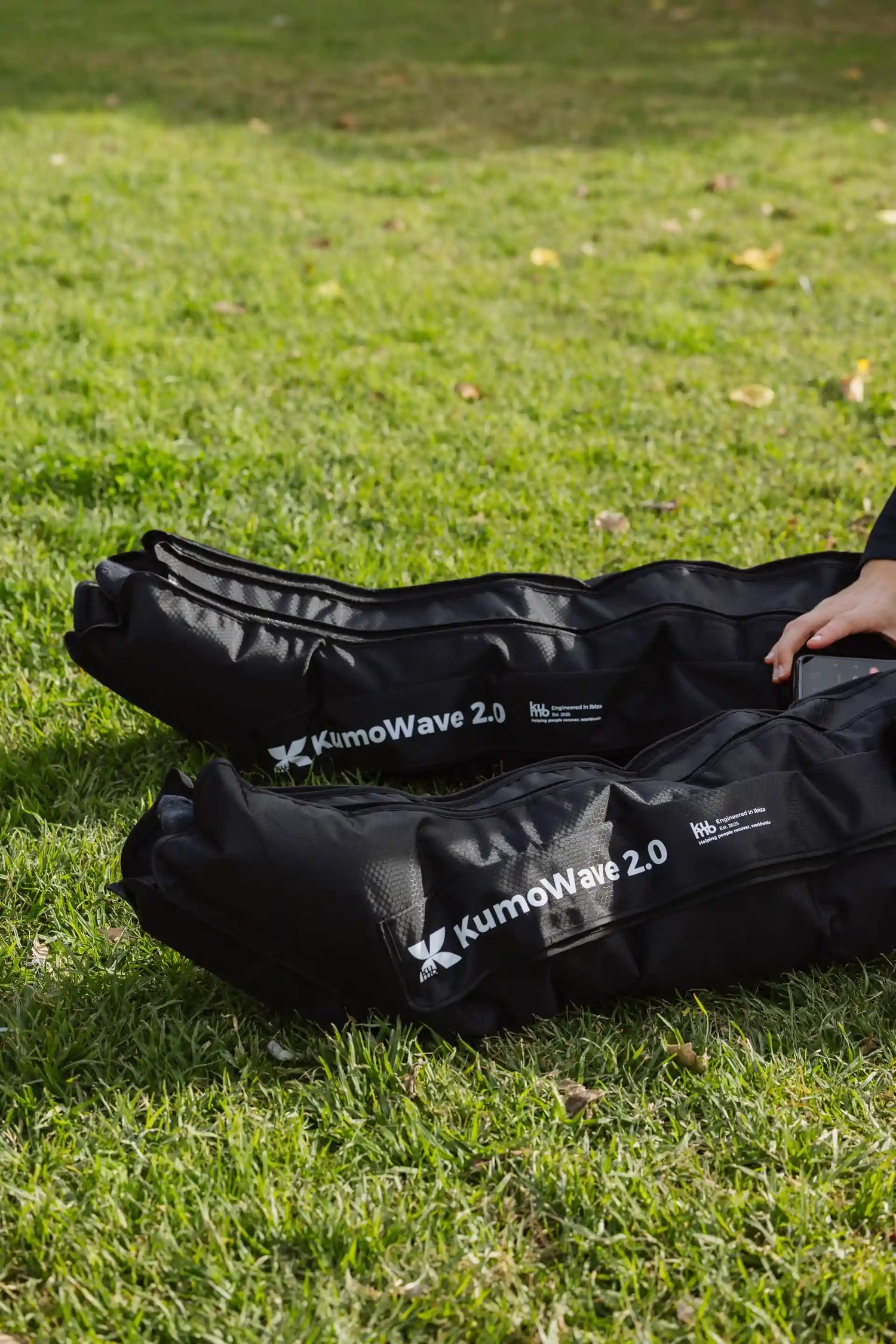
Your legs change more than you think.
Pressotherapy (also called intermittent pneumatic compression or IPC) is used to promote venous and lymphatic return, and for this reason, many people incorporate it into their recovery to feel less heaviness and arrive “fresher” at the next training session. The key is that if you don't measure well, you don't know if you are improving or just having a good day.
Pressotherapy at home
End the day with light legs
★★★★★ 4,8/5 · rated by verified customers
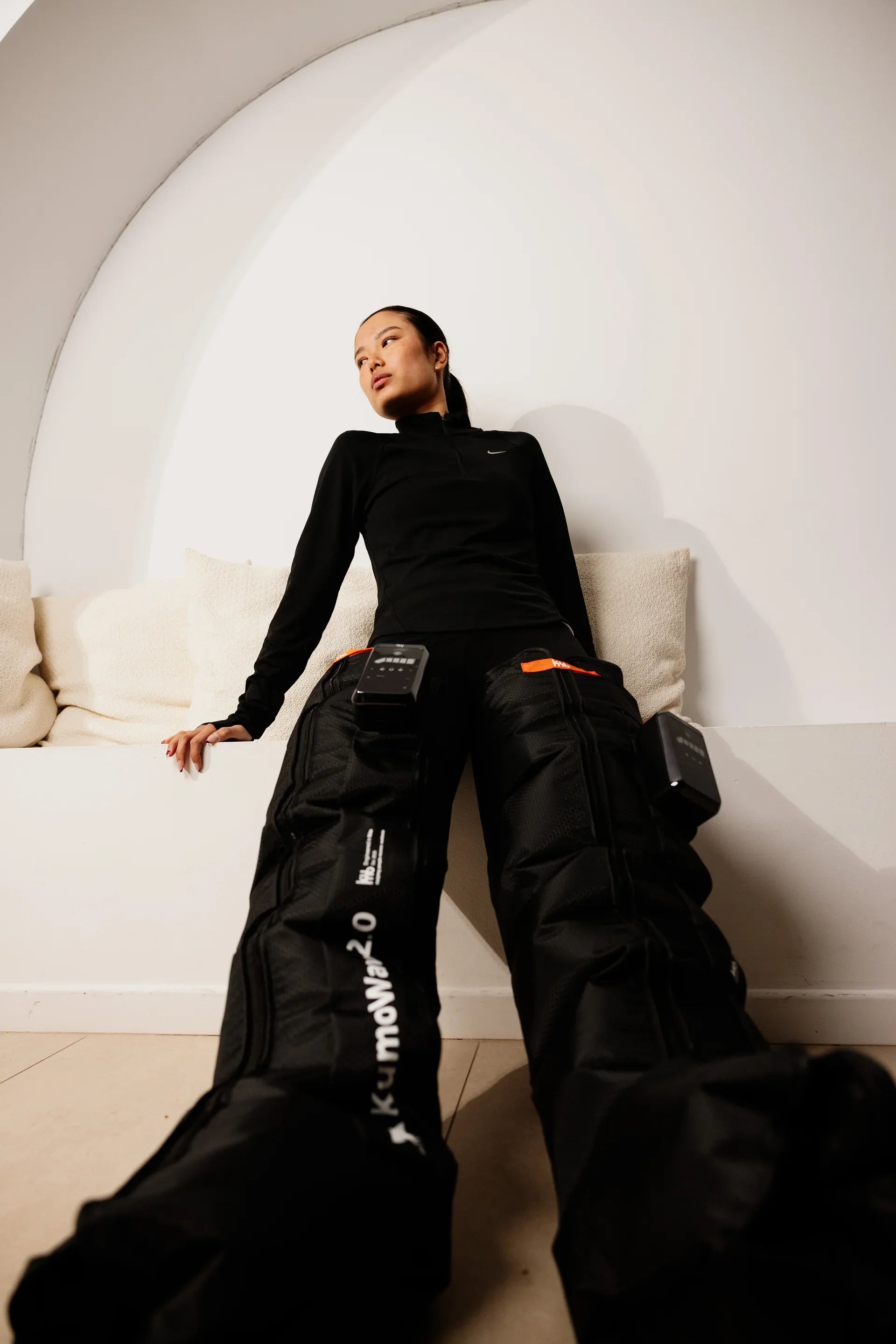
KumoWave pressotherapy boosts circulation and helps drain fluid with sequential compression, in 20-minute sessions at home.
- Boosts circulation and helps drain fluid
- Chamber-based compression, adjustable to you
- Sequential compression that mimics manual drainage
€799,00€999,00
−10% on your 1st order when you subscribe to the newsletter

In this Kumo guide, I explain what changes are measurable, what metrics to use (at home or in the gym), and a simple protocol to track your legs' progress without self-deception.
What is pressotherapy and why it might affect your legs
Intermittent pneumatic compression (IPC): what it does (and what it doesn't do)
IPC applies pressure in cycles using air chambers (e.g., in the form of boots) that inflate and deflate. In a medical context, it is used to increase blood flow in the legs and help prevent problems like thrombosis in situations of immobility, precisely because it mechanically “pushes” blood towards the heart (popular explanation from Johns Hopkins Medicine).
Personalized protocol · included with your purchase
Want us to tell you how to use it in your case?
With your purchase, our experts prepare a personalized usage protocol for your case: sport, circulation, fluid retention, pregnancy or lipedema.
Message us on WhatsAppOur experts reply · no obligation
In performance and recovery, the idea is similar: if you train hard, travel, spend many hours standing, or notice "heavy" legs, this type of compression can transiently modify sensations and indirect markers such as peripheral swelling.
Important: pressotherapy does not replace training, sleep, or nutrition. And it does not always translate into objective improvements in power or times, although it can improve perceived comfort in some cases.
What changes are reasonable to expect (according to evidence)
- Pain and muscle soreness (DOMS): A systematic review with meta-analysis published in Biology of Sport (2024) found a small-to-moderate effect on pain/soreness sensation in the immediate window (0–2 h) (SMD ≈ 0.49), with more uncertain results at 24–48 h (wide intervals and heterogeneity). You can read the full article in PubMed Central: Maia et al., 2024.
- Muscle function (neuromuscular performance): In the same review (2024), changes in "muscle function" appear as trivial or inconclusive in several time windows (0–2 h, 24 h, 48 h, 72 h), suggesting that it is not advisable to only measure "sensations," nor to promise miracles in power.
- Studies that find no differences: A randomized trial (2021) compared IPC vs placebo after eccentric exercise and concluded that, in that protocol, IPC was not superior to placebo for DOMS (strength, pain, ROM). Source: Trybulski et al., 2021 (PMC).
- Prolonged use (real sports environment): An RCT in competitive handball players (2025) suggests that daily use for 5 weeks can slightly mitigate training fatigue effects and improve subjective recovery. Source: Nuell et al., 2025 (PMC).
Practical tip: if you are looking for "proof" of pressotherapy, focus first on small but repeatable changes (ankle/calf, heaviness, sleep quality, and readiness to train) before expecting big jumps in performance.
−10%on your first order when you join the newsletter
We send you the code instantly. No spam.
Before measuring: control the variables that most distort your results
The leg is not a laboratory: perimeter and sensation of heaviness can vary due to factors unrelated to pressotherapy. If you want a useful record, standardize the basics:
- Time: always measure at the same time (ideal: in the morning after using the bathroom, before training).
- Temperature and heat: heat and hot showers can increase vasodilation and change sensations.
- Salt/hydration: a high-sodium dinner can increase fluid retention the next day.
- Training load: record volume and intensity (sets, km, elevation, RPE).
- Travel and sedentary lifestyle: flights/long car rides often increase distal swelling.
- Menstrual cycle: in some people, there are fluid variations due to the cycle phase.
Useful metrics to measure changes in your legs (without complicating things)
1) Perimeters with a tape measure: the well-done "home standard"
The tape measure is cheap and, if you standardize points and tension, it is surprisingly useful. In peripheral edema evaluation, different quantitative methods (including perimeters, figure-of-eight, volumetry) have been compared, highlighting that standardization improves reliability. Open reference: “Reliability and Feasibility of Methods to Quantitatively Assess Peripheral Edema” (PMC).
Recommended points (choose 2–4 and always keep the same ones):
- Ankle ("figure-of-eight" method): wrap around the foot-ankle passing over bony points (malleoli, instep, etc.). In one study (JOSPT, 2007), the standardized version showed very high reliability (ICC > 0.99) and a minimum detectable change close to 1 cm (MDC 9.6 mm) under certain conditions. Source: Rohner-Spengler et al., 2007 (PubMed).
- Calf: perimeter at the point of greatest circumference (mark it with a dermatological pen or a fixed reference).
- Shin/tibia (optional): X cm above the medial malleolus.
- Thigh: 10 or 15 cm above the kneecap (or at the midpoint between the hip and knee).
Golden tip: measure 3 times and record the average. And if the change is less than ~0.5–1.0 cm, interpret it with caution: it could be measurement noise (especially if you don't mark points or change the tape tension).
2) Estimated leg volume (with formula) to see trends
If you want a more "global" metric than a single perimeter, estimate the volume by segments using the "truncated cone" approximation. You need perimeters every 10 cm (for example, from the ankle upwards), and then sum the volume of each segment.
Formula per segment (in cm and cm³): V = (h / (12π)) × (C1² + C1×C2 + C2²), where h is the distance between perimeters (e.g., 10 cm) and C1, C2 are the circumferences of each end.
This type of level-based measurement even appears in clinical studies where edema is quantified by perimeters at intervals (for example, 10 cm from the ankle and higher levels).
3) Sensations (0–10): heaviness, stiffness, and “ready legs”
Sensations matter because they are part of the real intention: to feel better for training. But they must be measured consistently:
- Heaviness: 0 = none, 10 = very heavy.
- Pain/DOMS: 0 = none, 10 = limiting.
- Stiffness: 0 = loose, 10 = very stiff.
- Perceived recovery: 0 = exhausted, 10 = ready to perform.
4) Simple performance metrics: the final filter
If your goal is performance, add a quick, repeatable, and safe test. Examples:
- Vertical jump (3 attempts, record the best or the average).
- Short sprint (10–20 m) with the same stopwatch every time.
- Time over a fixed segment (e.g., 1 km flat at RPE 7).
- Resting heart rate / HRV (if you already use it, don't add it from scratch just for this).
The 2024 review suggests that, on average, the effects on "muscle function" can be small or inconclusive, so this block helps you decide if pressotherapy gives you something beyond comfort.
Practical protocol (14 days) to evaluate if pressotherapy is changing your legs
This protocol is designed to help you detect real trends by minimizing daily variations.
- Days 1–3 (baseline): measure without pressotherapy to understand your "normal" variability.
- Days 4–14 (intervention): use pressotherapy after your most demanding sessions or at the end of the day, following the device instructions (duration and pressure recommended by the manufacturer).
- Fixed daily measurement (mandatory): perimeters + weight + sensations in the morning.
- Post-session measurement (optional): 10–20 min after pressotherapy, repeat ankle (figure-of-eight) and "heaviness."
- Performance test (2–3 times/week): always at the same time (for example, before the main training session).
Logging template (simple and actionable)
| Variable | How to measure | When | What it tells you |
|---|---|---|---|
| Ankle (figure-of-eight) | Tape measure, 3 repetitions (average) | Morning + (optional) post-pressotherapy | Distal changes (swelling/retention) |
| Calf (maximum point) | Tape + fixed mark | Morning | Local volume and "heavy leg" |
| Body weight | Scale (same, same conditions) | Morning | Global trend (hydration/retention) |
| Heaviness (0–10) | Subjective scale | Morning + night | Perceived recovery |
| DOMS/pain (0–10) | Subjective scale | Morning | Perceived muscle damage |
| Performance test (choose 1) | Jump/sprint/fixed segment | 2–3×/week | Real functional impact |
| Context | Notes: heat, travel, salt, sleep, load | Daily | Explains "anomalies" |
How to interpret your measurements (to avoid confusion with "noise")
- Don't stick to one day: look at 3–4 day averages.
- Prioritize the ankle if you travel or stand for many hours: it usually better reflects distal changes.
- Very small changes may not be real: for example, in ankle measurement with a standardized method, minimum detectable change values around ~1 cm are reported under certain conditions (see JOSPT 2007). If you are below that, interpret with caution.
- If the perimeter decreases but performance does not improve: it may still be useful for comfort, but your goal (performance) may depend more on sleep, load, and nutrition.
- If performance improves but the perimeter does not change: perfect; your "change" may be neuromuscular or perceptual, not volumetric.
Safety: when NOT to use pressotherapy and when to consult
- remember that absolute and relative contraindications must be considered, and that adverse events are rare if used correctly and with appropriate indication. Source: S1 guideline on intermittent pneumatic compression (PubMed
Additionally, Johns Hopkins explains risks and situations where it may not be recommended (for example, increased risk of skin problems or in certain vascular conditions). Informative source: Johns Hopkins Medicine.
Warning signs (urgent medical consultation):
- Marked unilateral swelling, calf pain, redness, or local heat.
- Difficulty breathing, chest pain, or sudden shortness of breath.
- Open wounds, active skin infection, significant loss of sensation, or unusual pain during the session.
This content is for informational purposes only and does not substitute medical advice, especially if you have a history of vascular conditions, thrombosis, heart failure, diabetes with complications, or clinical concerns.
How to fit pressotherapy into a "Kumo-style" recovery routine
At Kumo, we understand recovery as a habit: technology + consistency + measurement. If your priority is your legs, you can set up a staggered routine:
- Base (always): gentle walking for 10–15 min, hydration, dinner with sufficient protein, and regular sleep.
- When you notice heavy legs or after heavy days: add pressotherapy boots (see collection: Kumo pressotherapy).
- If the problem is localized muscle stiffness: combine with myofascial release and a percussion tool like KumoPulse Air (always with caution: short time, good technique, without overworking painful areas).
- If you are looking to support general rest and recovery: consider LED light therapy as part of your night routine, especially during times of stress and high load.
The advantage of this approach is that you don't rely on "sensations": you choose tools according to the day's objective (drainage/perception, stiffness, rest) and validate it with your metrics.
FAQ: frequently asked questions about Kumo, pressotherapy, and leg measurement
What should I measure if I use Kumo pressotherapy to notice real changes?
For useful tracking, combine an objective measure (figure-of-eight ankle or calf perimeter) with a functional measure (jump, short sprint, or fixed segment) and a subjective scale (heaviness/DOMS 0–10). If you only measure "how you feel," it's easy to confuse real improvement with a day of lower load or better sleep. If you only measure performance, you might not capture comfort. The trio of perimeter + performance + sensation is usually the most practical balance.
Which area is most reliable to measure: ankle, calf, or thigh?
It depends on your pattern. The ankle is usually more sensitive to distal changes from sitting/standing for many hours or traveling. The calf can better reflect the feeling of "heavy leg" after running or cycling volume. The thigh is useful if your main load is strength (squats, lunges), but it can vary less due to fluids and more due to local inflammation. Whatever you choose, mark points and always repeat the same protocol to reduce error.
Does pressotherapy reduce muscle soreness (DOMS) or just the feeling of heaviness?
- found a small-to-moderate improvement in pain/soreness in the immediate window (0–2 hours), but the improvement in muscle function was less clear. Additionally, a randomized trial (
- found no superiority over placebo in its protocol. In practice, many people notice it mainly for heaviness and comfort, and sometimes for perceived pain; that's why it's good to measure perimeter and performance to see what it does for you
Can I combine Kumo pressotherapy boots with a massage gun and LED light on the same day?
Yes, as long as you do it logically and without overdoing it. A reasonable sequence is: first gentle mobility or a short walk, then localized work with a massage gun (short time, avoiding very painful areas), and then pressotherapy for an overall feeling of lightness. LED light can fit better at night as part of your rest routine. The important thing is not to try to "compensate" for poor load management with too many tools: measure and adjust.
What now?
If you want to turn recovery into a system (not an intuition), start by measuring for 14 days and choosing a primary metric (ankle or calf) + a performance test. Then, integrate the appropriate tool: explore the pressotherapy collection and build your routine with consistency. If you need guidance on fitting pressotherapy, LED light, or massage into your week, you can write to us from the contact page.
KumoWave pressotherapy
Choose your at-home pressotherapy
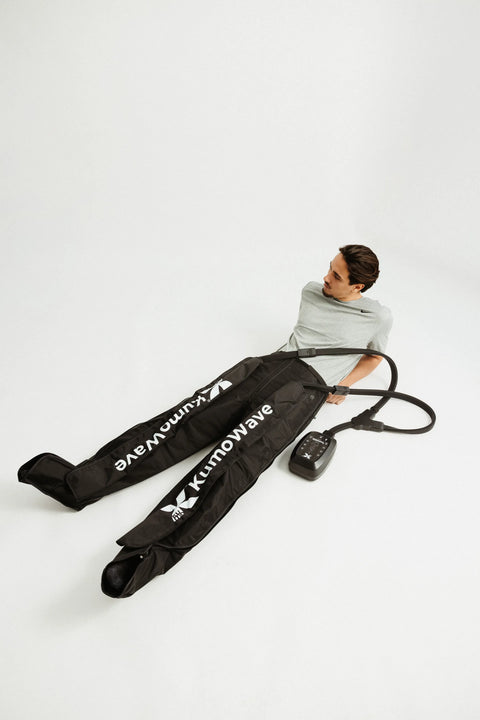
KumoWave Elite – Pressotherapy Pants
Full-coverage trousers. Ideal for lipedema, fluid retention and intensive use.
€799,00 €999,00
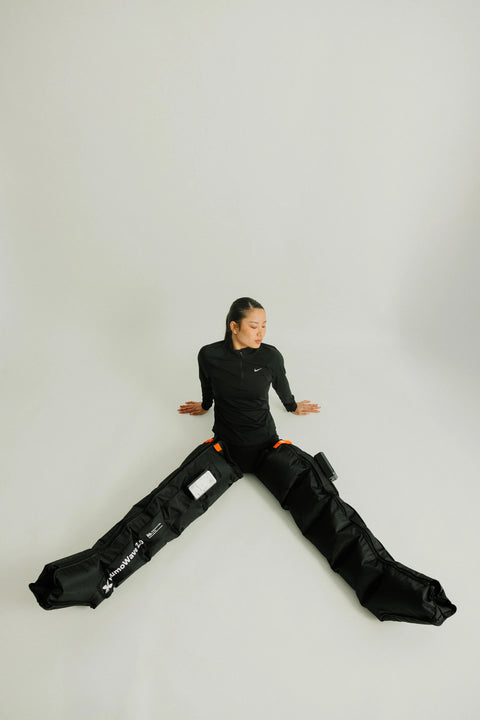
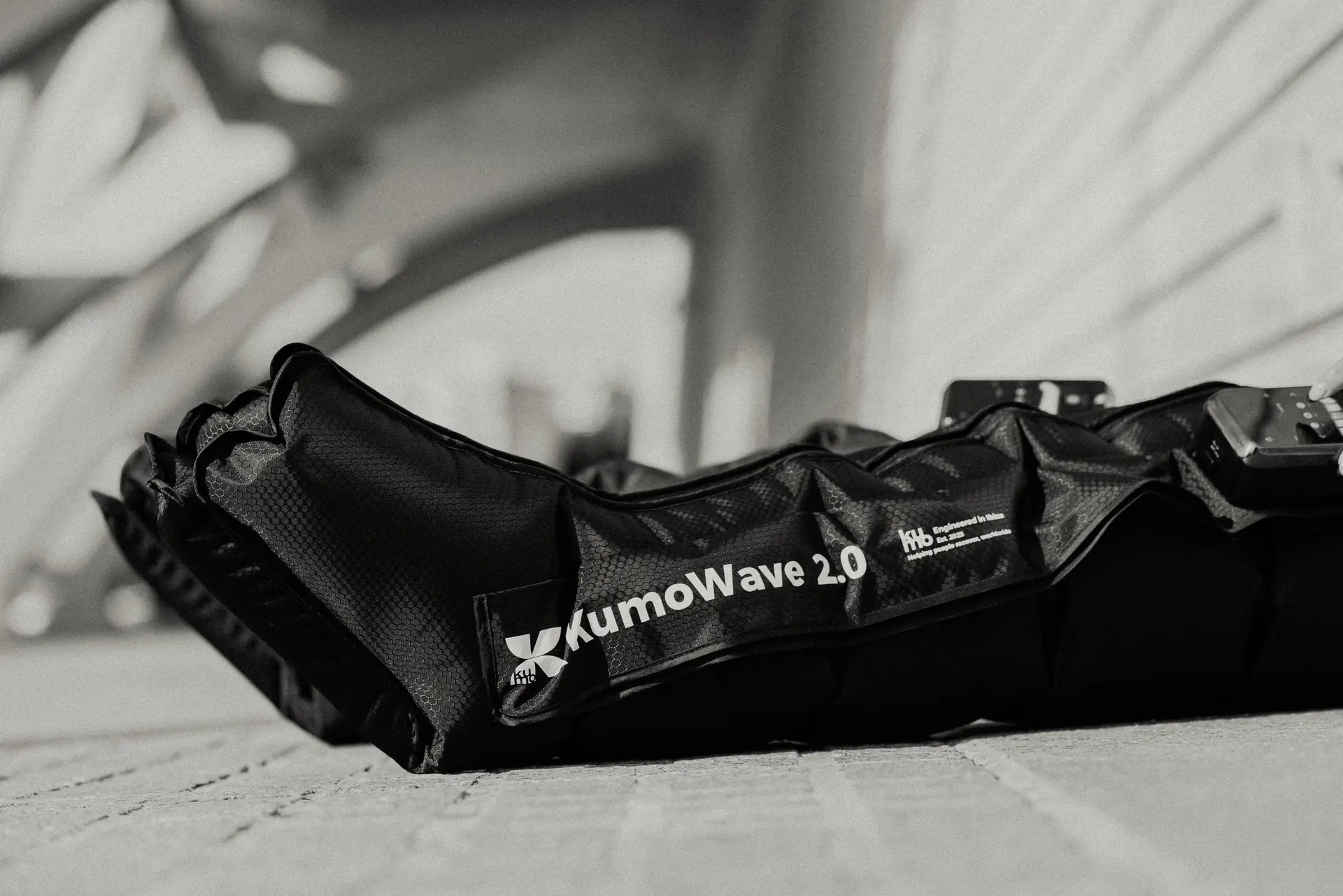
KumoWave 2.0 - Wireless Pressotherapy
Wireless, lightweight boots. Perfect for daily use and recovery.
€499,00 €599,00