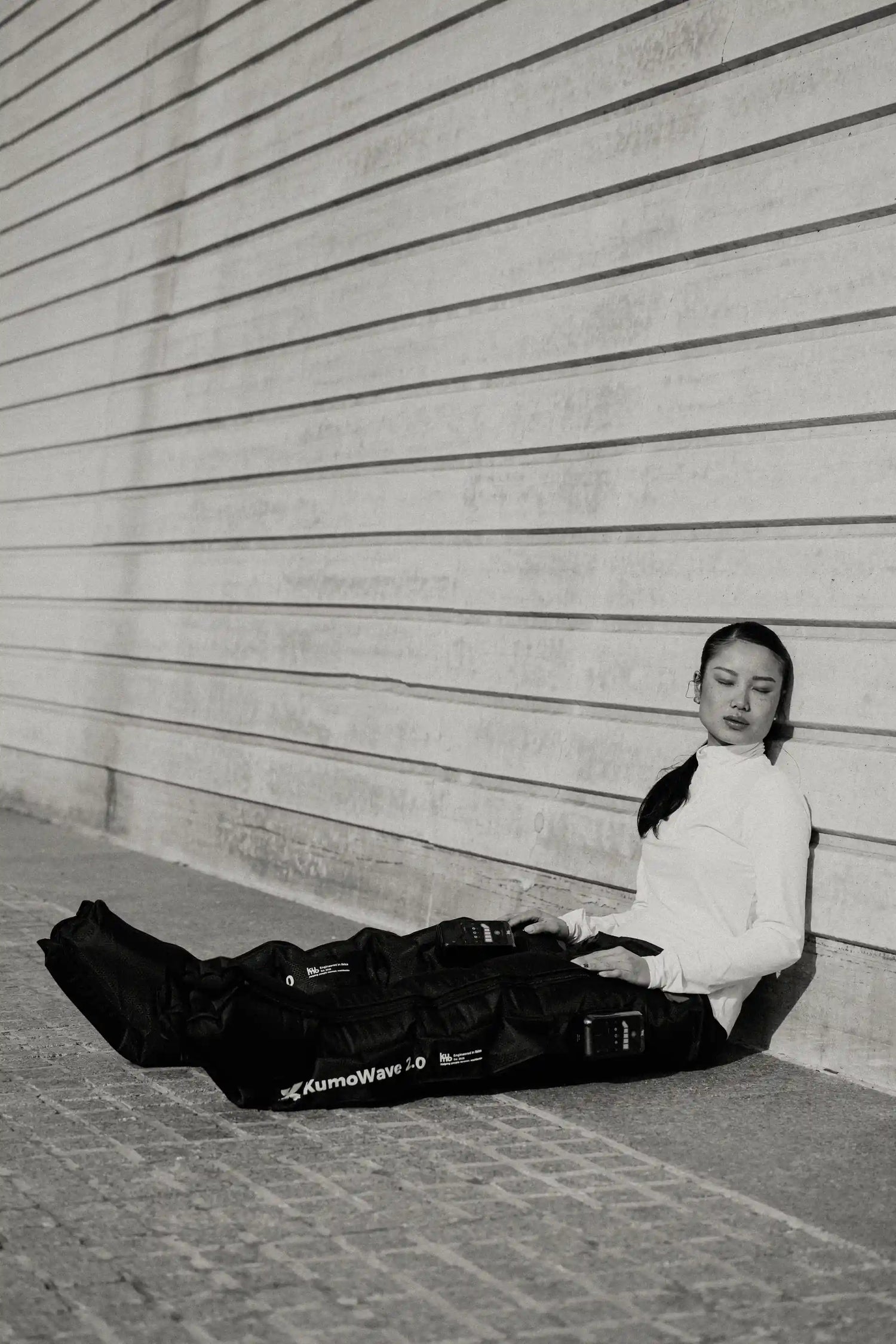
One-legged pressotherapy is possible—and very useful.
Unilateral pressotherapy (or intermittent pneumatic compression applied to a single limb) involves using a compression boot on one leg to promote venous return and drainage, without treating the other. It's a practical strategy when there are asymmetries (one leg is more tired or "heavy"), localized overloads, or simply when you want to prioritize a specific area within your recovery routine.
Pressotherapy at home
End the day with light legs
★★★★★ 4,8/5 · rated by verified customers
KumoWave pressotherapy boosts circulation and helps drain fluid with sequential compression, in 20-minute sessions at home.
- Boosts circulation and helps drain fluid
- Chamber-based compression, adjustable to you
- Sequential compression that mimics manual drainage
€799,00€999,00
−10% on your 1st order when you subscribe to the newsletter

In this guide, you'll learn when it's beneficial, how to set up a safe session, and how it fits into a complete recovery approach with Kumo technology.
(my.clevelandclinic.org)What is unilateral pressotherapy (and how does it differ from bilateral)?
Pressotherapy uses inflation and deflation cycles within a boot with chambers (segments) that apply sequential compression to the foot, ankle, calf, and/or thigh. In the clinical setting, it is known as intermittent pneumatic compression (IPC) and is used, for example, to help mobilize fluids and support circulation in various contexts (always under professional guidance).
Personalized protocol · included with your purchase
Want us to tell you how to use it in your case?
With your purchase, our experts prepare a personalized usage protocol for your case: sport, circulation, fluid retention, pregnancy or lipedema.
Message us on WhatsAppOur experts reply · no obligation
The key difference between unilateral and bilateral is not "power" but the goal:
- Bilateral: global approach (both legs simultaneously), ideal if you're looking for a general sense of relief and symmetrical treatment.
- Unilateral: precision approach, ideal for one leg that feels heavier, more fatigued, or more "loaded" after training or after sitting/standing for many hours.
When does it make sense to do pressotherapy on one leg?
Unilateral pressotherapy usually makes more sense when recovery is not symmetrical. Specific examples:
- Post-training asymmetry: after a workout with unilateral dominance (lunges, step-ups, changes of pace, sports with turns), one leg may accumulate more fatigue.
- Localized overload: one calf or quadriceps is particularly "tense" due to volume or technique.
- Heavy legs at the end of the day: if you notice one leg swells more (feeling of a sock mark, unilateral heaviness).
- Return to activity: when you are readapting and want a conservative recovery stimulus in one area, without "overloading" sensations in the other.
- Logistics: limited time, limited battery, or you simply want to split the session (right leg now, left leg later).
Practical idea: if your goal is to "equalize sensations," unilateral might be more efficient than always doing both legs at the same time.
−10%on your first order when you join the newsletter
We send you the code instantly. No spam.
How to perform a unilateral pressotherapy session step-by-step
1) Prepare the ground (2 minutes)
- Position: if possible, lie down or recline to be relaxed and avoid compressing the area with awkward postures.
- Skin and clothing: avoid thick wrinkles in socks or leggings inside the boot; wrinkles can create uncomfortable pressure points.
- Quick check: if there is acute pain, abnormal heat, intense redness, or unusual sensitivity, prioritize caution and do not force a session.
2) Place the boot correctly (more important than it seems)
- Insert your foot all the way in, so it doesn't "float."
- Align the boot with your leg (so it's not rotated inward or outward).
- Close zippers/Velcro evenly: firm, but never painful.
3) Choose mode and intensity: start conservatively
At home, the smartest approach is usually to start at low to medium levels and only increase if the sensation is comfortable and stable. With compression, "more" does not always equal "better": the goal is effective and tolerable pressure, not discomfort that makes you tense your body.
4) Decide on duration according to your goal
There isn't a single perfect duration for everyone, but there are useful references:
- In a lymphedema context, a systematic review (2018) described results with sequential programs using 30–60 mmHg for 45–60 minutes (evidence is limited and should be interpreted with caution).
- In a muscle recovery context, a randomized controlled trial (2021) applied IPC for 15 minutes after exercise (and repeated sessions on subsequent days) and observed improvements in recovery variables/muscle soreness sensation compared to control.
Translation to real life: for wellness and recovery use, many people find 15–30 minutes per leg to be suitable when time is short, or longer sessions when the goal is closer to "relief" and comfort. If your case is clinical (e.g., significant edema), it's advisable to follow professional guidance.
5) When finished: "seal" the session with a simple gesture
- Walk for 2–5 minutes around the house or do ankle pumps (flexion-extension).
- Hydrate normally.
- Observe your skin: a slight mark is normal; pain, numbness, or irritation is not.
Unilateral pressotherapy with Kumo: how to leverage leg-by-leg control
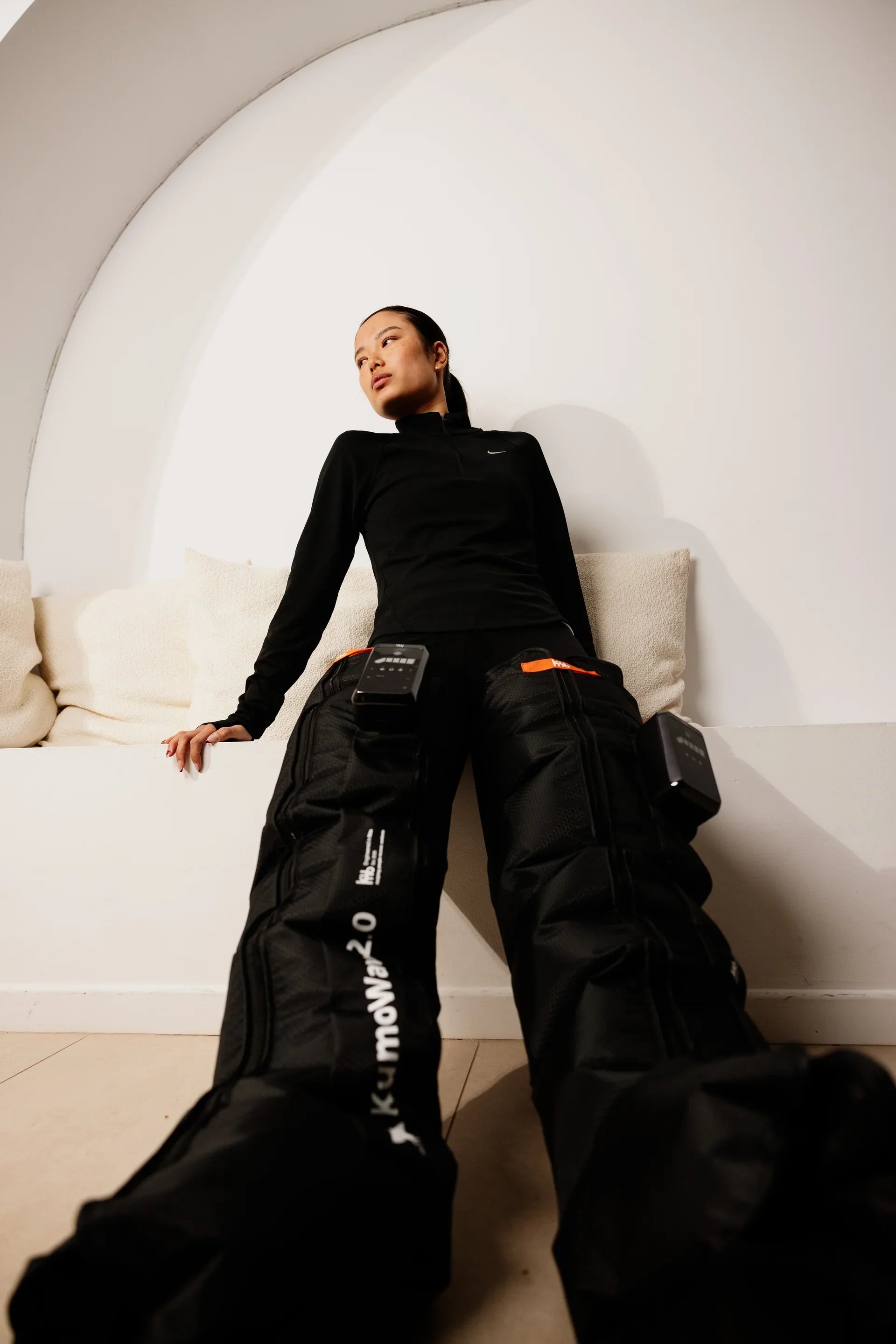
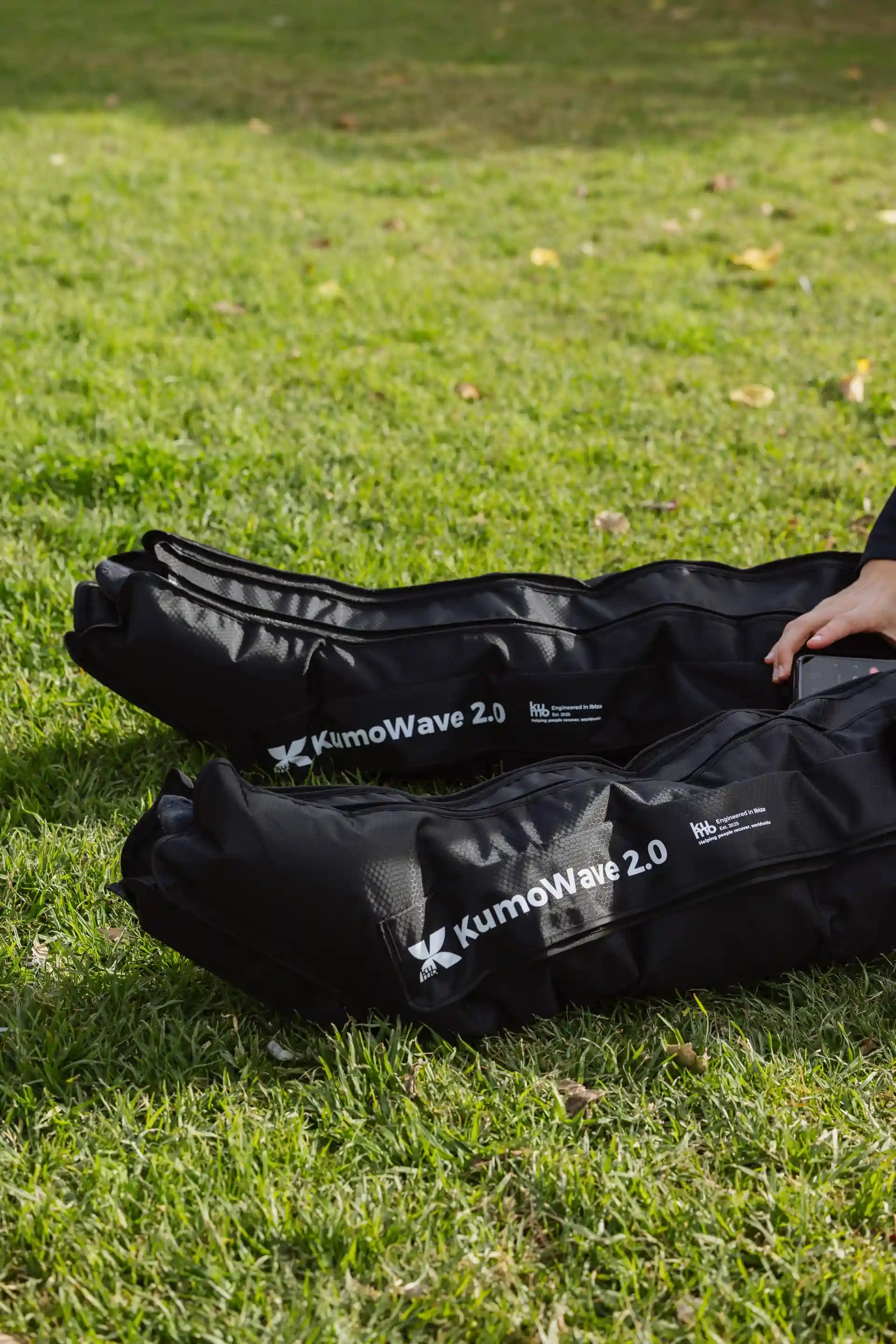
If you want to work on only one leg, it's crucial that the system allows for independent control. In Kumo's pressotherapy collection, for example, KumoWave 2.0 is described as a wireless system with 5 chambers, adjustable pressure, and independent leg control for unilateral or simultaneous use (designed precisely for asymmetries and localized overloads).
To view options and choose the format that fits your routine, you can visit Kumo's pressotherapy collection.
(kumobalance.com)Recommended settings (without overcomplicating): pressure, frequency, and "ok" signals
In home pressotherapy, the best guide is not to chase the highest number: it's to combine comfort, regularity, and a clear goal. If your equipment shows levels or mmHg, use these ideas as a framework:
- Golden rule: perceptible and enveloping pressure, without pain, tingling, or uncomfortable "throbbing."
- If numbness appears: lower intensity or end the session.
- If it forces you to tense up: the intensity is too high for that moment.
Quick reference table: unilateral or bilateral?
| Situation | Best option | Why | Practical advice |
|---|---|---|---|
| One leg more loaded after training (lunges, soccer, padel) | Unilateral | Prioritizes the "dominant" leg for fatigue and saves time | Start with 15–20 min and reassess sensations |
| Generalized heavy legs at the end of the day | Bilateral | Global and symmetrical approach | Relaxed session + diaphragmatic breathing |
| Visible asymmetry of sock marks or subjective "swelling" | Unilateral | Allows you to dose according to real need | Reduce intensity and check tolerance |
| Limited time | Unilateral | Better a short, well-done session than a long, half-hearted one | Alternate leg A / leg B on different days |
| Routine recovery without discomfort | Bilateral | Consistency, habit, and relaxation | Low-medium intensity, "wellness" focus |
What you can expect (and how to measure results without obsessing)
In wellness and sports, the most common changes to notice are:
- Feeling of lightness and less "heaviness" when walking.
- Perception of muscle soreness (DOMS) in subsequent days, especially if you are consistent.
- Contour (in people prone to fluid retention): measuring ankle/calf circumference always at the same time can give you a reference.
As an example of clinical (non-sporting) data: a randomized trial from 2025 on stasis dermatitis evaluated both legs with standard treatment and added impulse pneumatic compression to one leg; the treated leg showed a reduction in ankle circumference (mean difference of approximately −2.125 cm during the studied period), along with changes in tissue oxygenation measurements.
(mdpi.com)Safety and contraindications: when not to do pressotherapy (or to do it with supervision)
Compression is a useful tool, but it is not "for everyone all the time." An international consensus on the risks and contraindications of compression treatments emphasizes that serious complications are rare and usually appear in predisposed individuals or due to improper use; therefore, it recommends screening and proper device adjustment.
(pmc.ncbi.nlm.nih.gov)Avoid pressotherapy (or consult first) if you have any of these typical scenarios:
- Suspected or recent diagnosis of deep vein thrombosis (intense pain, warmth, redness, marked unilateral swelling): best to rule out with a professional.
- Significant peripheral artery disease or severe arterial problems (compression may not be suitable).
- Active skin infection (e.g., cellulitis), uncontrolled wounds, or severely irritated dermatitis in the contact area.
- Decompensated heart failure or sudden worsening of symptoms.
- Significant sensory impairment (severe neuropathy): increases the risk of not noticing excessive pressure.
Warning signs during or after: pain, numbness, skin lesions under the boot, or shortness of breath. Clinical resources also recommend reporting any respiratory symptoms or unusual discomfort.
(my.clevelandclinic.org)And a practical point: if you use devices at home, the FDA reminds that the home environment adds risks (cables, tripping, heat/humidity, cleaning). Keep the equipment on a stable surface, without tension on tubes and away from walkways.
(fda.gov)Common mistakes when doing unilateral pressotherapy (and how to avoid them)
- Turning up the pressure too high "to make it work": if it hurts or causes tingling, you're not recovering; you're fighting the session.
- Placing the boot with wrinkles: can create uncomfortable pressure points.
- Doing it just before a tough workout: if you're looking for performance, it usually fits better as a post-workout tool or on recovery days (depending on sensations).
- Not being consistent: recovery is more noticeable through habits (weekly routine) than through a single "perfect" isolated session.
- Ignoring body signals: if one leg reacts differently (unusual pain, heat, sudden swelling), pause and prioritize safety.
How to integrate unilateral pressotherapy into a Kumo recovery routine
"Premium" recovery is usually a sum of small, consistent stimuli. A smart combination (without overdoing it) could be:
- Unilateral pressotherapy (loaded leg) + gentle mobility (ankle/hip) when finished.
- Light therapy on low-load days: if you're interested in a holistic wellness and care approach, you can explore LED light therapy within the Kumo ecosystem.
- Localized tissue work when the problem is a "specific point": a massage gun can be useful if used wisely (short duration, without bruising sensitive areas). At Kumo, you have the KumoPulse Air as a portable percussive massage option.
Simple approach: if you do unilateral pressotherapy today, tomorrow you can balance it with a gentle bilateral session or with mobility + a walk. Recovering well means alternating, not always pushing hard.
FAQ about unilateral pressotherapy and Kumo
Can KumoWave be used on only one leg?
Yes, provided the model is designed for unilateral use or allows for independent control per leg. Within Kumo's pressotherapy range, the KumoWave 2.0 description specifically highlights this independent control to work on one leg or both as needed (useful for asymmetries and localized overloads). To do it correctly, prioritize proper placement, start with a comfortable intensity, and check tolerance during the first few days. If you have a history of vascular issues or atypical pain, consult a professional first.
(kumobalance.com)How long should unilateral pressotherapy be performed after running?
As a practical guideline, many wellness routines fit into 15–30 minutes for the more loaded leg, adjusting intensity to comfort. In sports research, there are trials where 15-minute pneumatic compression sessions were used after exercise and improvements in recovery-related variables compared to control were observed. If after running you notice a significant asymmetry or unusual discomfort (heat, localized pain, marked swelling), avoid "masking" the signal with compression and prioritize evaluation.
(pubmed.ncbi.nlm.nih.gov)What pressure should I choose for unilateral pressotherapy if I'm looking for drainage and lightness?
It depends on the equipment and your tolerance, but the rule is clear: firm and pleasant pressure, never painful. Clinically, a systematic review (2018) on IPC dosage in lymphedema reported sequential programs with 30–60 mmHg for 45–60 minutes, although it also noted methodological limitations and the need for caution when generalizing. For wellness/sports, it usually works to start at low-medium levels and only progress if there's no tingling, numbness, or irritation.
(pubmed.ncbi.nlm.nih.gov)Can I combine unilateral pressotherapy with Kumo red light or LED therapy?
In terms of a recovery routine, many people combine tools as long as they maintain the focus: not "doing everything at once" with maximum intensity. A simple idea is to separate stimuli: pressotherapy (loaded leg) for circulatory sensation/lightness, and at another time of day, a light session for a more global wellness approach. If you have a medical condition (e.g., significant edema, vascular problems, or an ongoing injury), the best combination and order should be validated with a professional.
(pmc.ncbi.nlm.nih.gov)Does unilateral pressotherapy help with heavy legs from sitting for many hours?
It can be very suitable when the heaviness is more pronounced in one leg or when you want to save time. In the clinical setting, intermittent pneumatic compression is used to support circulation in certain contexts and is understood as a tool that promotes blood movement in the legs when there is little mobility. At home, use it as a complement to the basics: active breaks, walking, ankle mobility, and hydration habits. If the heaviness is new, intense, or unilateral with pain/heat, prioritize ruling out medical causes.
(my.clevelandclinic.org)What now?
If you want to make unilateral pressotherapy a habit (not a "quick fix"), start by choosing a system that fits your daily routine and your asymmetries. Explore Kumo pressotherapy, complete your routine with LED therapy or localized massage with KumoPulse Air, and if you need guidance on what best suits your case, you can write directly from the contact page.
KumoWave pressotherapy
Choose your at-home pressotherapy
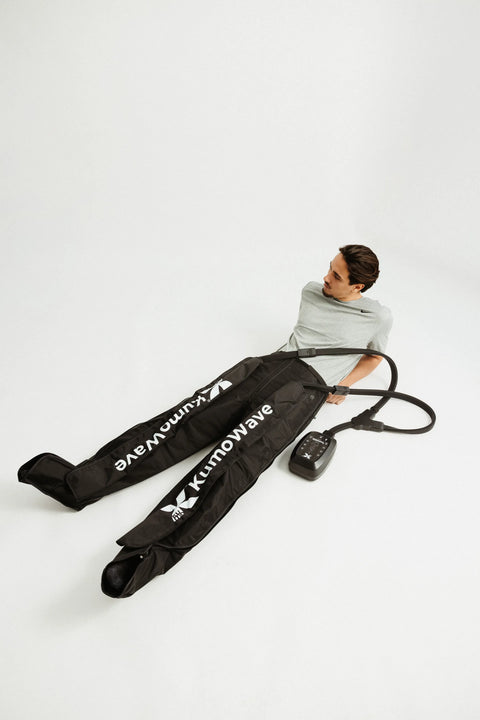
KumoWave Elite – Pressotherapy Pants
Full-coverage trousers. Ideal for lipedema, fluid retention and intensive use.
€799,00 €999,00
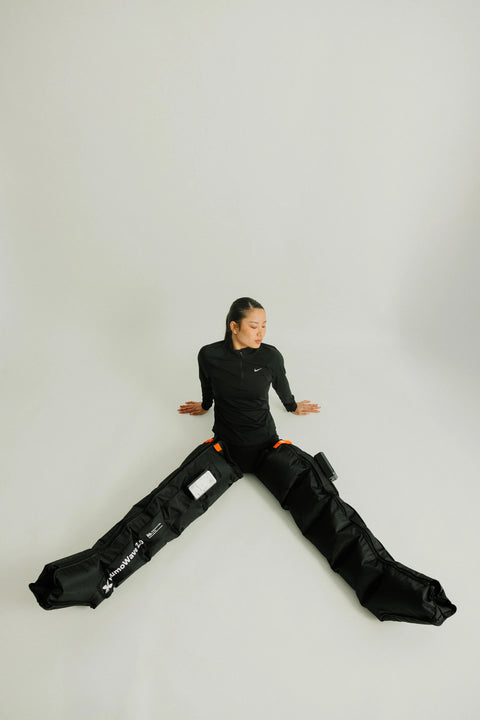
KumoWave 2.0 - Wireless Pressotherapy
Wireless, lightweight boots. Perfect for daily use and recovery.
€499,00 €599,00