
Choosing wisely changes everything. A useful red light therapy panel is not defined by brand, but by four variables: wavelength, irradiance, fluence, and beam size. The FDA itself describes photobiomodulation as low-irradiance light that does not heat tissue and whose results depend on these variables. (fda.gov)
At home, LED panels are a practical option because they can cover large areas and do not require direct contact; moreover, the FDA reminds us that these technologies are used at very low doses and that eye protection remains important. If you want to fine-tune your choice, this article helps you read the specifications without falling for marketing. (fda.gov)
Red & infrared light
Recover faster, at home
★★★★★ 4,8/5 · rated by verified customers
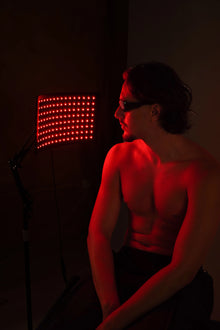
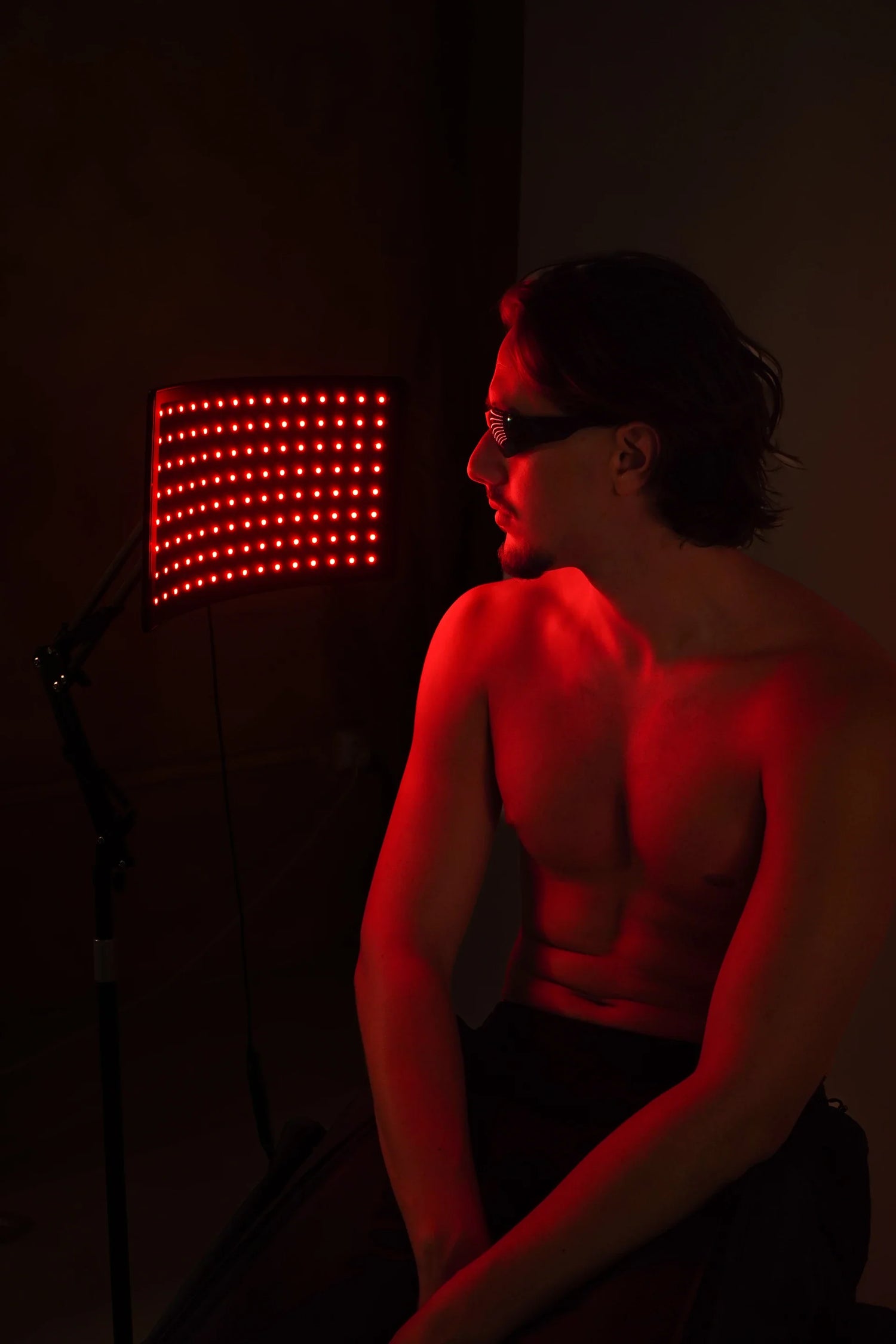
The KumoLux panel supports muscle recovery with full-body red and infrared light.
- 660 nm red + 850 nm infrared light
- Full-body muscle recovery
- Clinically validated biohacking protocols
€399,00€499,00
−10% on your 1st order when you subscribe to the newsletter

In 2026, the most common bands in photobiomodulation continue to be red around 630-660 nm and near-infrared around 830-850 nm; this is why they are so often combined in home panels. If you want to better understand why these two wavelengths are so talked about, the practical explanation of the differences between 660 nm and 850 nm will help you relate the band to the objective. (pmc.ncbi.nlm.nih.gov)
What is a red light therapy panel?
A red light therapy panel emits visible red light and, in many models, near-infrared for photobiomodulation. The FDA's draft guidance defines this technique as the application of light at an irradiance that does not induce heating, with the aim of modifying biological activity; it also notes that the result depends on wavelength, fluence, irradiance, pulse mode, and beam size.
Personalized protocol · included with your purchase
Want us to tell you how to use it in your case?
With your purchase, our experts set up your red and infrared light sessions for your sport and goal.
Message us on WhatsAppOur experts reply · no obligation
That explains why two panels that "look the same" can perform very differently. In recent literature, visible red and near-infrared continue to appear as the most used bands, although the homogeneity of protocols is still limited. In practice, the best purchase is not the most flashy: it's the one that best aligns spectrum, real power, and intended use.
What you should check before buying
Wavelength
For home use, start with the objective. If you are looking for a panel more geared towards skin, texture, or facial routine, visible red is usually the base; if your priority is muscle, joints, or recovery, near-infrared adds depth. Clinical and sports reviews continue to find red wavelengths 630-660 nm and those close to 808-850 nm among the most used in these contexts. (pmc.ncbi.nlm.nih.gov)
In practice, this means that more colors do not automatically equate to a better panel. The important thing is that the chosen band fits your objective and that the manufacturer explains what the device actually emits. If you want to delve deeper into this criterion, you can read the guide on red and infrared light therapy and their differences between 660 nm and 850 nm.
on your first order when you join the newsletter
We send you the code instantly. No spam.
Irradiance and dose
Irradiance is the power reaching a surface per unit area, and fluence is the energy per unit area. The FDA uses these definitions and reminds us that a panel's performance also depends on distance, exposure time, and beam size; therefore, laboratory data without a specific distance is of little use.
When comparing models, always ask for the irradiance measured at the distance you intend to use at home. If a manufacturer only shows total watts or number of diodes, you still don't have the information that determines the actual dose received by the skin. This is a practical conclusion based on FDA definitions and the review of the complexity of parameters in PBM.
Useful coverage and uniformity
The useful area matters as much as the power. A review on radiometric measurement and another paper on beam accuracy insist that spot size, beam homogeneity, and actual treated surface change effective exposure. Translated to purchase: a panel should indicate what part of the body it covers well and at what distance it maintains that coverage. (pmc.ncbi.nlm.nih.gov)
If you are treating your face, neck, or a small area, coverage can be limited without issue; but if you are looking for thighs, back, or recovery of several muscle groups, a larger active surface and a clear use specification are advisable. This is a practical conclusion derived from how irradiance is measured and how LEDs work on large surfaces. (pmc.ncbi.nlm.nih.gov)
Photobiological safety
Safety is non-negotiable. Standard IEC 62471:2006 provides guidance for evaluating the photobiological safety of lamps and lamp systems, including LEDs, and specifies exposure limits, measurement techniques, and risk classification; IEC TR 62471-4:2022 adds practical radiometric and spectroradiometric measurement methods. (webstore.iec.ch)
Additionally, the FDA warns that photobiomodulation can damage the eyes and is not recommended for people with photosensitivity disorders, pregnancy or planning pregnancy, active implants, cancer in the treated area, photosensitizing medication, or active infection in the area. This does not mean all red light is dangerous; it means responsible use requires reviewing contraindications.
Home-friendly design
LED panels fit well at home because they allow covering large areas and are easier to use than laser solutions when the goal is a consistent routine. A reference review on LEDs versus lasers specifically highlights their ease of home use and the absence of safety considerations specific to lasers.
Before finalizing the purchase, it is advisable to review technical datasheets critically and compare them with a guide on how to buy red light therapy without making a mistake. This helps you separate useful specifications from difficult-to-verify promises.
How to choose according to your objective
Skin, texture, and facial routine
If your priority is skin, surface glow, texture, or a cosmetic protocol, focus on panels with well-specified visible red light. Recent dermatological reviews on photobiomodulation describe results in collagen, rejuvenation, and wound healing with LED and laser devices, and continue to place red light around 660 nm among the most common options.
In that case, the panel doesn't have to be "the most powerful"; it has to be the most consistent, with an easy-to-repeat dose and sufficient coverage for the area you want to treat. If you're looking for a more skin-focused routine, the photobiomodulation protocol for skin can serve as a reference.
Muscle, joints, and recovery
If your focus is muscle recovery, joint comfort, or post-workout, near-infrared takes center stage. In sports and muscle studies, combinations of 660 and 850 nm frequently appear, and reviews describe effects on fatigue, muscle damage, and recovery, although protocols remain heterogeneous. (pmc.ncbi.nlm.nih.gov)
This makes a red + near-infrared combination more versatile than a red-only panel for this objective. Still, the key remains the same: clear specification, measured irradiance, useful coverage, and comfortable use to maintain several times a week.
Nighttime use and sleep
If you're going to use it at night, think about the routine, not just the device. As a non-thermal and easy-to-use technology at home, the best strategy is usually a brief, repeatable, and easy-to-integrate session. To establish this habit, you can rely on a step-by-step nighttime protocol for red light.
First sessions: how to try it at home
The first week is for checking comfort and tolerance. Maintain the same distance, use the same area, and observe the response of your skin and eyes; the FDA reminds us that eye exposure and certain contraindications matter, so prudence is worth more than a long session.
- Start with a small area or with short, consistent sessions.
- Do not change the distance every day, because you would be changing the dose.
- If you notice eye or skin sensitivity, reduce use and check the settings.
- Record what distance and time are most comfortable for you to repeat it effortlessly.
Frequent buying mistakes
The most frequent mistake is confusing marketing with dosimetry. The evidence reviewed by the FDA indicates that the result depends on wavelength, fluence, irradiance, pulse, and beam size; therefore, a panel is not better just because it has more watts, more LEDs, or more colors.
- Do not buy without knowing the irradiance at a specific distance.
- Do not confuse the total surface area of the panel with the actively well-lit area.
- Do not ignore photobiological safety markings or tests.
- Do not use the device if you have photosensitivity, photosensitizing medication, or active implants without professional evaluation.
- Do not assume that "more intensity" equates to better results for any objective.
Simple rule: if the manufacturer doesn't state what it emits, at what distance it measures it, and what safety standard it complies with, you're not yet comparing panels; you're just comparing promises.
Quick buying guide
If you are going to compare models, use this matrix and not the isolated commercial data sheet. A solid purchase relies on spectrum, irradiance, coverage, safety, and real ease of use at home.
| Criterion | What you should confirm | Positive sign |
|---|---|---|
| Wavelength | Look for specific values consistent with your objective. | The manufacturer indicates 660 nm, 850 nm, or a well-explained combination. |
| Irradiance | Must be measured at a real distance, not just in the general datasheet. | The specification includes distance, method, and is not limited to total watts. |
| Coverage | The active area and beam uniformity matter. | The area you want to treat is covered without obvious gaps. |
| Safety | Review IEC 62471, warnings, and eye protection. | Technical documentation is clear and easy to verify. |
| Home use | It should have a timer, stand, and ventilation. | It's easy for you to repeat several times a week. |
This matrix summarizes what we've already seen: spectrum, irradiance, coverage, and safety. The FDA defines the parameters that really change the dose, and IEC 62471 and IEC TR 62471-4 are the most useful safety and measurement frameworks when evaluating an LED panel.
Frequently asked questions
What specifications should red light panels for home use have to ensure results in photobiomodulation?
There is no absolute guarantee, because the response depends on the objective and the actual dose received. For home use, look for the panel to clearly indicate what wavelengths it emits, at what distance the irradiance was measured, and what the active area is. It is also advisable for the manufacturer to explain warnings for use and eye protection. The FDA defines PBM by low irradiance, fluence, pulse, and beam size; without this data, you cannot properly judge a panel.
What wavelengths are most effective in 660 nm and 850 nm red light therapy?
There is no magic wavelength. In practice, 660 nm is widely used for skin and superficial tissue objectives, while 850 nm appears frequently in muscle and joint recovery because near-infrared penetrates deeper. Many sports and healing studies combine both bands. If your objective is mixed, a 660 + 850 combination is usually more versatile than opting for a single color.
How to compare the irradiance and coverage area of a red light panel before buying?
Always compare irradiance at the same distance, because it is a measure of power per surface, not a subjective feeling of brightness. Then look at the active area and beam uniformity: a large but poorly distributed panel can perform worse than a smaller but better-specified one. The FDA and technical literature insist that distance, beam size, and measurement point change the actual result.
What safety certifications should a red light therapy panel have to avoid skin damage?
At a minimum, look for the panel to have been evaluated under IEC 62471 for photobiological safety and for the manufacturer to offer clear measurement methods, ideally aligned with IEC TR 62471-4. Additionally, the FDA warns about eye protection and certain profiles for which photobiomodulation is not recommended. If the product is intended for a specific medical use, check that the regulatory documentation corresponds to that indication.
Which red light panel is best for home use in 2026?
There is no universal winner. The most suitable panel is the one that best documents its spectrum, its irradiance at a distance, its coverage area, and its photobiological safety. For home use, a model with red + near-infrared is usually practical, provided you can use it easily and repeat it without friction. If a panel does not explain its data well, the supposed savings turn into an unreliable purchase.
What's next?
If you already know what you're going to prioritize, take the next step with the KumoLux Panel, review the advanced home LED light therapy collection, and come back to the Kumo Balance homepage anytime to continue exploring home recovery with informed choices.

Red & infrared light
KumoLux Panel – Red and Infrared LED Panel
★★★★★ 4,8/5 · rated by verified customers
- 660 nm red + 850 nm infrared light
- Full-body muscle recovery
- Clinically validated biohacking protocols
€399,00€499,00· pay in installments with seQura or Klarna