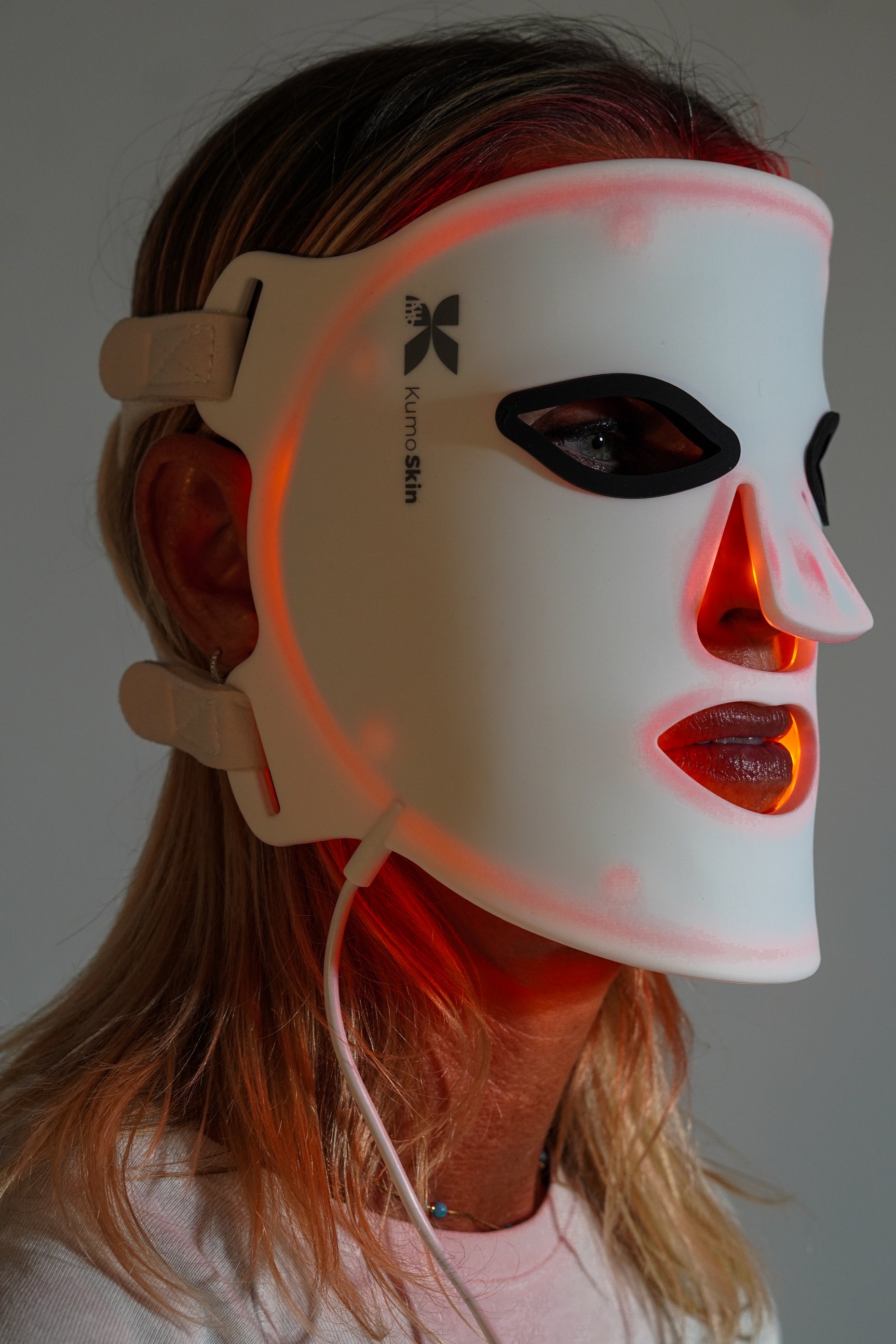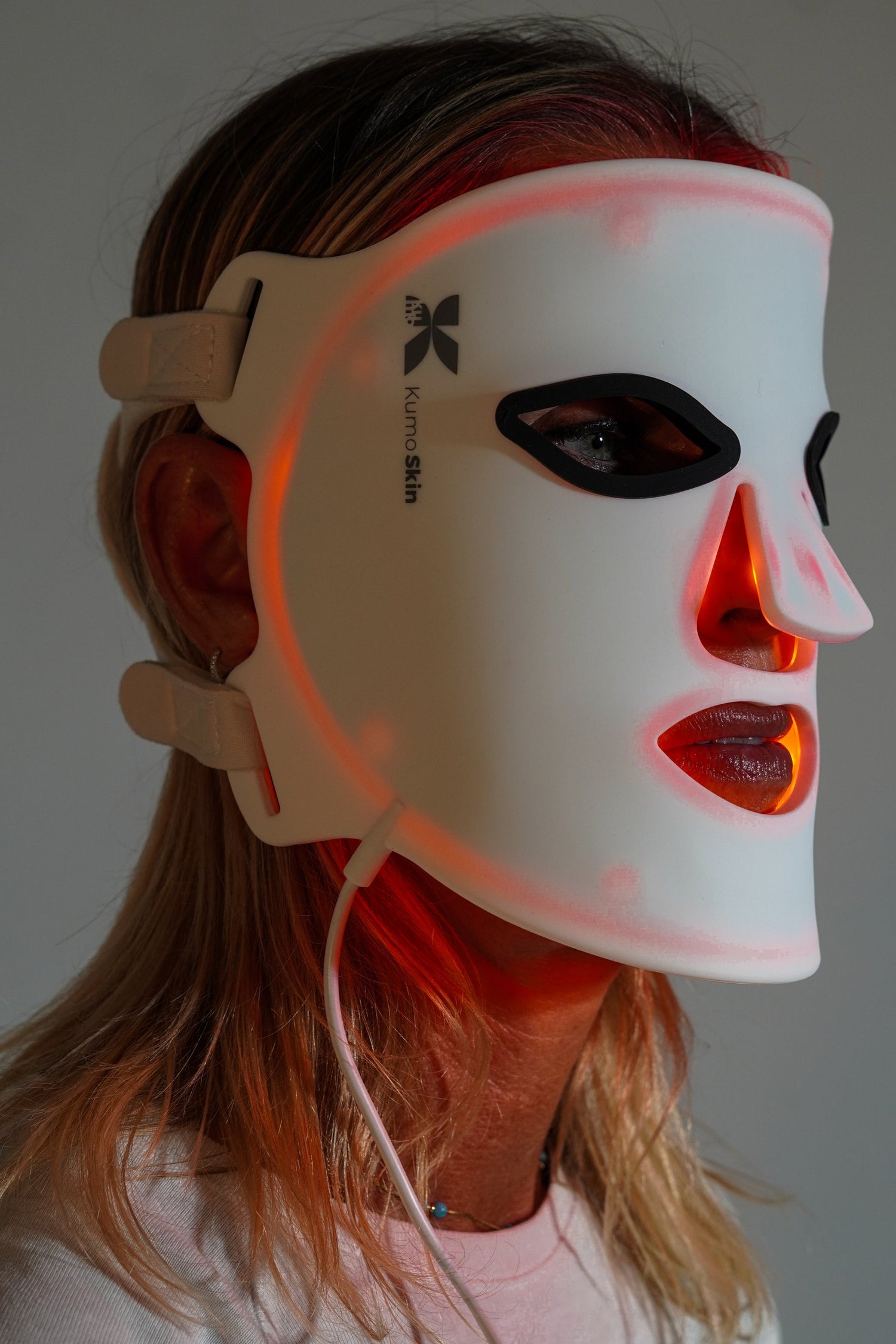
The same light doesn't always win. For most skin types, the red LED mask is the most versatile option when you're looking to improve fine wrinkles, texture, redness, or mild acne; near-infrared adds more depth and makes more sense when you want to support deeper layers or combine objectives. (aad.org)
The key is not just skin color, but also the objective, tolerance, and consistency. Photobiomodulation uses red and near-infrared light within ranges that, in recent reviews, are approximately between 620–700 nm for red and 700–1440 nm for NIR; furthermore, results are usually not seen in a single session, but after several weeks of regular use. (pmc.ncbi.nlm.nih.gov)
Red & infrared light
Recover faster, at home
★★★★★ 4,8/5 · rated by verified customers
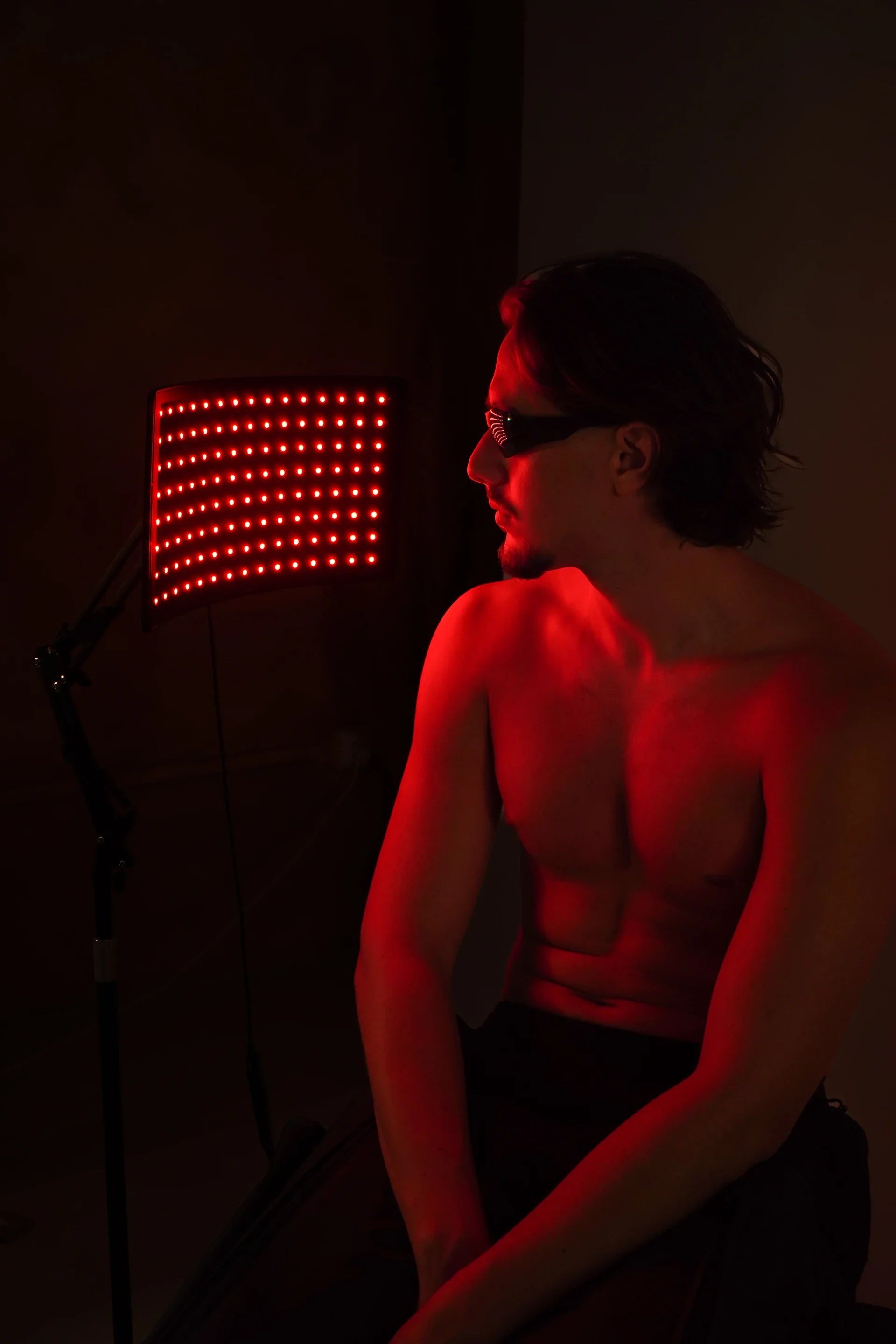
The KumoLux panel supports muscle recovery with full-body red and infrared light.
- 660 nm red + 850 nm infrared light
- Full-body muscle recovery
- Clinically validated biohacking protocols
€399,00€499,00
−10% on your 1st order when you subscribe to the newsletter

Quick Answer: What to choose based on your skin
- Mature skin or skin with early lines: start with red light, as the AAD describes it for signs of aging such as wrinkles and slight sagging.
- Skin with mild to moderate inflammatory acne: red light can help, although many protocols combine blue and red; the overall evidence for LED in acne is promising, but not uniform.
- Skin seeking a deeper action: near-infrared or the red + NIR combination usually fits better because it penetrates deeper.
- Dark, tanned, or very reactive skin: more caution is advised, as the AAD warns of greater sensitivity to visible light and a higher risk of hyperpigmentation.
If you want to first understand the logic behind the device, this guide on how a facial LED mask works will help. This will make it easier to distinguish between wavelength, dose, and consistency. (pmc.ncbi.nlm.nih.gov)
Differences between red and near-infrared light
Red light primarily targets more superficial skin concerns, while near-infrared tends to penetrate deeper and is associated with more profound applications. Scientific reviews generally place red light in the 620–700 nm band, and NIR at longer wavelengths; furthermore, penetration depth increases with wavelength.
Personalized protocol · included with your purchase
Want us to tell you how to use it in your case?
With your purchase, our experts set up your red and infrared light sessions for your sport and goal.
Message us on WhatsAppOur experts reply · no obligation
Summary table
| Situation | Light that usually fits best | Why | Caution |
|---|---|---|---|
| Mature skin or skin with early wrinkles | Red | The AAD describes it for signs of aging, and evidence links it to more superficial rejuvenation goals. | Start with short sessions if your skin is sensitive. |
| Skin with mild inflammatory acne or recent marks | Red; if the device allows, blue + red combination | The AAD uses it as a complementary therapy for acne, and meta-analyses show the benefit of LED in acne vulgaris. | If acne is severe or leaves scars, an LED mask does not replace a dermatological regimen. |
| Skin with a deeper objective | Near-infrared or red + NIR | Reviews place NIR in longer ranges and associate it with greater penetration depth. | Don't confuse "deeper" with "more intense": the dose still matters. |
| Dark, tanned, or very reactive skin | Red with caution and conservative doses | The AAD warns that darker skin tones are more sensitive to visible light and can develop hyperpigmentation. | If you have photosensitivity, lupus, or take photosensitizing medication, consult first. |
If you want to expand the map by specific concerns, you can also read what benefits the LED mask offers for each skin type. The idea is not to choose by trend, but by what your skin needs today.
Which LED mask is best for your skin
Mature or photoaged skin
For fine wrinkles, dull tone, visible pores, and uneven texture, red light is usually the first choice. The AAD mentions it for signs of aging, and in one of its references, it summarizes a study with 90 people who received 8 facial treatments over 4 weeks; more than 90% noticed some improvement. That doesn't mean immediate results, but it does mean consistency matters.
Skin with inflammatory acne
If your skin tends to have red breakouts, red light can be useful as support, although many phototherapy routines combine blue and red because they work on different mechanisms. A 2023 meta-analysis on LED for skin found an important role for red and blue light in acne vulgaris, and another review concluded that red light alone does not always outperform conventional treatments. If you want to understand what results to expect, this guide on facial LED mask results helps set realistic expectations. (pubmed.ncbi.nlm.nih.gov)
on your first order when you join the newsletter
We send you the code instantly. No spam.
Sensitive skin or skin prone to redness
For reactive skin, it is advisable to start with cautious sessions and monitor the skin's response. The AAD notes that, in general, red light therapy appears safe in the short term, but also reminds us that long-term effects are not entirely clear and that some people experience temporary irritation. If you take photosensitizing medications or have a condition that increases light sensitivity, seek professional advice.
Dark, tanned skin or skin at risk of blemishes
The choice is still possible, but expectations and dosages need to be adjusted. The AAD warns that darker skin tones are more sensitive to visible light and can develop more intense and prolonged hyperpigmentation; in addition, mild adverse effects such as prolonged redness and hyperpigmentation were described in maximum dose cohorts in red LED safety trials.
If you're looking for deeper action
When the goal isn't just the surface, near-infrared makes more sense. Recent reviews place it within the photobiomodulation range and link it to greater penetration depth, making it a better fit if you're looking for a more comprehensive approach or a device that combines red + NIR. To better understand the philosophy of home use, you can also review the complete home use guide.
How to use it effectively
Before getting into the routine, it's worth remembering a basic idea: LED light works best when used regularly, the device is well-chosen, and the dosage is not improvised.
- Choose the light based on the objective: red for wrinkles, texture, and mild acne; near-infrared when you want to add depth.
- Follow the manufacturer's instructions: the AAD insists that not all masks work the same and that effectiveness depends on the device and correct use.
- Be consistent for several weeks: in clinical evidence, improvements are observed after repeated treatments, not from a single session.
- Protect your eyes if the equipment requires it: for facial masks, this is not a minor detail.
- If you have photosensitivity or are taking medication that alters light response, consult beforehand: this way you avoid use that could worsen your skin.
And if you want to go from theory to an organized routine, the complete home use guide will help you integrate the mask without improvising.
What the evidence says
The scientific basis is promising, especially for gentle rejuvenation, support for acne and inflammation, and complementary home use. The AAD summarizes studies in which red light showed noticeable improvements in texture, redness, and blemishes, and notes that the FDA has cleared several home devices for signs of aging; even so, it reminds us that not all equipment is equivalent and that long-term data is still lacking.
It's also important to read the evidence with nuance: in reviews and meta-analyses, LED works best when the problem, wavelength, and dose are well-chosen, and it doesn't always clearly outperform conventional treatments. An example cited by the AAD talks about 90 patients with 8 sessions over 4 weeks, with more than 90% reporting some improvement; this suggests potential, but does not guarantee the same result for all equipment or all skin types.
Frequently asked questions
Is red or infrared LED mask better for acne?
For mild to moderate inflammatory acne, red light usually makes more sense than isolated infrared, because it is the one that appears most often in facial protocols and in clinical evidence on skin. However, many masks combine blue and red, as blue is used for acne and red for modulating inflammation and supporting skin recovery. If your acne is intense, leaves scars, or frequently worsens, the LED mask should be seen as a complement, not as a sole treatment.
Is near-infrared better than red for wrinkles?
Not necessarily. Red light is usually the first option when you're looking for a visible effect on the skin's surface, while near-infrared adds depth. That's why in many home and clinical routines, it makes sense to combine both: red for the more superficial part and NIR to add reach. The correct choice depends more on your objective than on an absolute hierarchy between colors.
Can I use it if I have dark skin?
Yes, but with more caution. The AAD indicates that darker skin may be more sensitive to visible light and develop more pronounced hyperpigmentation, so it is advisable to start with conservative sessions and observe the skin's response. If you also have lupus, very active rosacea, or are taking photosensitizing drugs, it is most sensible to seek an assessment before incorporating it into your routine.
When will I see results?
It's usually weeks, not minutes. The AAD reports a study with 90 patients who received 8 treatments over 4 weeks, and more than 90% reported some improvement, but this result is not identical for all equipment or all skin types. Consistency, the type of light, and the quality of the device influence results much more than a single session.
What now?
If you already know you want to try a combined facial mask, the KumoSkin Mask is a direct way to start; if you prefer to first understand the entire ecosystem of light and recovery, explore advanced LED light therapy at home and come back anytime to the Kumo Balance homepage to continue guiding your choice.

Red & infrared light
KumoLux Panel – Red and Infrared LED Panel
★★★★★ 4,8/5 · rated by verified customers
- 660 nm red + 850 nm infrared light
- Full-body muscle recovery
- Clinically validated biohacking protocols
€399,00€499,00· pay in installments with seQura or Klarna