
The neck also ages.
If you already take consistent care of your skin, switching to an LED mask for your neck and décolleté is one of the most logical (and effective) ways to extend your anti-aging routine beyond your face. These areas are often exposed to sun, perfume, friction, and daily neglect, and this is reflected in texture, blemishes, and lines. The good news: with a simple strategy—sun protection + well-chosen active ingredients + LED light—you can gradually improve your skin's quality without any hassle.
Facial red light
Bring your skin back to life
★★★★★ 4,8/5 · rated by verified customers
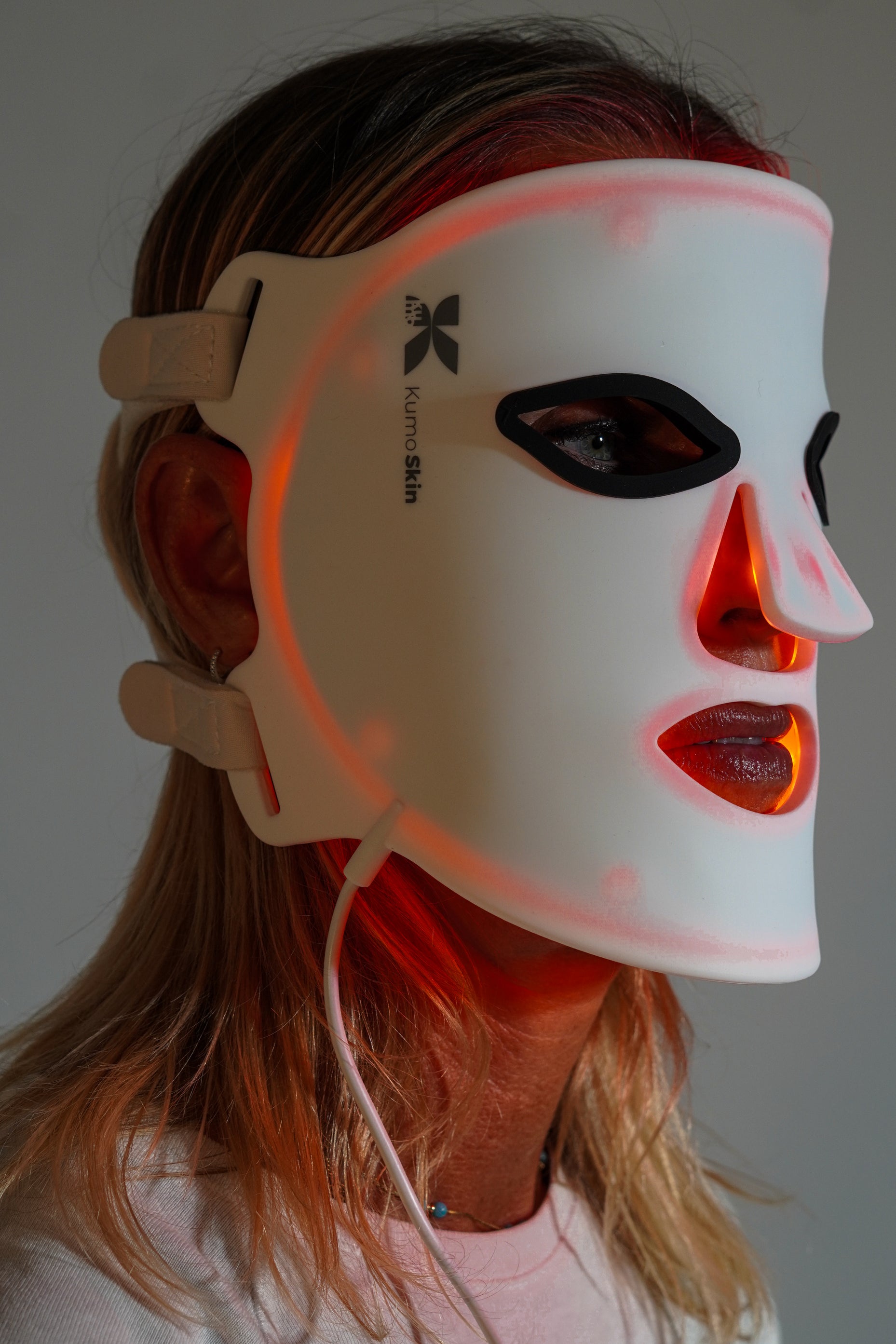
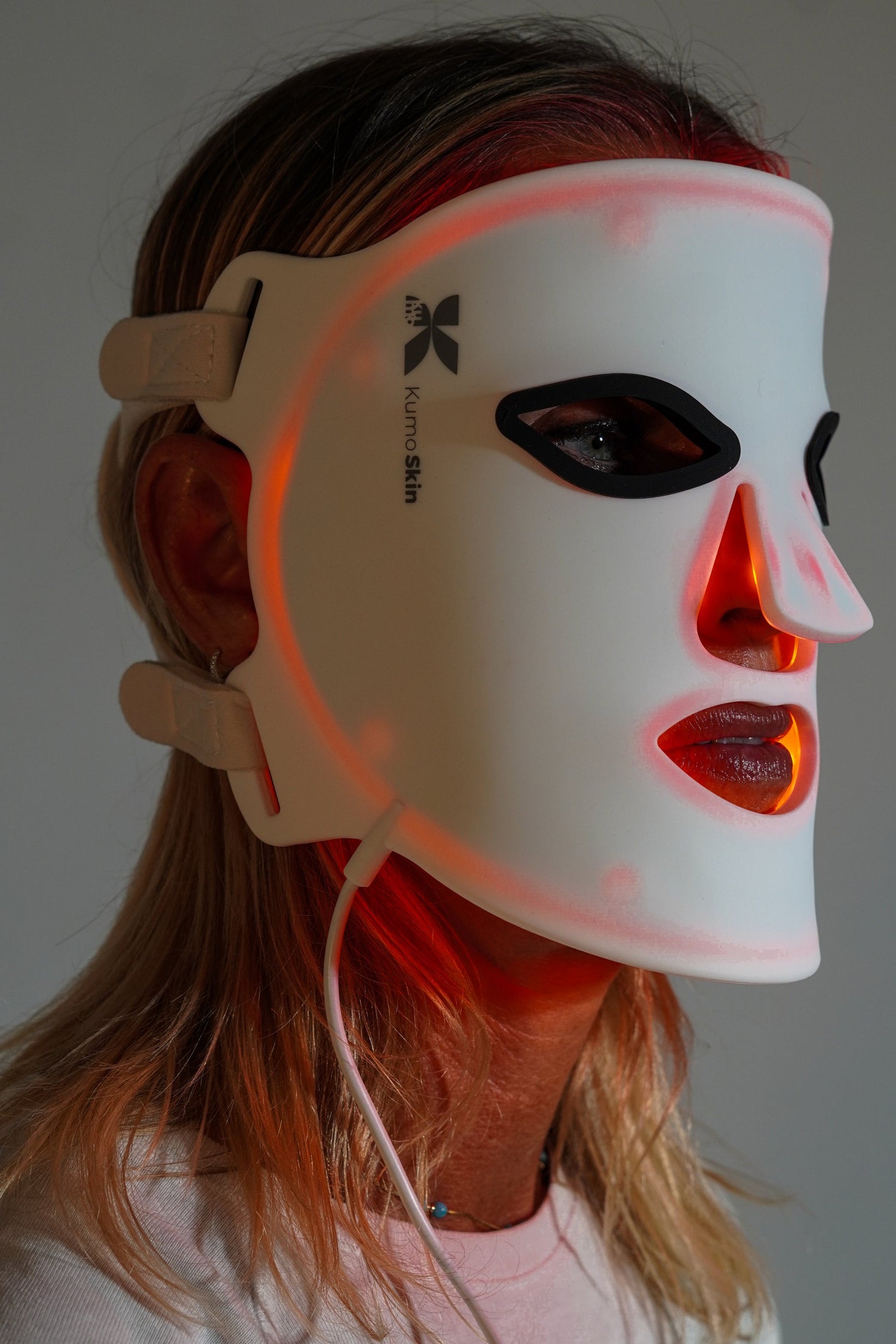
The KumoSkin LED mask helps repair and calm your skin in short sessions at home.
- 250 LEDs in flexible medical silicone
- Red light to boost collagen and glow
- 4 lights: red, infrared, blue and yellow
€299,00€429,00
−10% on your 1st order when you subscribe to the newsletter

At Kumo, we understand skin as an integral part of daily performance: when the barrier is balanced and the routine is sustainable, the results follow. Therefore, if you want to integrate technology into your self-care, you can start by exploring the world of Kumo and its premium recovery approach applied to wellness and aesthetics. ( my.clevelandclinic.org )
Why do the neck and décolletage often "give away" before the face?
Thinner skin, less "reserve" and more exposure
In dermatological literature and aesthetic clinical practice, the neck is often described as a more delicate area: thinner skin with less sebum production than the face, which promotes dryness, a feeling of tightness, and a crepey appearance over time. Furthermore, the décolleté is a major receptor of UV radiation, and many people do not apply sunscreen evenly to their chest and neck. ( whowhatwear.com )
Personalized protocol · included with your purchase
Want us to tell you how to use it in your case?
With your purchase, our experts prepare the ideal LED protocol for your skin type and goal (acne, wrinkles, dark spots...).
Message us on WhatsAppOur experts reply · no obligation
Photoaging: the most significant factor (and it is modifiable)
Skin aging is a combination of intrinsic factors (genetics, the passage of time) and extrinsic factors (primarily UV radiation). A 2013 observational study on visible clinical signs of aging proposed an indicator that attributed a large proportion of these signs to sun exposure in the evaluated population (average ~80%). This isn't a "universal" figure for all skin types and lifestyles, but it effectively illustrates the point: what you do in the sun today greatly influences how your neck looks tomorrow . ( pmc.ncbi.nlm.nih.gov )
Typical spots and redness on the neck: a common example
A classic example of chronic sun damage on the sides of the neck and upper chest is poikiloderma of Civatte (reddish-brown mottling with telangiectasias, sometimes sparing the area under the chin due to shade). It's a good reminder that the neck/décolleté doesn't just "wrinkle": it can also change color and vascularity. ( dermnetnz.org )
What can an LED mask do for the neck and décolleté (without promising miracles)?
LED = photobiomodulation: working with light, not heat
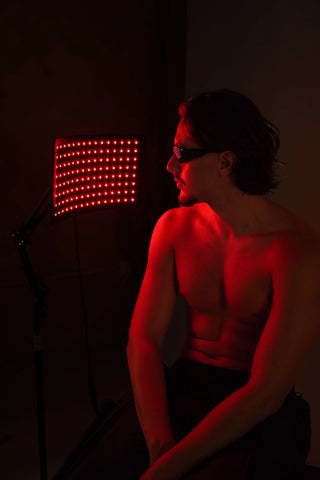
LED therapy (especially red and near-infrared ) falls under the umbrella of photobiomodulation: light acts as a signal for cellular processes related to inflammation, repair, and energy metabolism. In dermatology, it is used to address concerns such as skin texture, fine lines, and signs of photodamage, with a non-invasive approach. ( pubmed.ncbi.nlm.nih.gov )
on your first order when you join the newsletter
We send you the code instantly. No spam.
What the evidence says: modest but real results with consistency
The quality of evidence varies depending on the device, parameters (wavelength, dose), and protocol. Even so, there are trials and reviews that support an effect on signs of photoaging when applied serially. For example, a 2006 clinical trial with combined LEDs (633 nm and 830 nm) reported improvement in wrinkles through instrumental analysis and ultrastructural changes consistent with collagen fiber modification after one course of sessions. ( pubmed.ncbi.nlm.nih.gov )
More recently, a systematic review and meta-analysis (published 2023) evaluated studies on the use of LEDs in skin therapies and concluded that, despite the heterogeneity, there is potential for effectiveness in dermatological/aesthetic applications (with the usual caveat: protocols are not fully standardized). ( pubmed.ncbi.nlm.nih.gov )
Smart expectations: what to expect and what not to expect
- Yes : gradual improvement in luminosity , a feeling of "denser" skin, and a more even texture appearance when combined with a consistent routine.
- No : “erasing” marked laxity or replacing medical procedures (laser, radiofrequency, etc.) if the indication is different.
- Key : consistency. In the clinic and at home, results usually appear after weeks of consistent use.
Even medical sources for the general public point out that home devices are usually less powerful than those used in clinics, so the changes tend to be more subtle. ( my.clevelandclinic.org )
How to integrate the LED mask into an anti-aging routine for neck and décolleté
Recommended order (easy to hold)
- Gentle cleansing : no harsh perfumes; the neck is easily irritated.
- LED on clean, dry skin (or as indicated by your device).
- Hydration/barrier : cream with moisturizers (glycerin, hyaluronic acid) and/or repairers (ceramides).
- Tomorrow : apply sunscreen to the neck and décolletage as well.
If you use potent active ingredients (retinoids, exfoliants), your priority is to avoid irritation: less frequent treatments, smaller doses, and good hydration. LED light therapy doesn't "compensate" for an altered skin barrier; it complements it when the skin is stable.
Sun protection: the most cost-effective “anti-aging” treatment for décolletage
The American Academy of Dermatology (AAD) recommends choosing broad-spectrum sunscreens with SPF 30 or higher that are water-resistant , in addition to measures such as shade and clothing. Without this foundation, any anti-aging technology will have a harder time, especially on the décolletage. (aad.org)
Practical usage protocol (based on how studies are usually designed)
A typical “5-week” cycle to start with
In clinical studies, it is common to see protocols with multiple sessions spread over several weeks. The 2006 trial administered nine treatments over five weeks and assessed changes afterward. At-home treatments vary; therefore, it is advisable to use this idea as a framework (not as an “exact dosage”) and always follow the manufacturer's instructions. ( pubmed.ncbi.nlm.nih.gov )
- Weeks 1–2 : 3–4 sessions/week (duration depends on device).
- Weeks 3–5 : 4–5 sessions/week if there is no sensitivity.
- Maintenance : 2–3 sessions/week.
Signals to adjust (without forcing)
- If persistent redness , stinging or marked dryness appears: reduce frequency and reinforce hydration.
- If you use retinoids on your neck: alternate nights (retinoid) with days of LED lighting and hydration.
- If you have any concerns due to a pre-existing condition or medication, consult a dermatologist.
Safety: what you should know before using LEDs on your neck and décolletage
Eyes, photosensitivity and “FDA-cleared”: understanding the terms
The AAD explains that many devices are sold as “FDA-cleared,” meaning the FDA considers the device low-risk for the public; this does not automatically mean “maximum effectiveness.” Furthermore, the short-term safety of red eye drops appears favorable, with side effects generally being mild (transient irritation), but instructions should always be followed, and eyes should be protected if the manufacturer recommends it. ( aad.org )
Dark skin and sensitivity to visible light
The AAD also warns that, on average, people with darker skin tones may be more sensitive to visible light; if this is the case for you and you plan to use a device at home, it is reasonable to consult a doctor beforehand to minimize the risk of post-inflammatory hyperpigmentation or reactivity. ( aad.org )
The big rule: more is not better.
Photobiomodulation depends on specific parameters (dosage), and excessive use may not provide any benefit. Medical sources for the public emphasize that misuse (too frequently or without eye protection) can increase the risk of irritation or discomfort. If your goal is anti-aging, prioritize consistent, sustainable use. ( my.clevelandclinic.org )
What to look for in an LED mask for the neck and décolleté
Clinically based wavelengths (hint: red + near-infrared)
For anti-aging goals (texture, fine lines, photodamage), red and near-infrared are the spectra most frequently used in studies and reviews on skin rejuvenation. The 2006 trial used 633 nm (red) and 830 nm (near-infrared) with measurable results in photoaging. ( pubmed.ncbi.nlm.nih.gov )
Actual coverage: neck and décolletage are not flat
Look for a design that conforms to the curve of your neck/collarbones, because uniform light distribution matters. A rigid mask that "floats" leaves areas without light and reduces consistent use (comfort = adherence).
Ergonomics and habit: timer, clear sessions and easy to use
At home, success often depends less on “perfect theory” and more on execution: a simple timer, reasonably long sessions, and a routine that doesn't require you to juggle multiple tasks. Medical sources point out that home devices require a time commitment, which can vary widely depending on the product. ( my.clevelandclinic.org )
How this fits into the Kumo approach: aesthetics, technology, and recovery
At Kumo, we treat recovery as a premium habit: well-applied technology, consistency, and an experience you'll want to repeat. If your goal is to extend anti-aging care to your neck and décolleté, it makes sense to do so within a coherent self-care ecosystem.
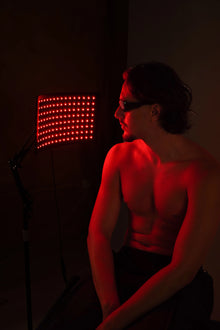
- Explore the LED light therapy collection to integrate light as part of your routine (always respecting instructions and safety).
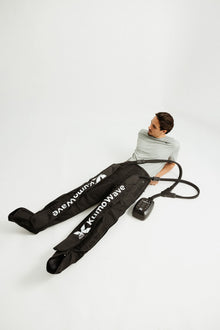
- If your priority is overall well-being (circulation/feeling in your legs), you can combine self-care habits with pressotherapy in your recovery schedule.
- And to release muscle tension that often accumulates in the trapezius/neck, a complementary support can be a deep massage with KumoPulse Air (on muscles, not on the thyroid or sensitive areas).
If you need guidance on how to fit your habits with your skin and lifestyle, the best starting point is to contact us.
Quick reference chart for neck and décolletage
Common goals and how to combine them with LED (without saturating the skin)
| Target on neck/décolleté | Focus with LED light (indicative) | Routine supplements | Safety notes/expectations |
|---|---|---|---|
| More uniform texture + finer lines | Red/Near Infrared (PBM) | Hydration + ceramides; mild retinoid if you tolerate it | Gradual results (weeks). Follow device dosage instructions. |
| Dull and “tired” appearance of the neckline | Red/Near-infrared | Antioxidants in the morning + SPF | Without consistent SPF, progress is slowed by new photodamage. |
| Sunspots and redness (mottled) | LEDs can be support, not "eraser" | Strict SPF; avoid perfume on the neck; consult a doctor if you have poikiloderma. | Diagnosis is key: some disorders require medical laser/IPL. |
| Reactive/irritable skin | Start less frequently | Minimal routine: gentle cleansing + barrier cream + SPF | If there is persistent itching, pause and reassess. |
Scientific reference base on LED/PBM and safety/limitations: clinical trial (2006), reviews and guidelines from AAD/Cleveland Clinic (2021–2024). ( pubmed.ncbi.nlm.nih.gov )
Recommended sources and readings (for further study)
- American Academy of Dermatology (AAD): red light therapy and safety . ( aad.org )
- Cleveland Clinic: LED light therapy (benefits, risks, expectations) . ( my.clevelandclinic.org )
- Clinical trial (2006): LED 633 nm + 830 nm in photoaging . ( pubmed.ncbi.nlm.nih.gov )
- Systematic review and meta-analysis (2023): Use of LED in cutaneous therapies . ( pubmed.ncbi.nlm.nih.gov )
- Study (2013): Impact of the sun on visible signs of aging . ( pmc.ncbi.nlm.nih.gov )
FAQ: Frequently asked questions about Kumo, LED and neck/cleavage
How long does it take to see results from an LED light therapy routine on the neck and décolletage?
It depends on your starting point (sun damage, dryness, consistency) and the device's protocol. In clinical research, cycles are usually measured in weeks: for example, there are trials with several sessions spread over about 5 weeks, followed by evaluations. At home, the most realistic approach is to look for subtle changes after 4–8 weeks of regular use, always combining daily hydration and sun protection. If irritation or sensitivity occurs, reduce the frequency: sustained adherence is better than an all-or-nothing approach. ( pubmed.ncbi.nlm.nih.gov )
Can I use an LED face mask on my neck as well?
Sometimes it's possible, but it's not always ideal. The neck has a different curve, more delicate skin, and areas that may be left uncovered if the device isn't properly fitted. Furthermore, safety and dosage are designed for a specific area: the correct approach is to follow the manufacturer's instructions and prioritize comfort to ensure consistent use. If you're going to incorporate light into your routine with Kumo light therapy, the key is to look for solutions designed for practical and safe use, avoiding improvisations that could increase irritation or lead to discontinuation. ( my.clevelandclinic.org )
What does it mean for a device to be “FDA-cleared” and why does it matter?
“FDA-cleared” indicates that the FDA considers the device low-risk for the public based on its category and regulatory process; it is not an automatic guarantee of optimal results. The AAD emphasizes that seeing “FDA-cleared” indicates relative safety, while terms like “FDA approved/certified” can be misleading in marketing. In a serious neck and décolleté routine, this matters because it helps you filter out devices with better control standards and maintain realistic expectations: consistency, correct parameters, and eye protection when appropriate. ( aad.org )
Is red light compatible with retinol or acids on the neck and décolleté?
Yes, it's usually compatible, but the key is tolerance. The neck is more easily irritated, so it's best to alternate: retinoid at night (small amount) and LED light therapy + barrier hydration on other days. Avoid accumulating strong stimuli on the same day if your skin reacts (for example, exfoliation + retinoid + LED light). If persistent stinging occurs, reduce frequency, simplify your routine, and prioritize SPF. Technology helps when the skin barrier is stable; if there is inflammation, the skin will "recover" first. ( my.clevelandclinic.org )
Is it a good idea to use LED if I have dark spots or redness on my décolletage?
It can be helpful, but it's important to identify the cause. Some changes in skin color and blood vessels on the neck (such as poikiloderma of Civatte) are related to chronic sun exposure and, sometimes, to sensitizers like perfumes applied to the area. In these cases, the foundation is strict sun protection and avoiding fragrances on the neck and décolleté; and, depending on the severity, medical treatment (IPL/laser) may be more effective than at-home LED light therapy. If you have any doubts, a dermatological evaluation will save you time and frustration. ( dermnetnz.org )
So what now?
If you want to take your anti-aging routine beyond your face with a technological and sustainable approach, start by building a solid foundation (SPF + hydration) and then intentionally integrate light therapy. You can discover LED light therapy within the Kumo ecosystem, and if you need help fitting these habits and recovery into your daily life, contact us through our contact page .

Facial red light
KumoSkin Mask – LED Facial Mask
★★★★★ 4,8/5 · rated by verified customers
- 250 LEDs in flexible medical silicone
- Red light to boost collagen and glow
- 4 lights: red, infrared, blue and yellow
€299,00€429,00· pay in installments with seQura or Klarna