LED facial mask: a complete guide to treating acne, blemishes and wrinkles with safe and effective light.
If you're looking for a non-invasive solution to improve acne, reduce blemishes, and smooth wrinkles, LED light therapy in a mask is an option supported by modern dermatology. Here you'll discover how it works, which colors to use, how to use it safely at home, and what results you can expect based on the available evidence.
Facial red light
Bring your skin back to life
★★★★★ 4,8/5 · rated by verified customers
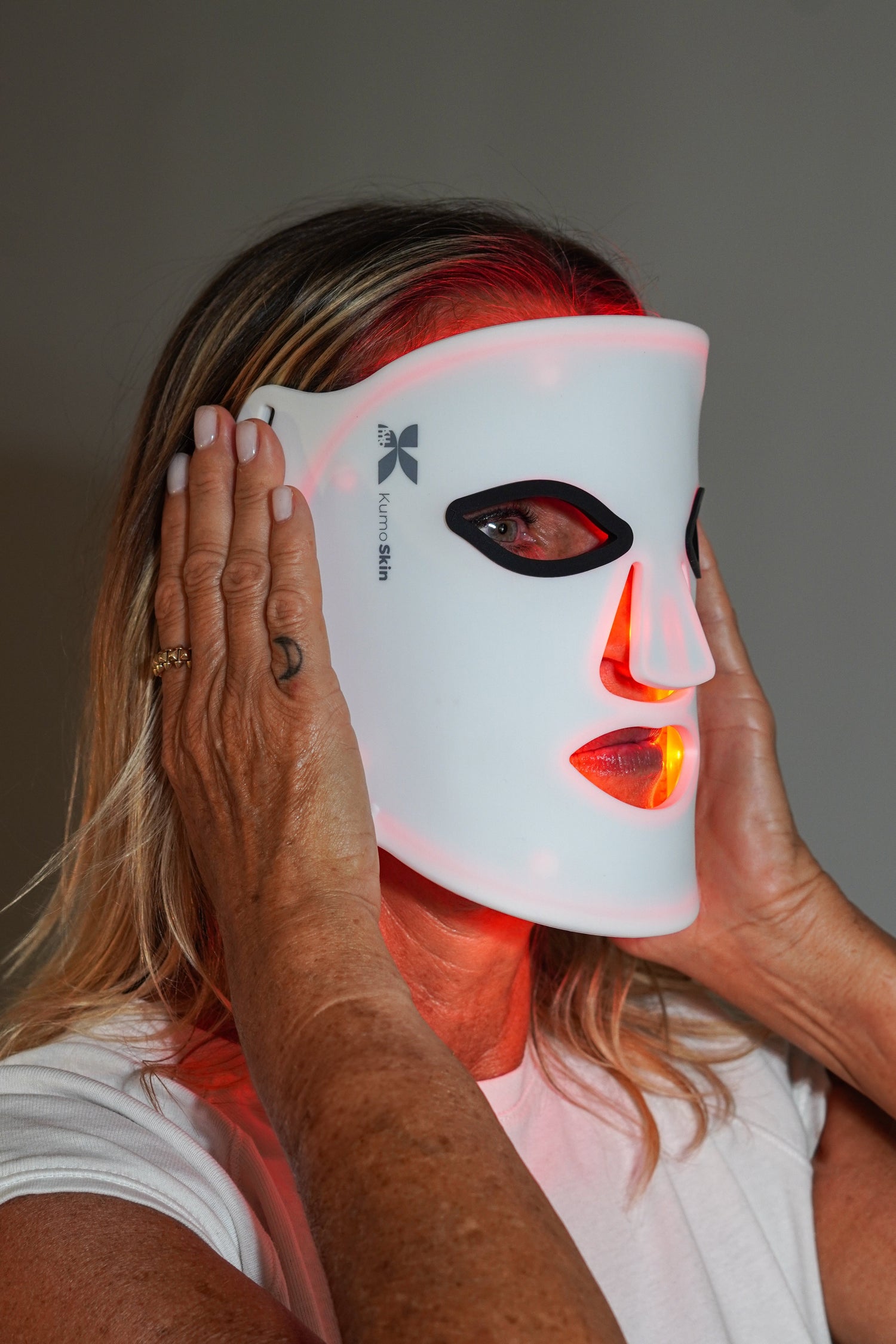
The KumoSkin LED mask helps repair and calm your skin in short sessions at home.
- 250 LEDs in flexible medical silicone
- Red light to boost collagen and glow
- 4 lights: red, infrared, blue and yellow
€329,00€429,00
−10% on your 1st order when you subscribe to the newsletter

In a little while
- It works by photobiomodulation: blue light for acne, red light for inflammation and collagen, and near infrared light for support in deep repair.
- Typical use: short, regular sessions over several weeks; consistency > occasional intensity.
- Safe for most skin types; use caution if you are taking photosensitizing drugs or have photosensitive conditions.
- Complementary improvement: it does not replace medical treatments when these are necessary.
- Choose for precise wavelengths, realistic power, comfort, and safety guarantees.
What is an LED face mask and how does it work?
The LED facial mask emits specific wavelengths that activate biological processes in the skin without heat or damage. This interaction is called photobiomodulation: photons are absorbed by cellular chromophores (such as cytochrome c oxidase), modulating cellular energy and signaling that influence inflammation, tissue repair, and collagen synthesis. You can delve deeper into the fundamentals in this landmark 2013 clinical review on dermatological photobiomodulation by Avci et al., Seminars in Cutaneous Medicine and Surgery .
Main colors and objectives
- Blue light (≈415 nm): helps against Cutibacterium acnes by activating porphyrins and may reduce superficial breakouts.
- Red light (≈630–660 nm): modulates inflammation, supports fibroblasts and collagen synthesis, associated with improvement of fine texture and lines.
- Near infrared/NIR (≈810–850 nm): greater penetration; used as an adjunct in skin repair and comfort.
DermNet NZ offers a global overview of low-level light therapy and its dermatological uses.
Personalized protocol · included with your purchase
Want us to tell you how to use it in your case?
With your purchase, our experts prepare the ideal LED protocol for your skin type and goal (acne, wrinkles, dark spots…).
Message us on WhatsAppOur experts reply · no obligation
Skin care benefits
Acne: Breakouts, Inflammation and Maintenance
The combination of blue and red light is commonly used to address both bacterial load and inflammation. The American Academy of Dermatology indicates that lights and lasers can help reduce acne when used correctly and with realistic expectations (AAD: Lasers and lights for acne). A Cochrane review (2016) suggests positive, though variable, results and highlights the need for consistent protocols and adherence to treatment (Cochrane Library, 2016 ).
Practical example: If your acne is mild to moderate, you can use blue/red light several days a week for 8–12 weeks and consider maintenance. If nodules or cysts are present, consult a dermatologist; LED therapy can be an adjunct to, but not a substitute for, medical treatments.
Spots: uneven tone and post-inflammatory hyperpigmentation
LED therapy doesn't "erase" dark spots on its own, but it can contribute indirectly: by calming inflammation (redness/NIR) and supporting repair, it helps in cases of post-inflammatory hyperpigmentation associated with acne. It's essential to combine it with daily sun protection to prevent recurrence, as recommended by the AAD in their Hyperpigmentation Overview. For melasma or other types of dark spots, LED therapy can be a gentle complement; consult with your specialist to personalize your treatment plan.
on your first order when you join the newsletter
We send you the code instantly. No spam.
Fine lines, texture and firmness
Red light and near-infrared (NIR) light have been investigated for mild photoaging: they soften fine lines and improve radiance and overall appearance over time. A clinical review in JCAD (2018) compiles evidence on LED rejuvenation and its favorable safety profile (J Clin Aesthet Dermatol, 2018 ). Controlled studies have observed modest but significant improvements after several weeks of consistent use (Avci 2013 ).
The key is not intense exposure, but the right cumulative dose and regularity, adjusted to your skin tolerance.
How to safely use an LED mask at home
Before the session
- Cleanse the skin and dry gently.
- Avoid retinoids, AHAs/BHAs, or benzoyl peroxide right before if your skin is sensitive; reintroduce them on alternate days.
- If you are taking photosensitizing drugs (e.g., certain antibiotics), consult your doctor.
During the session
- Follow the manufacturer's recommended time; typical sessions are short.
- Keep your eyes closed; wear eye protection if the mask includes it.
- You don't need heat or pain: the LED works at low power.
A clear guide on benefits and precautions is offered by the Cleveland Clinic LED Light Therapy, Cleveland Clinic.
After the session
- Apply a gentle moisturizer.
- During the day, use broad-spectrum sunscreen.
- Observe your skin: if you notice persistent irritation, reduce the frequency or consult a professional.
How to choose a good LED face mask
- Specific wavelengths: look for clear nm (e.g., 415 nm blue, 630–660 nm red, 810–850 nm NIR).
- Realistic and uniform irradiance: more is not always better; the total safe dose matters.
- Comfort and ergonomics: stable adjustment, timer, integrated eye protection.
- Certifications and safety: skin-safe grade materials and electrical compliance.
- Useful modes, not just “many colors”: prioritize red/blue/NIR with clear protocols.
If you value aesthetics, technology, and performance to make recovery a habit, discover the KUMO philosophy.
Table: Wavelengths and intended uses
| Light/Color | Wavelength (approx.) | Main objective | Evidence/Notes | Indicative frequency |
|---|---|---|---|---|
| Blue | 415 nm | Superficial acne outbreaks | Activates porphyrins of C. acnes | Several times/week during 8–12 week cycles |
| Red | 630–660 nm | Inflammation and collagen support | Light rejuvenation, texture | 3–5 times/week, short and regular sessions |
| NIR | 810–850 nm | Deep repair/adjuvant | Complements red; greater penetration | 3–5 times/week depending on tolerance |
| Amber | 585–590 nm | Luminosity/slight redness | Complementary use, less evidence | Optional, depending on skin response |
Note: The exact frequency depends on the device and your tolerance. Prioritize consistency and listen to your skin.
Contraindications and side effects
- Photosensitivity: If you are using medication or have photosensitive conditions, consult a doctor first.
- Migraines/headaches: light can be a trigger for sensitive people; adjust duration and intensity.
- Photosensitive epilepsy: avoid without medical advice.
- Pregnancy and breastfeeding: LED lighting is generally considered safe, but consult your doctor if you have any doubts.
- Common but mild effects: temporary dryness, slight redness or tightness; these usually subside when sessions are spaced out.
The NHS stresses that light therapy can be helpful as an adjunct to acne, but the response varies and sometimes specific medical treatments are required. NHS: Acne treatment .
Evidence in context
- AAD: Overview of lasers and lights for acne and realistic outcome expectations.
- Cochrane Review (2016): Light therapies for acne with modest benefits and heterogeneity of Cochrane studies.
- Clinical review on LED in dermatology and photobiomodulation Avci 2013 .
- Summary of safety/benefits in LED rejuvenation JCAD 2018 .
- Cleveland Clinic Practical Guide to Patient Safety and Expectations
- Hyperpigmentation: importance of daily photoprotection AAD.
Frequently Asked Questions
How long does it take to see results with an LED mask?
Most users notice gradual changes after 4–6 weeks of consistent use, with more noticeable improvements at 8–12 weeks. For acne, inflammation and the frequency of breakouts typically decrease first; for texture and fine lines, the changes are more subtle and cumulative. Consistency is key: several short weekly sessions are more effective than sporadic use. If you don't see progress after 12 weeks, review the protocol, combine it with appropriate topical care, and/or consult a dermatologist to adjust the plan.
Is it safe for sensitive skin or rosacea?
LED light operates at low power and does not heat the skin, so it is usually well-tolerated, even on sensitive skin. Even so, start with shorter, less frequent sessions, observing your response. In rosacea, some people experience an improvement in redness with gentle red light; others may experience irritation. Adjust the settings and avoid potentially irritating active ingredients on the same day (e.g., strong acids). If flare-ups occur, discontinue use and consult a professional to personalize your treatment plan.
Can I use it if I'm on retinoids or antibiotics?
You can, but with some caveats. Topical retinoids can increase sensitivity; spacing out their application (e.g., alternating nights) helps minimize irritation. Some antibiotics and medications are photosensitizing: check the package insert and consult your doctor if you're unsure. If you are currently taking or have recently taken oral isotretinoin, it's wise to seek dermatological advice before starting any at-home light therapy.
Eye damage? Do I need eye protection?
Quality LED masks include diffusers and recommend closing your eyes; some even come with eye protection. Although LEDs are not lasers and do not emit heat, prolonged, direct exposure to intense light can be uncomfortable. Use the mask as directed, avoid staring at the LEDs, and if you are photosensitive or bothered by the light, use the included or compatible blackout glasses. If headaches or eye strain occur, reduce the time or frequency of exposure.
Red light vs. blue light: which do I choose?
It depends on your goal. For active acne, blue light (≈415 nm) helps target C. acnes and is often combined with red light to modulate inflammation. To improve texture, reduce redness, and minimize fine lines, red light (≈630–660 nm) is the priority and can be complemented with near-infrared (≈810–850 nm) for deeper support. Many masks allow you to alternate programs; try 8–12 week cycles and adjust according to your skin's response and the manufacturer's guidelines.
To remember
- The LED mask is a non-invasive and safe tool when used consistently and following instructions.
- Blue for breakouts; red (and NIR) for inflammation, texture, and collagen support.
- The results are gradual: think in weeks, not days; sun protection is mandatory if you are treating spots.
- Personalize: start with short sessions, adjust according to tolerance, and combine with a simple routine.
- If you have moderate-to-severe acne or medical concerns, coordinate its use with a dermatologist.
- Take the first step towards a smart and aesthetic recovery routine with KUMO 's proposal.

Facial red light
KumoSkin Mask – LED Facial Mask
★★★★★ 4,8/5 · rated by verified customers
- 250 LEDs in flexible medical silicone
- Red light to boost collagen and glow
- 4 lights: red, infrared, blue and yellow
€329,00€429,00· pay in installments with seQura or Klarna