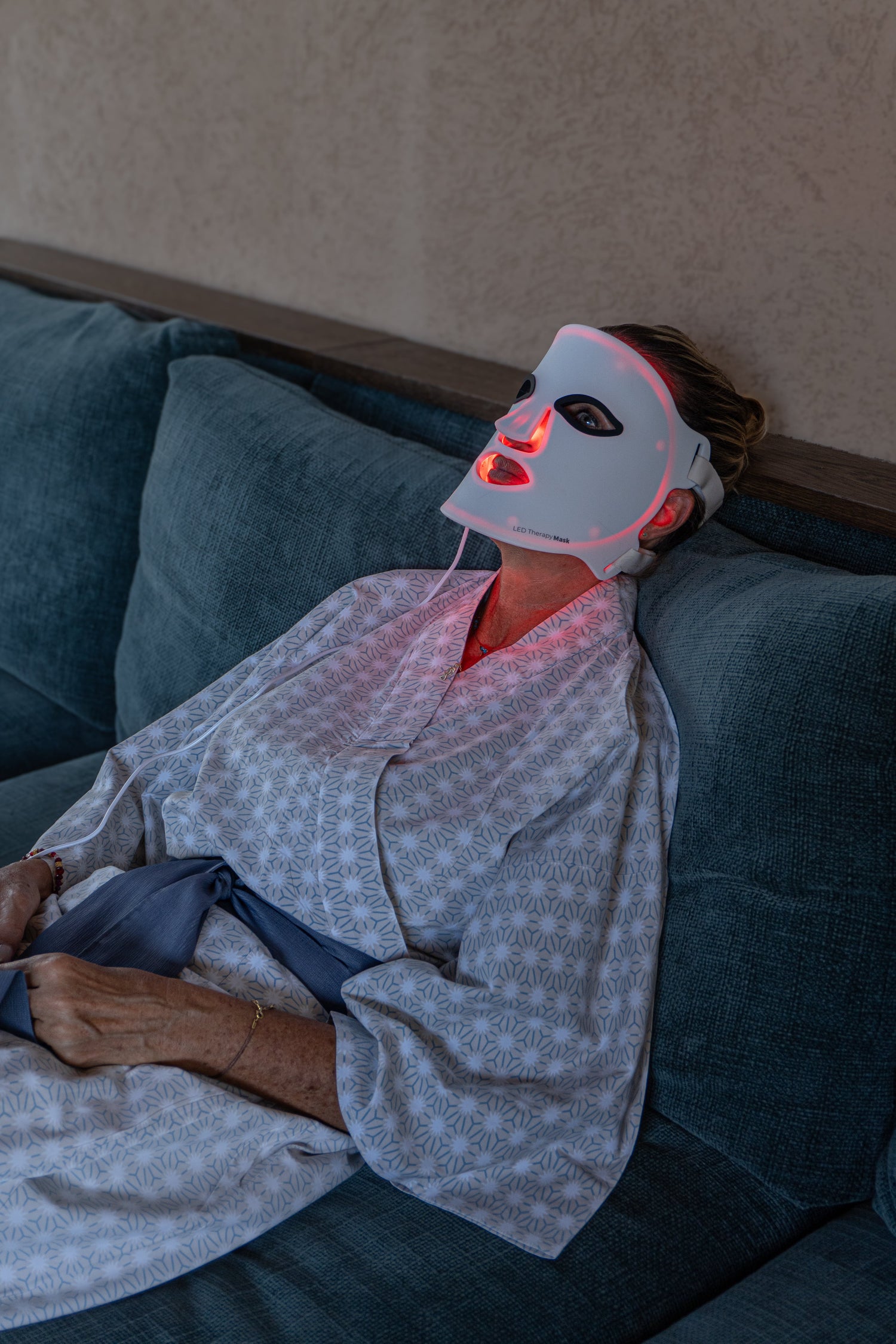
At-home facial phototherapy can work.
The problem is usually not with the light itself, but with how it's used: too much frequency, poor skin preparation, unrealistic expectations, or ignoring contraindications. If you want a general overview of the brand's approach, Kumo Balance's wellness and recovery proposal and the explanation of what a facial LED mask is and how it works will help you get oriented; here we will focus on the most common mistakes that hinder results. (aad.org)
Facial red light
Bring your skin back to life
★★★★★ 4,8/5 · rated by verified customers
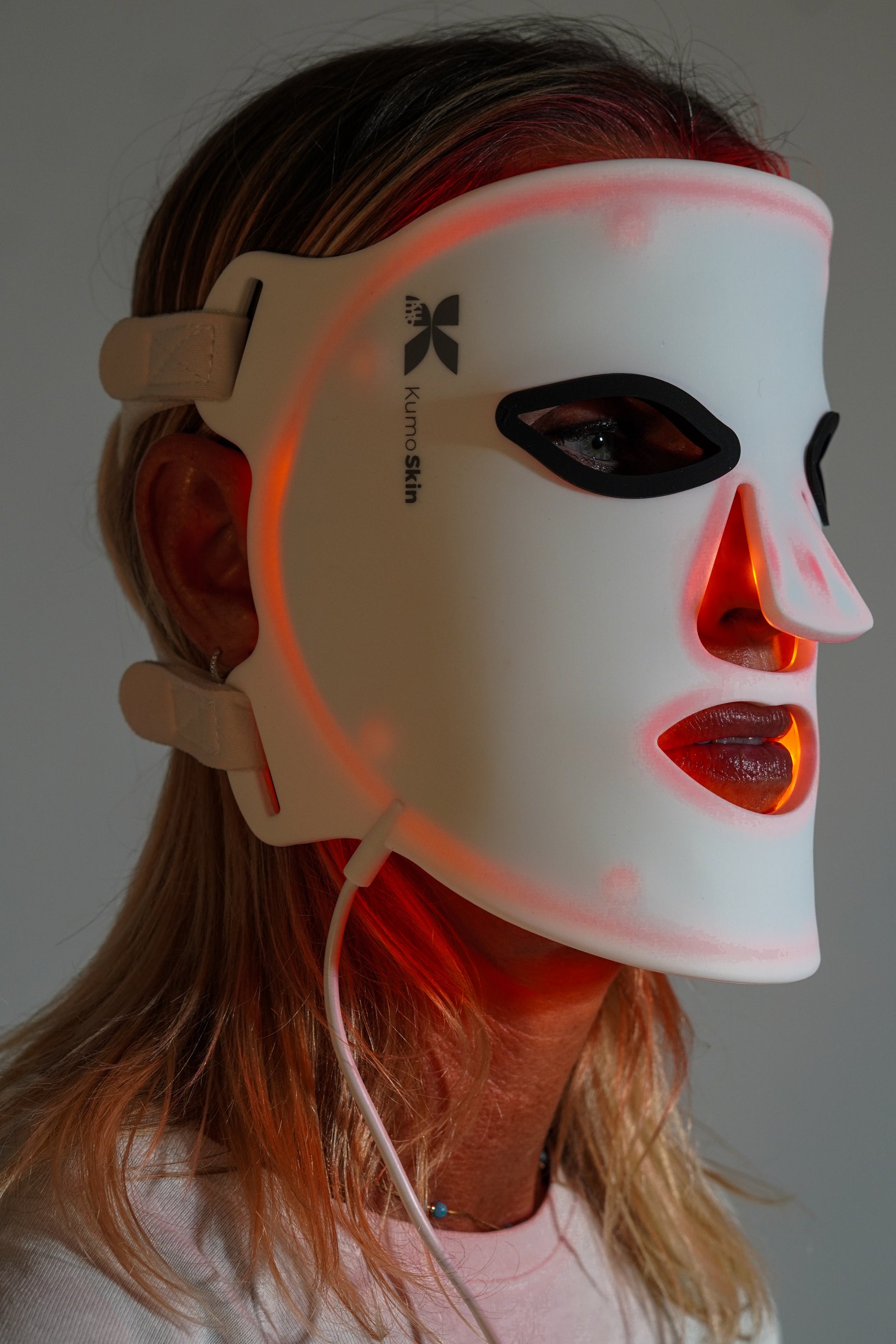
The KumoSkin LED mask helps repair and calm your skin in short sessions at home.
- 250 LEDs in flexible medical silicone
- Red light to boost collagen and glow
- 4 lights: red, infrared, blue and yellow
€299,00€429,00
−10% on your 1st order when you subscribe to the newsletter

What you should know before starting
Red light therapy or photobiomodulation uses red or near-infrared light and is sold in formats such as masks, panels, and wands. The AAD's guide to red light therapy notes that, in the short term, it appears safe, that long-term effects are not yet entirely clear, and that the "FDA-cleared" label does not equate to a promise of efficacy. (aad.org)
If you are looking at at-home options, at-home facial LED light therapy can serve as a starting point, but it's important to choose the device according to your actual goal. The AAD points out that home devices are usually less powerful than those used in clinics and that visible light does not treat all skin problems equally. (aad.org)
Personalized protocol · included with your purchase
Want us to tell you how to use it in your case?
With your purchase, our experts prepare the ideal LED protocol for your skin type and goal (acne, wrinkles, dark spots...).
Message us on WhatsAppOur experts reply · no obligation
Common mistakes when using at-home facial phototherapy
Quick summary of the most frequent mistakes
| Mistake | What usually happens | How to avoid it |
|---|---|---|
| Extending sessions or increasing frequency without control | Skin becomes irritated and there isn't always more benefit. | Follow the manual and start with the minimum tolerated frequency. |
| Choosing a device that doesn't match your goal | You expect results for acne, wrinkles, or dark spots that this device doesn't address equally. | Buy by objective, not by general promise. |
| Ignoring medication or photosensitivity | Increases the risk of discomfort or hyperpigmentation. | Review contraindications before starting. |
| Seeking immediate effects | You give up before giving the treatment time to work. | Think in weeks, not in a single session. |
| Not adapting the routine to your skin type | Some skin types react worse, especially if they tend to stain easily. | Start slowly and observe the response. |
To elaborate on these points, the AAD's guide on red light, the AAD's guide on lights and acne, the 2024 systematic review on visible light in acne, and the 2023 clinical study on facial red photobiomodulation are worth reading. (aad.org)
Don't confuse safety with efficacy
Another very common mistake is to rely more on the label than on the actual indication. In the FDA warning letter to an LED manufacturer, it was explained that certain uses, such as scars, skin tightening, or inflammation, were not supported for that device; the AAD, for its part, clarifies that "FDA-cleared" only indicates a low level of risk, not that the device works miracles. (fda.gov)
The goal dictates
If your goal is acne, visible light can mainly help with pimples, but not with all lesions. The AAD on lights and acne indicates that a series of treatments is usually necessary and that results are variable; moreover, a 2024 review gathered 35 studies and 1,185 cases, but could not convert that diversity into a single universal recipe. (aad.org)
on your first order when you join the newsletter
We send you the code instantly. No spam.
The correct frequency is what your skin tolerates
In rejuvenation, the mistake is to copy someone else's routine without looking at the manual. A 2023 study with 20 healthy women used two sessions per week for three months and observed progressive improvements in signs of facial aging; this serves as a reference, not as a rule for all devices. (pubmed.ncbi.nlm.nih.gov)
Skin also matters
The AAD warns that darker skin tones may be more sensitive to visible light and develop more intense and long-lasting hyperpigmentation. If you tend to stain easily, start cautiously and observe your skin's response before increasing frequency or duration. (aad.org)
Don't ignore contraindications
If you have a photosensitive condition or take medications that increase light sensitivity, it's not advisable to improvise. The AAD recommends talking to a dermatologist before using a home device in these cases. To learn more about this, you can review the contraindications and safety of the LED mask. (aad.org)
Don't expect instant results
Consistency matters more than intensity. The AAD insists that it is not a one-time treatment and that changes usually take time; giving up after a few uses is one of the most common reasons for disappointment. (aad.org)
How to avoid irritation and improve efficacy
Prepare your skin with a simple routine
- Start with clean, dry skin to avoid adding variables to the session.
- Avoid combining it with active ingredients that already irritate you.
- Respect the frequency indicated by the manufacturer.
- If you notice that your skin reacts easily, reduce the complexity of the routine before turning on the device.
The AAD insists on following the device's instructions and starting with a conservative approach rather than an aggressive one. If you want to better organize your sessions, the step-by-step guide to using a facial LED mask will help you. And if you are interested in refining the pre- and post-cleaning, the device cleaning and care guide can support you. (aad.org)
Signs that you should stop and review
- Burning or persistent pain after the session.
- Redness that does not subside quickly.
- New or darker spots.
- Repeated irritation after several sessions.
The idea is not to "endure more," but to adjust better. The AAD describes mild discomfort and temporary irritation as the most common effects, and also reminds that hyperpigmentation can appear more easily on some skin types. (aad.org)
What are realistic results
At-home facial phototherapy does not usually produce spectacular changes overnight. According to the AAD, red light is a useful option but not a miracle cure; in acne, improvement depends on the individual and often requires several treatments. (aad.org)
Recent evidence helps explain why the results are so variable. The 2024 review of visible light in acne gathered 35 studies and 1,185 cases, but the diversity of designs prevented a single quantitative synthesis. In parallel, a 2023 clinical study with 20 healthy women observed progressive improvements in signs of facial aging after a protocol of two sessions per week for three months. (journals.sagepub.com)
In other words: consistency matters more than intensity, and the right device for your goal matters more than accumulating minutes without criteria. (aad.org)
Frequently asked questions
What are the most common mistakes when using at-home facial phototherapy and how can they be avoided?
The most common mistakes are extending sessions, using the device more often than indicated, choosing a light that does not match your goal, and skipping contraindications. The safest way to avoid them is to read the manual, start with the most conservative protocol, not mix it with products that irritate you, and check if your skin is photosensitive. The AAD reminds us that therapy is not a one-time treatment and that the choice of equipment should correspond to the problem you want to treat. (aad.org)
Is at-home facial phototherapy safe and what precautions should I take to avoid side effects?
Yes, in the short term it is usually safe, but it is not for everyone. The AAD indicates that the most common side effects are mild, such as temporary irritation or discomfort; it also warns that people with lupus, photosensitivity, or treatments that increase light sensitivity should consult beforehand. If your skin tone tends to pigment easily, proceed more slowly because visible light can promote hyperpigmentation. (aad.org)
What factors can make at-home LED phototherapy less effective and how to optimize them without damaging the skin?
The main factors are using an incorrect objective, not being consistent, skipping the manufacturer's frequency, and expecting the LED to solve everything on its own. The AAD reminds us that results vary, that home devices are less powerful than those used in clinics, and that, in acne, visible light does not treat pimples, blackheads, or nodules equally. To optimize without irritating, maintain a simple and consistent routine for several weeks. (aad.org)
How to prepare the skin before an at-home facial phototherapy session for best results?
Before the session, clean and dry your skin, remove makeup, and avoid active ingredients that already sensitize you. The idea is to reduce variables so that the skin responds stably. If you use retinoids, acids, or prescribed treatments, consult how to space out the session. It also helps to follow the device's instructions precisely and maintain a conservative frequency at the beginning. (aad.org)
How long should each at-home facial phototherapy session last and how often is it recommended to use it to avoid irritation?
There is no universal duration. The AAD insists on following the device's instructions and not treating phototherapy as a one-off. As a clinical reference, a 2023 study on facial rejuvenation used two sessions per week for three months; in acne, the AAD describes more frequent home protocols for some devices, but that does not mean you should copy someone else's. The best frequency is what you can sustain without irritation. (aad.org)
What now?
If you want to take the next step, continue reading what red light therapy is and how it works and turn at-home facial phototherapy into a simple, consistent, and well-tolerated routine.

Facial red light
KumoSkin Mask – LED Facial Mask
★★★★★ 4,8/5 · rated by verified customers
- 250 LEDs in flexible medical silicone
- Red light to boost collagen and glow
- 4 lights: red, infrared, blue and yellow
€299,00€429,00· pay in installments with seQura or Klarna