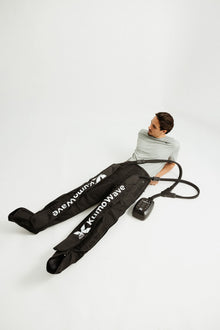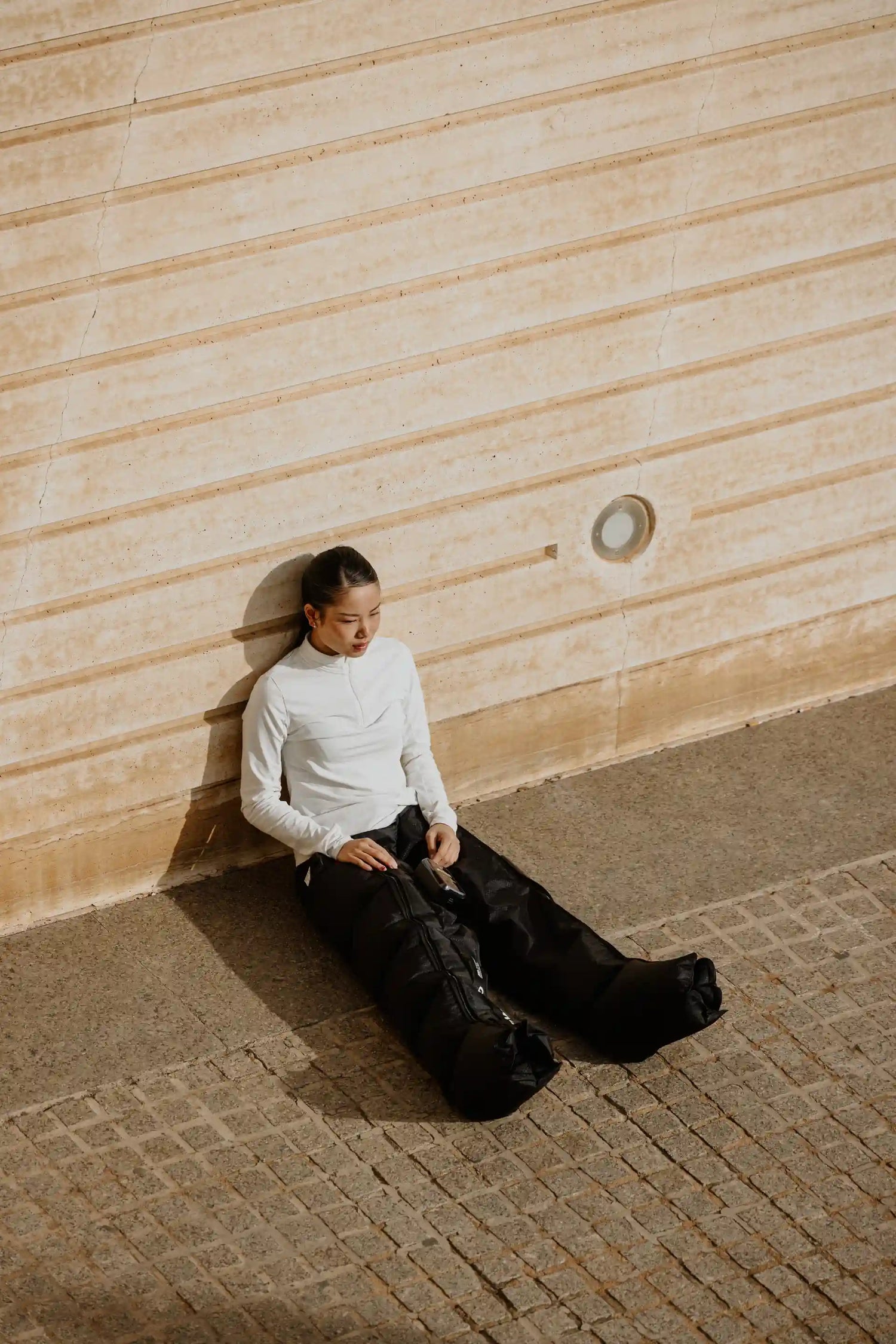
Not all legs require the same compression.
Independent leg control (left/right) is a particularly useful feature when your recovery is asymmetrical: one leg is more stressed, more sensitive, has more fluid retention, or simply feels different. In this article, you will see real use cases, a practical methodology for adjusting each side without complication, and how to integrate it into a recovery approach with Kumo as a daily habit.
Pressotherapy at home
End the day with light legs
★★★★★ 4,8/5 · rated by verified customers
KumoWave pressotherapy boosts circulation and helps drain fluid with sequential compression, in 20-minute sessions at home.
- Boosts circulation and helps drain fluid
- Chamber-based compression, adjustable to you
- Sequential compression that mimics manual drainage
€799,00€999,00
−10% on your 1st order when you subscribe to the newsletter

If you've just arrived here looking for "how to use it" and "when it makes sense," this guide gets straight to the point: what it is, who it's for, how to set it up, and what the evidence says (without promising miracles).
To learn about the Kumo universe and its philosophy of premium recovery, you can start here: Kumo.
Personalized protocol · included with your purchase
Want us to tell you how to use it in your case?
With your purchase, our experts prepare a personalized usage protocol for your case: sport, circulation, fluid retention, pregnancy or lipedema.
Message us on WhatsAppOur experts reply · no obligation
What does “independent leg control” mean in pressotherapy?
Two levels of "independence": by leg vs. by chambers
In practice, independence is discussed in two senses:
- Independent leg control (L/R): you can apply different intensity, program, or time to the left and right legs.
- Zone control (chambers): the device works with several chambers that inflate sequentially to "travel" up the leg. More chambers mean more possibilities to distribute pressure progressively.
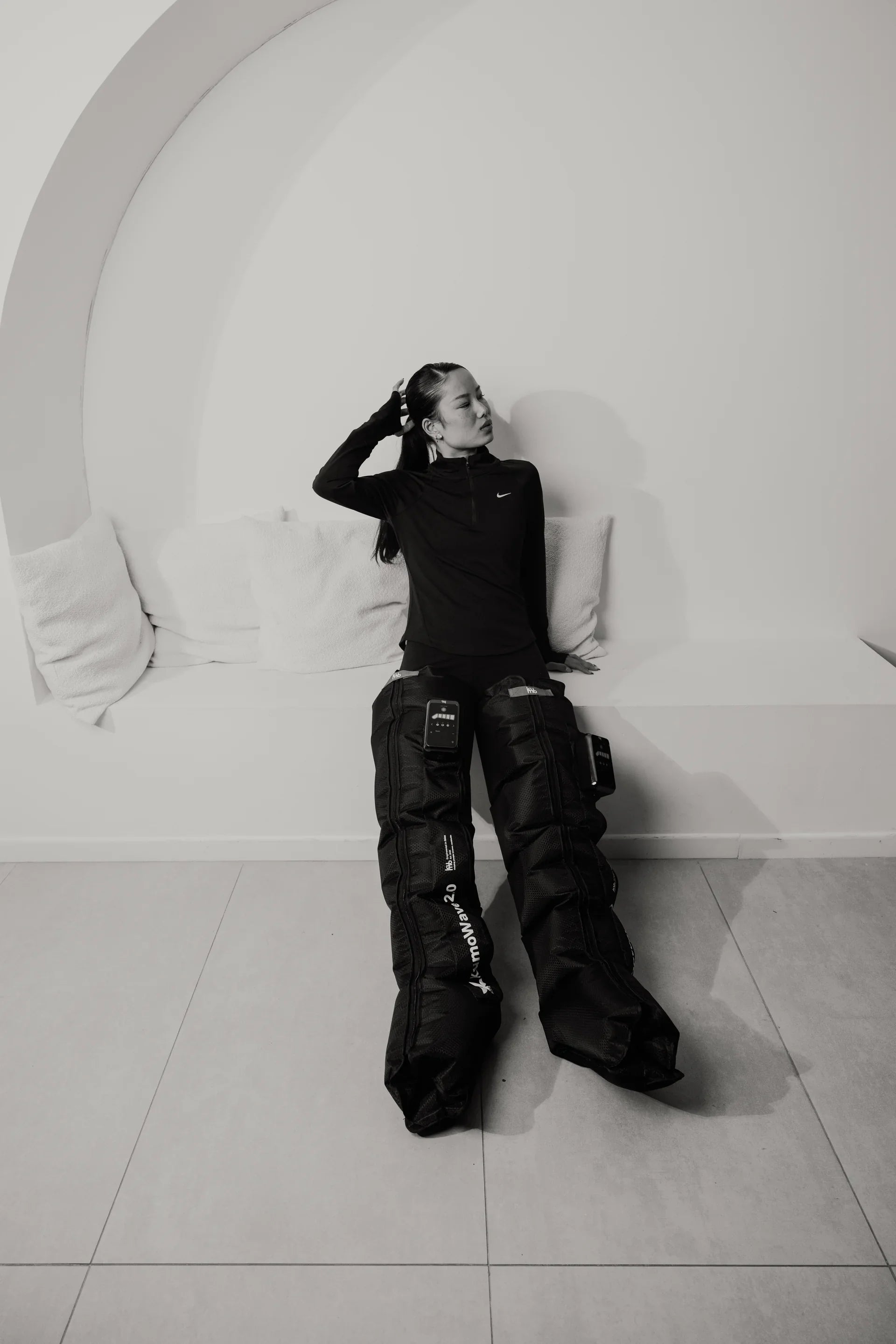
In Kumo's pressotherapy range, for example, the use of independent compression chambers (8 chambers) and configurable parameters like pressure, duration, and modes is described. This allows for very "targeted" work based on travel and sensation, although the concept of "by leg" (L/R) depends on the specific architecture of the device.
Why asymmetry is more common than it seems
Even in healthy individuals and athletes, it is common to notice differences between legs due to:
on your first order when you join the newsletter
We send you the code instantly. No spam.
- Dominance (one leg pushes/stabilizes more).
- Repetitive movements (running on asphalt with a slight incline, cycling with suboptimal adjustments, rotational sports).
- History of discomfort (a "delicate" ankle, a knee that bears more weight, an overstressed calf).
- Situational swelling (travel, many hours standing/sitting, heat).
Useful Rule: When adjusting independently, let the more sensitive leg "lead." If one of the two is uncomfortable, reduce the stimulation there and keep the other side at a tolerable level.
Real use cases: when it makes sense to adjust each leg
Independent leg control is not a "technical whim." It's a way to make the session more comfortable, more consistent, and, above all, more aligned with what your body is asking for that day.
Table: real scenarios and how to apply independent leg control
| Scenario | What usually happens | How to use L/R control (practical idea) | What to watch out for |
|---|---|---|---|
| Post-workout with uneven load (sets, inclines, pace changes) | One leg feels "harder" or has more perceived DOMS | Maintain moderate intensity in the more loaded leg and lower it by one point in the other to avoid "overtreatment" by compensation | Tingling, sharp pain, or deep marks: signs to reduce pressure |
| Return to training after unilateral discomfort (non-acute phase) | The "affected" side tolerates pressure less well | For the sensitive leg: lower intensity and/or less time; for the other: standard session to maintain routine | Worsening sensation the next day: reduce load and consult |
| Long travel / office: heavy legs, one more swollen | Fluid retention more evident on one side | Prioritize comfort and regularity: same duration, but lower intensity on the "fuller" side if it causes discomfort | If there is heat, redness, and pain in only one leg: rule out emergencies |
| Standing work (hospitality, retail, healthcare) | Calf or ankle more loaded on the dominant side | Gentle and "clean" program on both; if one side is particularly tense, increase only there within tolerable limits | Significant venous discomfort: consult a professional |
| Differences in size or sensitivity (scars, reactive skin, pressure points) | One side marks more or feels uncomfortable | Same routine, different intensity: the goal is for the session to be repeatable week after week | Skin irritation: check fit, base layer, and pressure |
How to configure it without complication: a 6-step method
1) Define the day's objective (not the "maximum")
Before touching any buttons, choose an intention:
- Post-workout recovery: reduce sensation of heaviness and fatigue.
- Daily well-being: relax legs after the day.
- Targeted relief: travel, heat, many hours sitting.
This avoids the typical mistake: blindly increasing intensity on both legs.
2) Choose a "sufficient" duration
In many domestic and sports uses, sessions of 20–30 minutes are repeated as a frequent protocol in studies and practice, with variability according to objective and device.
For KumoWave devices, the manufacturer mentions typical recommendations of 15 to 30 minutes per session (adjusted to sensations) and a configurable timer.
3) Adjust intensity by sensation (then "separate" L/R)
If your device allows L/R control, use this sequence:
- Start identically on both at the lowest level that feels clear and comfortable.
- Evaluate after 3–5 minutes: Does it feel pleasant or is it already too much?
- Separate by leg: lower by 1–2 levels on the more sensitive leg; leave the other at the "base" level.
The goal is to be able to finish the session with a feeling of relief, not "endurance."
4) When in doubt, reduce pressure rather than stopping completely
When there is asymmetry, it usually works better to continue the session (to maintain the habit) but lower the intensity on the problematic side, instead of canceling completely.
5) Repeat consistently and record 2 data points
- How it leaves you at the end (lightness, comfort, sleep).
- How you wake up the next day (feeling of recovery vs. irritation).
6) Integrate "the basics" to enhance perceived results
Pressotherapy does not replace movement, rest, and habits. It adds more when combined with:
- Hydration and active breaks.
- Gentle ankle/hip mobility after many hours of sitting.
- Slight leg elevation during the session if comfortable for you.
How it fits into a Kumo recovery routine (without filler)
Kumo positions itself as a recovery ecosystem: aesthetic and effective technologies to make "self-care" a routine. In practice, independent leg control fits very well with a modular approach: today I adjust for asymmetry, tomorrow I return to standard.
Pressotherapy for legs: the "pillar" when there is heaviness or load
If your focus is the lower body (running, strength training, standing), the natural entry point is pressotherapy. You can see the selection here: pressotherapy collection.
LED light: a complement for routine, skin, and rest
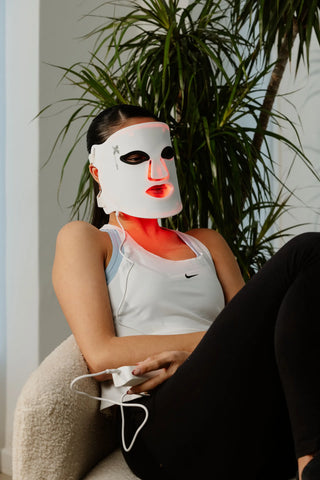
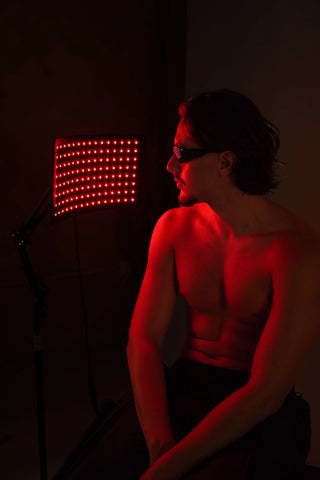
On days when you don't want "more intensity" in your legs, but do want to maintain the ritual, many people alternate with LED light (for example, for well-being/rest or skin care). Kumo brings this approach together here: LED light therapy.
Massage gun: for specific points (not for "pounding")
When asymmetry is very localized (a calf, a soleus, a lateral band), a well-used percussion tool can help prepare the ground before a gentle compression session or relieve specific areas. Kumo product: KumoPulse Air.
What the scientific evidence says (with numbers and context)
Pressures, times, and why "more" doesn't always mean "better"
In clinical and performance research, various ranges and protocols appear. Two useful ideas to understand why independent control (and moderation) matters:
- In a classic study on edema, better mean volume reductions were observed with specific parameter combinations; for example, the greatest mean reduction was reported with 40 mmHg along with specific inflation/deflation times (2003 study).
- In lymphedema, research on fluid dynamics suggests that not only pressure matters: inflation time conditions the generation of effective tissue pressure (work published in 2013/2014).
Practical translation: if one leg tolerates less, being able to lower that side helps maintain a useful stimulus without turning it into an uncomfortable session.
Sports recovery: moderate benefits and a lot of "it depends"
In sports, the evidence is not uniform. A systematic review and meta-analysis in open access concludes that intermittent pneumatic compression on legs can provide moderate benefits in perceptions of pain/soreness, while the effects on markers or mechanical performance are small or insignificant; it also notes that common protocols last 20–30 minutes and use pressures around 80 mmHg in many studies.
And, to ground it even more, a randomized trial published in 2025 (DOMS induced by plyometrics) used repeated 15-minute sessions (immediately and at 24/48/72 h), observing improvements in pain variables and muscle conditions compared to control in specific windows.
What you can conclude without deceiving yourself
- Yes: it can improve the feeling of light legs and the perception of recovery in some contexts.
- Not always: it guarantees direct improvements in performance or biomarkers.
- That's why independent leg control is relevant: it optimizes adherence (so you can use it 3–5 days/week) and comfort.
Safety: when NOT to adjust… and when to stop
Warning signs (especially if it's only one leg)
If you experience symptoms consistent with a possible acute vascular problem, do not use compression and seek medical attention. For example, in DVT (deep vein thrombosis), pain and swelling in only one leg, warm skin, and redness/darkening may appear.
Contraindications and precautions: better safe than sorry
Clinical sources and reviews point to caution or contraindication of compression therapies in situations such as severe peripheral arterial insufficiency and decompensated heart failure, among others, so if you have relevant history, it is advisable to consult a professional first.
And if you experience pain during the session, the general recommendation is to stop and discuss it with a healthcare professional.
FAQ: independent leg control and Kumo
What is independent leg control in pressotherapy boots for?
It helps adapt the session to a very common reality: your legs don't always feel the same. On days of uneven load (due to sport, standing work, or travel), one leg may be tenser or more sensitive. Adjusting the intensity separately helps keep the session comfortable and repeatable, preventing the "delicate" side from forcing you to cancel everything. The main utility is adherence: if you can use pressotherapy regularly, you are more likely to notice a perceived benefit in heaviness and recovery.
What should I do if one leg hurts more during the session?
Prioritize safety and comfort. If your device allows L/R control, first lower the intensity in the leg that hurts and keep the other at a moderate level. If it does not allow independent control, reduce the overall level or stop the session. It is not a good idea to "endure" thinking that you will recover more that way: the goal is to leave with a feeling of relief, not with pain or numbness. If the discomfort is new, intense, or accompanied by marked heat/redness, it is prudent to stop and consult a professional.
How long should I use pressotherapy if I want to adjust one leg differently from the other?
As a practical reference, in sports research, sessions of 20–30 minutes frequently appear, and some protocols use pressures around 80 mmHg, although these vary depending on the device and population. If you are going to differentiate by leg, it usually works to maintain the duration and only adjust the intensity: the more sensitive leg goes softer. For KumoWave devices, the manufacturer mentions typical sessions of 15–30 minutes adjusted to sensations.
Does Kumo have solutions for a complete routine in addition to pressotherapy?
Yes. Kumo's approach is to build a recovery routine that you can sustain: pressotherapy for legs when there is heaviness or load, massage tools to relieve specific points, and LED technology as part of the wellness ritual (for example, rest and skin care). The key is not to rely on a single tool: on days when one leg is sensitive, you can lower the compression intensity and maintain the habit with a softer complement. If you want a recommendation for responsible use according to your profile, the ideal is to ask for guidance directly.
Where can I ask the Kumo team for help to choose or use the correct product?
If you have questions about use, tolerance, adjustment, or how to integrate pressotherapy into your week (especially if you notice asymmetries or are returning to training after discomfort), the most practical thing is to contact the team for product and usage guidance. Here is the official page: contact. Remember that pressotherapy does not replace medical diagnosis: if there are warning signs (severe pain, sudden swelling in one leg, heat and redness), it is prudent not to use it and seek medical attention.
Recommended external sources (reliable reading)
- Systematic review and meta-analysis on IPC and sports recovery (PMC).
- Randomized trial 2025 on IPC and DOMS (PubMed).
- IPC parameters for edema reduction (PubMed, 2003).
- Pressure/times and fluid flow in lymphedema (PMC).
- What is an intermittent pneumatic compression device (Cleveland Clinic).
- DVT symptoms (NHS).
What now?
If you want to incorporate this concept into your routine, the next step is simple: choose a solution you can use consistently and adjust the session to your reality (including asymmetry). Explore the pressotherapy and recovery options at Kumo, combine with LED or massage when appropriate, and if you need personalized guidance for your case, write to the team from the contact page.
KumoWave pressotherapy
Choose your at-home pressotherapy
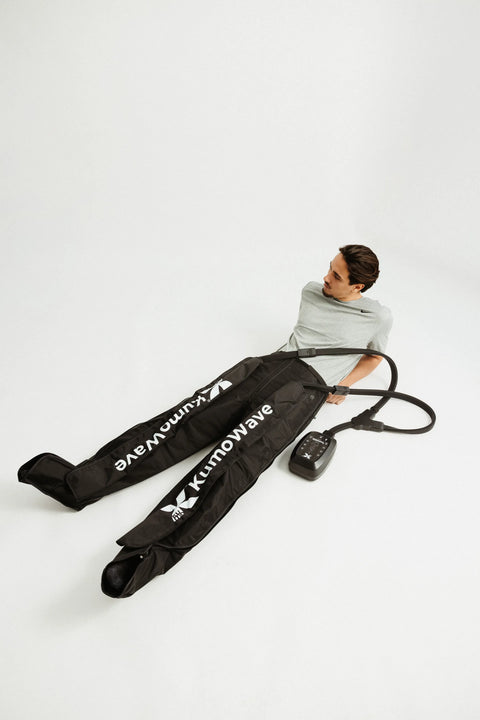
KumoWave Elite – Pressotherapy Pants
Full-coverage trousers. Ideal for lipedema, fluid retention and intensive use.
€799,00 €999,00
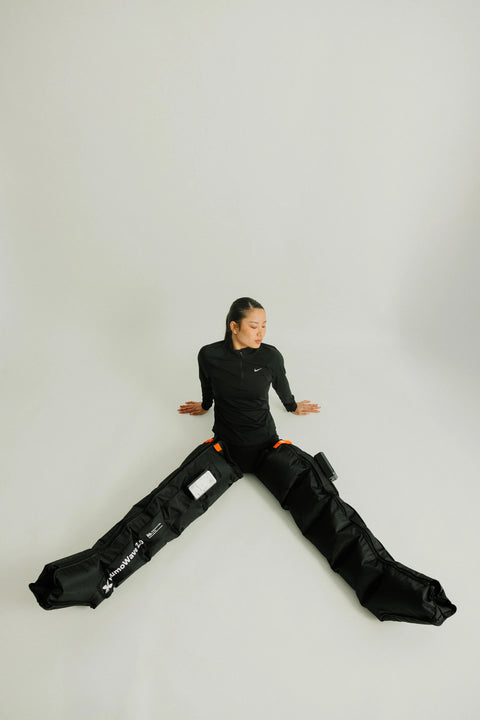
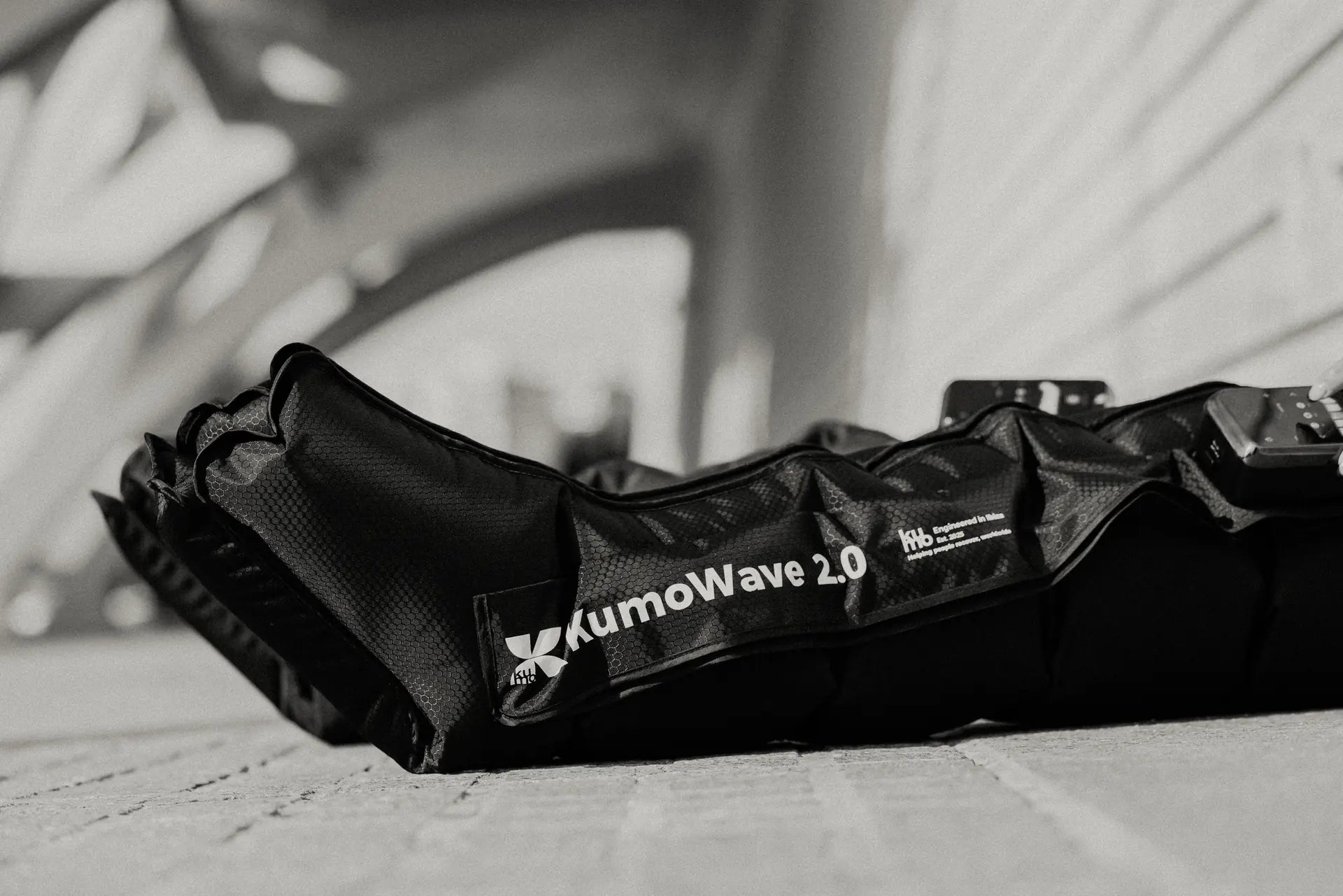
KumoWave 2.0 - Wireless Pressotherapy
Wireless, lightweight boots. Perfect for daily use and recovery.
€499,00 €599,00